

Table of Contents
ToggleWhat started off as little AI testing has turned into something far greater. AI is changing marketing, and what used to be testing is becoming actual work. AI is becoming a normal aspect of most significant SEO companies’ work. It transforms how people look up information, write content, look at SERPs, and assess success after publishing. Sometimes, this change might make things clearer and operate better. It also causes difficulties that didn’t exist a few years ago.
The main question is not whether AI should be used in marketing. That argument is ended. The main thing to remember is how AI is altering how search-driven marketing choices are made and how those changes affect rankings, visibility, and trust over time.
A similar trend has developed in audits, crawl analysis, and performance reviews: AI is changing marketing mostly via SEO. It affects how “quality” is judged over time, how search engines figure out whether material is still helpful, how competitive landscapes are built, and how search intent is understood. These changes aren’t just ideas. You can see this in the changes in rankings, click behavior, and the growing difference between sites that do well and those that have trouble keeping their traffic stable.
Why This Shift Matters in Real-World SEO
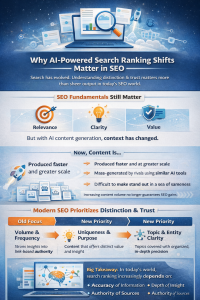
The core ideas behind SEO are still the same. Search engines still care most about how informative, clear, and on-topic a page is. We no longer judge these types of values the same way.
Now, material is produced quicker and in bigger amounts than ever before. Search engines have to figure out not just whether information answers a question, but also if it is useful in a world where all the responses are the same. This means that how loud something is doesn’t matter as much anymore.
A lot of sites have put out more material than ever before, yet they nonetheless lost position in recent audits. The technology on these sites was okay. Their buildings were neat, their internal connections were great, and there were no obvious problems with crawling. The issue was that the material was identical. AI-assisted techniques have caused several rivals to write about the same things in the same way, and sometimes even with the same words.
In today’s world, search engines work in an atmosphere where trust, the right goal, and being distinctive are more important than speed of output.
How AI Has Embedded Itself Into SEO Workflows
AI doesn’t often come to SEO processes as a single choice. It spreads slowly, sometimes without anybody noticing, until it becomes a part of the foundation.
Finding Keywords and Expanding Topics
These days, a lot of people utilize AI technologies to add more keywords, group similar questions, and recommend relevant subjects. At initially, this speeds up research, but it also adds some danger. When several teams use the same systems, they wind up working on almost the same things.
When I do audits, I frequently come across content strategies that seem complete but are really quite similar to those of rivals. The coverage is wide, but the point of view might shift. When this occurs, choosing a theme doesn’t make the work stand out anymore. It has to come from understanding, putting things in order, and going deeper.
Understanding SERP and Mapping Intent
AI can swiftly look at SERP trends and figure out what topics are most popular on the best-ranked sites. This helps us figure out what the most common kind of purpose is, but it has several disadvantages.
People and AI don’t see SERPs the same way. It doesn’t know when a query and result don’t line up perfectly, when they’re unclear, or when they’re just plain bothersome. It can’t tell whether a site is technically good for the user but doesn’t make them happy. When teams depend too much on AI-generated descriptions of purpose, they frequently produce content that looks like the SERP but doesn’t work in real life.
Making content and checking its quality within
AI has made it much easier to write drafts. That efficiency is useful, but it has also changed how teams think about quality. I’ve seen items pass internal inspections in a few tests because they were linguistically correct, well-organized, and technically sound. But it didn’t do well since it didn’t provide any meaningful information.
In competitive industries, it seems like search engines are looking for more than just structure. Writing well isn’t enough anymore.
Search Behavior Has Changed Faster Than Marketing Strategy
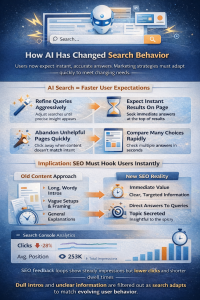
One of the most important but often ignored consequences of AI on marketing is how it changes what customers anticipate.
Now people:
- Be more aggressive when you narrow down your searches.
- Expect speedy replies on the site right away.
- If you don’t reach your objective, stop trying to get results straight away.
- You can look at a lot of results in just a few seconds.
This implies that SEO material has to be relevant right away. Long introductions, confused framing, and general explanations that used to work but don’t now.
In Search Console metrics, this often looks as consistent impressions with fewer clicks and shorter times spent on the site. These aren’t fines that are based on algorithms. They are feedback loops that change how search engines find out what is important over time.
How Search Engines Evaluate AI-Assisted Content Over Time
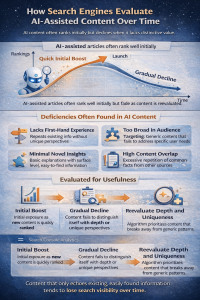
When AI helps with publication, the index usually rises up rapidly and then steadily goes down. At first, pages were ranked, but with time they became less important.
This generally comes with the following thing:
- You can’t see it for yourself.
- There isn’t enough of a distinction between the audiences.
- Explanations that are too broad
- Repeating information that is easy to find
Search engines appear to alter their thoughts about how useful something is once they find it. Even if it was incredibly well-optimized when it came out, content that doesn’t have depth or uniqueness frequently loses steam.
At this moment, a lot of AI-assisted solutions fail without anybody knowing. There isn’t a big drop; vision is simply slowly becoming worse.
What Commonly Goes Wrong in AI-Driven Marketing
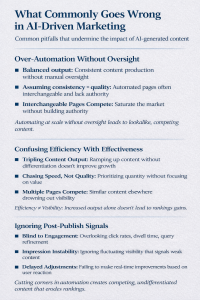
Too Much Automation Without Control
One of the most typical errors is to increase the amount of material being produced without also raising the requirements for reviewing it. Teams think that quality and consistency are the same thing. In reality, it frequently results in pages that are interchangeable and compete with each other instead of generating authority.
Confusing Effectiveness with Efficiency
AI speeds up processes, but speed alone doesn’t help rankings. I’ve seen sites treble their production yet not expand because each page included material that was comparable to that on other pages. Efficiency without being unusual seldom leads to visibility.
Not paying attention to post-publish signals
A lot of teams put a lot of money into optimizing their work before it is published, but they don’t pay much attention to how it performs once it is published. Engagement, query refinement, and impression stability are all good ways to tell whether AI-assisted content is really working. Not paying attention to these signs makes needed changes take longer.
A Practical Framework for Using AI in SEO
Based on what I’ve seen, AI works best when it’s only used in a few situations.
A straightforward method for decision-making may assist you in avoiding repetitive mistakes:
- Use AI to find trends, but don’t allow it make the ultimate decision.
- Look at genuine SERPs and live queries next to AI results.
- Make sure that essential pages provide context that is appropriate for the reader’s level of expertise.
- See how people behave following the post.
- When performance indicators start to fall, stop making things.
This manner, AI may focus on SEO results instead of how much material there is.
How Rankings Are Affected in the Long Term
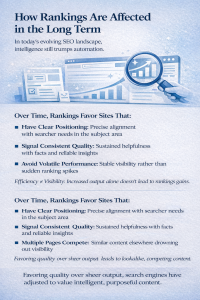
The sites that stay visible aren’t the ones who use the most AI; they’re the ones that use it sparingly. They put out fewer pages, but each one has a clearer purpose and is more in line with what users want.
Over time, rankings have been more favorable to:
- Clear positioning on the subject
- Signals of consistent quality
- Pages that don’t rocket up and down quickly
AI changes how SEO work is done, which affects marketing, but search engines still favor intelligence over automation.
FAQs
1. How is AI changing marketing from an SEO point of view?
AI is changing marketing in a big way by making SEO chores like research, content creation, and SERP analysis faster. The impact is not direct. AI impacts how quickly and how similarly things are made, which makes the competition stronger and search engines raise their expectations for quality.
2. Does using AI-made content affect rankings?
AI doesn’t always affect rankings. Problems happen when AI-assisted content doesn’t have enough depth, uniqueness, or purpose. This sort of content is often looked at again by search engines over time, which implies that it steadily becomes less apparent instead of being penalized immediately away.
3. Why do some sites with AI aid gain high ranks fast and then drop?
This happens a lot when the content is slightly useful but not useful in the long run. The initial rankings represent how well something was found, while the latter drops show how useful and interesting it was.
4. Has AI changed the way people search?
Yes. People expect answers that are faster and clearer today, and they are more inclined to limit their searches. This means that SEO content has to quickly and properly address the expectations of consumers.
5. Should marketers create less content when they employ AI?
Yes, in many cases. others who have less knowledge that is of higher quality often fare better than others who have a lot of similar information. AI should aid with quality control, not replace it.
6. How can SEO teams use AI and yet make sure the quality is high?
By limiting AI to pattern recognition, drafting help, and analysis, and making sure that interpretation, placement, and ultimate decisions are still made by people.
Conclusion
No, artificial intelligence is not replacing skill or strategy; rather, it is changing marketing by modifying the way search engine optimization (SEO) operates and the way customers look for information. Finding a happy medium between speed and judgment is the key to achieving the best results in search engine optimization (SEO) in the real world.
The most essential thing to take away from this is that artificial intelligence can only enhance marketing if it helps with things like clarity, relevance, and aligning purpose. Currently, the elements that determine search visibility are less concerned with the rate at which information is created and more concerned with the degree to which it exhibits comprehension. This is because search visibility is a kind of search engine optimization. It is more effective to use artificial intelligence (AI) as a tool rather than as a shortcut in order to improve search engine optimization (SEO).