


Search is changing right in front of our eyes. For years, we’ve been getting better at climbing higher in Google’s normal search results. Google AI Overviews is a new player in the game, however. We need to adapt how we approach SEO because these AI-generated summaries that show up at the top of the search results page are affecting how consumers seek for information.
You could have been both interested and anxious if you were a publisher, blogger, or marketer. Will these AI overviews hurt your website’s traffic? How do you achieve a good rating in a feature that doesn’t seem to have a clear mechanism to do so? This article will help you figure out the solutions to these kinds of inquiries. We’re going to go in depth about what Google AI Overviews are, how they work, and most importantly, how you can modify how you search so that you not only survive but also perform well in this new era of search.
We’ll speak about anything from good tips for improving your site and SEO best practices to how it will effect your traffic in the long term and the future of search itself. Let’s work together to find out how this great new feature works.
Google AI Overviews vs. Traditional Search Results
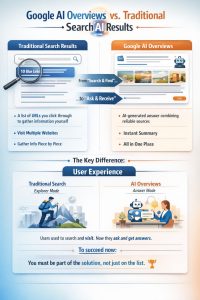
Before we start optimizing, let’s make sure we know what we’re working with. How do Google AI Overviews vary from the list of blue links we’ve been using for years?
The “10 blue links” that show up in traditional search results are a collection of URLs that Google’s algorithm thinks are related to your search. You, the user, click on these connections to go to other websites and put together the information you require.
On the other side, Google AI Overviews put things together for you. Google uses its powerful generative AI models to combine information from many reliable online sources and provide a short, conversational response right on the search results page. These overviews are meant to help you answer complicated, multi-step problems all at once. Instead of having to go to five separate blogs to plan a trip, the AI Overview could provide you all the information you need in one location, including the best dates to go, the finest attractions, and financial advice, with links to the source websites for further information.
The main difference is how the user feels. AI Overviews provide you a straight response, whereas traditional search is a directory. This change from “search and find” to “ask and receive” is quite important. Google’s mission is to better and quicker meet the needs of its users. This implies that the bar is higher for creators. You can’t just be on the list anymore; you have to be part of the solution.
How Google AI Overviews Affects Featured Snippets
You could be saying to yourself, “This sounds a lot like Featured Snippets.” And yes, there are certain things that are the same, but there are also some important things that are different.
“Position Zero” or “Featured Snippets” are brief pieces of text taken from a single site that immediately answer a search query. They show up above the usual search results and have been a major focus for SEOs for years. Getting a featured snippet generally meant a big increase in traffic and exposure.
Google AI Overviews are like the next step up from Featured Snippets. A Featured Snippet only draws information from one source, whereas an AI Overview combines information from many sources. It pulls together information from several articles, forum threads, and product sites to provide a more complete overview.
So, what does this imply for the future of Featured Snippets? Not yet, but they aren’t going away completely. If you have a basic, clear query and one source gives you the ideal answer, a Featured Snippet could still be the best way to show it. But AI Overviews are becoming increasingly important for more complicated questions.
AI Overviews also have distinct linkages. They generally seem like carousels of source websites, which means that more than one site may be acknowledged in one overview. This alters the situation from “winner-take-all” with Featured Snippets to “shared spotlight.” Even if you don’t provide the whole response yourself, your material may now add to the AI-generated answer, which might get you a reference and a possible click-through.
The Impact of Google AI Overviews on Website Traffic
That’s the million-dollar question, and the answer is: it depends.
What are the downsides? You could get less clicks if AI Overviews completely answer basic questions. This “zero-click” impact affects sites that rank for simple inquiries like “What is the capital of France?” or “How tall is Mount Everest?”
The good news? Some questions are not easy.
- AI can’t substitute expert opinions, unique research, or step-by-step guides on complicated or niche topics. Content that is worth a lot is still important.
- People who are interested in buying anything will still look at review sites and seller websites before making a choice.
- Citations from other sources: Being referenced in AI Overviews increases authority and exposure. Your brand stands out even if no one clicks on it.
- User Trust: A lot of people verify AI responses twice, particularly when it comes to important things like health or money. That implies they will click on your link to confirm.
In short, basic information sites may get less visitors. But if you write unique, in-depth, or purpose-driven material, Google AI Overviews could help you get more exposure, but in a different manner.
Google AI Overviews for Publishers and Bloggers: A New Playbook
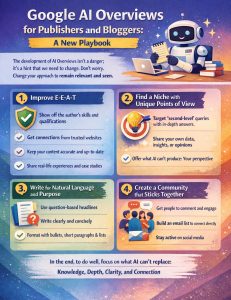
The development of AI Overviews isn’t a danger; it’s a hint that we need to change. Don’t worry. Change your approach to remain relevant and seen.
1. Improve E-E-A-T
Google gives more weight to material from reliable sources.
- Show off the author’s skills and qualifications
- Get connections from trusted websites
- Make sure your material is accurate, well-sourced, and up-to-date.
- Talk about real-life situations and case studies
2. Find a niche with unique points of view
AI may easily summarize generic material.
- Target “second-level” queries with thorough replies.
- Share your own facts, thoughts, or ideas.
- Put forth what AI can’t make: your point of view
3. Write for Natural Language and Purpose
AI gets replies from understandable, human-like information.
- Use headlines that are questions
- Write in a clear and simple way.
- Use bullets, brief paragraphs, and lists to format
4. Create a community that sticks together
Give them an incentive to come back if they obtain answers from Google.
- Encourage others to remark and talk to each other.
- Build an email list to talk to people directly
- Keep using social media
In the end, to do well, you need to concentrate on qualities that AI can’t replace, including knowledge, depth, clarity, and connection.
+Google AI Overviews Ranking Factors Explained
There isn’t an official list from Google of what makes an AI Overview “rank,” but we can figure out what the most essential aspects are by looking at their rules and the overviews that are already there. The emphasis is on the quality of the content and the arrangement, not on usual ranking signals.
Here are the primary “ranking factors” that Google AI employs to choose who to include:
1. How thorough and useful the information is:
Your material should address the user’s inquiry right away and thoroughly. It’s not about stuffing in keywords; it’s about offering a thorough and good response. Google’s AI will check out sites that appear to have the most extensive and helpful information on the subject.
2. E-E-A-T Signals: Trustworthiness, Authority, Expertise, and Experience:
This is really crucial. Google has made it clear that its Search Quality Rater Guidelines, which are based on E-E-A-T, are highly crucial for how its AI algorithms look at data. The AI searches for:
- Authoritative Sources: Is the site well-known as an expert in its field? Are there decent connections to it?
- Expert Authors: Did someone who is known to be good at what they do produce the information?
- Is the information genuine, well-researched, and supported by proof?
- Firsthand Experience: Does the content suggest that the author has worked with the topic in real life?
3. Truthfulness and Clarity:
AI models require data that is simple to grasp. People are more inclined to use anything as a reference if it is well-written, simple to understand, and true. We will remove any information that is unclear, poorly worded, or incorrect. Make sure your facts are right and give credit to your sources wherever you can.
4. Structured Data and Schema Markup:
Schema markup helps search engines figure out what your content means. When you utilize schema for FAQs, how-tos, articles, and author information, Google’s AI can read and use structured data. For example, an AI answer may include a clearly identified FAQ section immediately away.
5. Signs of Page Experience:
It’s still critical to pay attention to key online vitals and the overall site experience, even when they’re not as obvious. A site that loads fast, operates well on mobile devices, and is secure makes people more likely to trust it. A site that doesn’t provide consumers a nice experience is less likely to give Google information.
6. Agreement from Many Reliable Sources:
AI Overviews are often a good way to tell how many people agree on something. If a lot of reliable, high-quality websites agree on a fact or procedure, the AI is more likely to offer a solution. This implies doing things the right way in your area but also giving your own distinct opinion.
The “ranking factors” for Google AI Overviews are basically the same as the standards that have historically characterized good material, but stronger. The emphasis is moving away from technical SEO methods and toward a more complete strategy that is based on actual facts and gives real value.
How to Optimize Content for Google AI Overviews
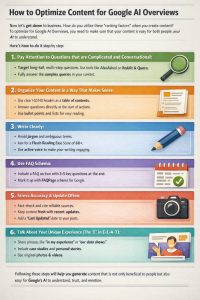
Now let’s get down to business. How do you utilize these “ranking factors” when you create content? To optimize for Google AI Overviews, you need to make sure that your content is easy for both people and AI to understand.
Here’s how to do it step by step:
1. Pay attention to questions that are complicated and conversational:
Instead of short-tail keywords, look into your audience’s long-tail, multi-step questions. You may find these kinds of questions by using tools like AlsoAsked or searching on sites like Reddit and Quora. Organize your information such that it fully addresses these difficult questions.
2. Organize Your Content in a Way That Makes Sense:
Think of your article as a little database for AI.
Use clear, descriptive headers (H2, H3) that act as a table of contents. Instead of a vague title like “Our Process,” use something more specific, like “Our 5-Step Process for Making Blog Posts Better.”
Answer questions directly: Start each part with a clear answer to the question in the heading. Then, provide examples, facts, and numbers.
Make use of bullet points and lists. Make long, hard-to-understand lists of things that are easy to understand. This format is easy for both people and computers to grasp.
3. Write clearly:
Don’t use jargon, hard-to-understand phrases, or words that might mean more than one thing. Use simple, unambiguous language. Picture that you’re talking about this with a smart high school student. This is in line with a Flesch reading-ease score of 60 or above, which makes your text easier to read. Using the active voice will make your writing more direct and exciting.
4. Use FAQ Schema:
Find the 3–5 most important questions concerning the main subject of your essay and include them in a FAQ section at the end. Use the FAQPage structure to mark up this section. This clearly tells Google, “Here are some common questions and their direct answers,” which makes it very easy for the AI to collect your information.
5. Stress the importance of accuracy and make sure to update often:
Before you make any assertions, be sure you have the facts straight. To back up what you say, link to reliable sources. Most importantly, keep your content up to date. An article that has been changed in the last six months is more trustworthy than one that hasn’t been changed in five years. Add a “Last Updated” date to your posts so that Google and users know how new they are.
6. Talk about your unique experience (the “E” in E-E-A-T):
Don’t simply say things again. Give your own distinct point of view.
- Say something like “in my experience,” “what we found,” or “our data shows.”
- Include real-life stories, real case studies, and real outcomes.
- Don’t simply tell, show. Add fresh photos and videos to your product reviews.
Following these steps will help you generate content that is not only beneficial to people but also easy for Google’s AI to understand, trust, and mention.
How to Optimize Blog Posts for Google AI Overviews
Let’s take a closer look at how you may apply these concepts to your blog entries. Here’s a checklist for optimizing each new (and old) post you create.
1. Prewriting: The Strategic Foundation
Keyword Research: Focus on long-tail keywords that are related to the situation. Think about “how to…” “what is the best way to…” or “X vs. Y” are examples of comparison keywords.
Analysis of SERP: Find the question you want. If there is one, look at the current AI Overview. What kinds of sources does it use? What queries does it respond to? Find any gaps that need to be filled or spots where you can provide a more full answer.
2. Writing: How to Organize for People and AI
Your H1 title should be short, straightforward, and include the main keyword in it.
- Summary of the Introduction: The first paragraph should tell the reader what the subject is about and what they will learn. AI may occasionally identify this as a short summary.
- Follow a logical order from H1 to H2 to H3. Don’t skip heading levels. Make the headings clear and ask questions.
- Short paragraphs: Keep paragraphs to two to four sentences. This makes the material easy to scan, which lets AI sort through different bits of information.
- Use language that is clear. Be clear when you explain an idea. For example, “Google AI Overviews are AI-generated summaries…” This basic, declarative phrase form is easy for AI to grasp.
- Make lists: Use numbered lists for step-by-step instructions and bulleted lists for groups of advice or features.
3. After Writing: Improvements and Markup
- Include a section for frequently asked questions: As was suggested before, provide a short FAQ section at the end of the article to address questions that are relevant. Use the FAQPage structure.
- HowTo Schema: Use the HowTo schema to mark up the steps in your content if it is a tutorial. This gives Google a formal way to do things.
- Improve pictures: Give your pictures meaningful file names and alt text. This gives search engines more information to work with.
Author’s Bio and Schema: Make sure that every post has a comprehensive bio and is linked to just one author. You may use the sameAs schema to link to the author’s social media profiles and previous publications, which shows that they are an expert.
Linking to other relevant and trustworthy information on your own website is called “internal linking.” This helps the AI understand more about the issue and gives it greater authority.
4. Check and update the content you already have
Use this list to update the best material on your site.
- Make sure that any old information and numbers are up to date.
- Change the wording so that the titles are better and the paragraphs are shorter.
- Include the FAQ and any other relevant schema.
- Add more direct experiences and unique insights to the text to make it more interesting.
Optimizing blog posts for Google AI Overviews means constantly making little changes to your content so that it is the best, most clear, and most valuable resource on the internet for your chosen subject.
SEO Tools to Monitor Google AI Overviews Presence
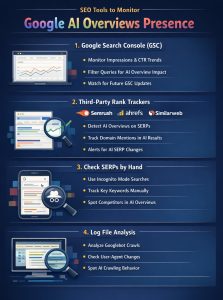
Changing your strategy is one thing; figuring out whether it works is another. As Google AI Overviews become more popular, SEO tool makers are rushing to include monitoring and analysis features. These are some of the best tools and methods for keeping an eye on your internet presence.
1. Google Search Console (GSC)
GSC is the best place to get data. There isn’t a specific “AI Overviews” report yet, but you may look for clues:
In your performance report, think about impressions and click-through rates (CTR). If you see that impressions for a keyword are going up but CTR is going down, it might be because an AI Overview is now available and satisfying user intent (a “zero-click” search). To see how it affects you, filter your performance by queries that you think could have AI Overviews in them.
Updates coming up: Watch the GSC dashboard. In the future, Google is likely to provide more detailed information to results that were made by AI.
2. Trackers for third-party rankings
AI Overview monitoring is currently a part of most key SEO tools.
Semrush: Semrush has developed tools that can tell whether a SERP has an AI Overview and even show you if your domain is referenced in it. This lets you keep track of how much of the conversation you are in these AI-generated answers.
Ahrefs: Ahrefs is also adding capabilities to keep an eye on AI in search results pages. You may use their rank tracker to keep an eye on changes to SERP features and receive an email when a “AI Overview” or “Generative AI” result appears for the keywords you are watching.
Similarweb: This tool can help you figure out how traffic is changing and how new SERP features, such AI Overviews, are affecting the number of visitors to particular sites.
3. Check SERPs by hand
Don’t forget how important it is to do manual checks, particularly when a new feature is first being used.
Incognito Mode: Use an incognito browser session to look up your most important phrases and see how the AI Overviews look.
Keep an eye on important questions: Keep a simple spreadsheet with your top ten to twenty business and informational keywords. verify them often to verify whether an AI Overview has been published, whether you have been cited, and who your competitors are in the overview. The qualitative data is quite important.
4. Looking at the log file
If you know a lot about technical SEO, log file analysis can show you how Googlebot interacts with your site. You could see changes in crawl patterns or user-agent strings. This might mean that Google is using your content to train its generative AI models.
To keep an eye on how visible you are in Google AI Overviews, you need to use both quantitative data from tools and qualitative analysis based on what you see. By keeping track of these changes, you may learn more about what works and what doesn’t, and how to improve your optimization technique over time.
The Future of SEO with Google AI Overviews
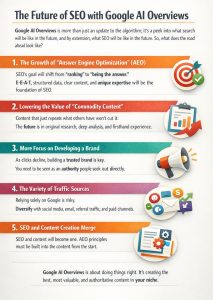
Google AI Overviews is more than just an update to the algorithm; it’s a peek into what search will be like in the future, and by extension, what SEO will be like in the future. This is a big difference from a bunch of links to a direct conversation. So, what does the road ahead look like?
1. The Growth of “Answer Engine Optimization” (AEO)
SEO’s goal will keep changing from “ranking” to “being the answer.” This means that the things we spoke about—E-E-A-T, structured data, clear content, and distinctive expertise—will be the basis of SEO. Technical SEO will still be important for developing a solid base, but content strategy will be the main driver of success.
2. Lowering the value of “Commodity Content”
If your content only replicates what is already on hundreds of other websites, it won’t be very valuable. There is no need for someone to visit your site if an AI can explain it better and quicker. The future lies in content that offers something AI can’t: original research, in-depth analysis, real personality, and direct experience.
3. More focus on developing a brand
As clicks on certain informational questions go down, it will be more important than ever to build a brand that people know and trust. Being included in an AI Overview is a good way to showcase your business. The goal is to make people think of your brand as an expert in your field, so that they come to you directly instead of searching for you on Google. This means putting money into building up the community, sending out emails, and being active on social media.
4. The variety of traffic sources
It’s always been a bad idea to rely entirely on Google organic traffic, and it’s much worse today. Smart marketers will work even harder to get visitors from a variety of sources. This includes social media, email newsletters, traffic from referrals, direct traffic, and even paid channels. The greatest way to protect yourself against changes in Google’s algorithms is to have a healthy marketing mix.
5. SEO and creating content will become one
There will be no difference between SEO and content creation. You can’t “do SEO” on something that has already been written. The ideas of Answer Engine Optimization should be part of the content creation process from the very beginning, starting with the main idea and moving on to organization, authoring, and formatting.
Google AI Overviews will not help you find new ways or loopholes in SEO in the future. It is about a deep commitment to doing things well. It’s all about making the best, most valuable, and most authoritative content on the web for your specific niche. The platforms and algorithms may change, but people will always want accurate, authoritative information. If you focus on satisfying that demand, you’ll be in a great position to do well in this new age of search.
FAQs
1. What are Google AI Overviews?
Google AI Overviews are AI-generated summaries that show up at the top of search results. They provide rapid answers to user questions based on information from several reliable sources.
2. What do Google AI Overviews do to SEO?
They could cut down on clicks for simple informative searches (zero-click searches), but if your material is used as a source, they might also provide you additional chances to be seen.
3. Can I make my material better for Google AI Overviews?
Yes. Use question-based titles, write clearly, and provide new information or insights. Focus on E-E-A-T (Experience, Expertise, Authoritativeness, Trustworthiness).
4. Will Google AI Overviews decrease the number of people that visit my website?
It all depends. Sites that use generic replies may lose visitors, while specialist, expert-driven material may still do well and even gain from AI citations.
5. How can I know whether my material appears in a Google AI Overview?
Right now, Search Console doesn’t let you track directly, but you may keep an eye on your branded mentions and hunt for more impressions without direct clicks.
Conclusion
Google AI Overviews is a huge step forward for the growth of digital information. It could be intimidating, but it also provides you a big opportunity. It’s a call to improve the quality of our material and stop writing articles that are solely focused on keywords. Instead, we should provide resources that are valuable and based on trust and expertise.
Don’t worry about losing visitors; instead, focus on being a valuable source that Google’s AI wants to acknowledge. Your experience, facts, and point of view are what set your stuff apart. Make a brand and a community that people want to join.
Knowing what consumers want and offering it to them has always been the most crucial element of SEO. Google AI Overviews are only the next step in that direction. You can make sure your material not only stays alive but also grows by altering how you do things, focusing on quality, and embracing this change. It will earn its place as a reliable source in the new search world.