


Companies don’t just “add” AI to their marketing stacks anymore to see what happens. In the actual world of SEO, it’s now a part of how scale is either reached or discreetly hurt. The fact that certain organizations expand consistently via search while others stagnate has nothing to do with whether or not they employ AI. It all depends on how AI is used in SEO processes and making decisions.
One thing continues coming up in audits, crawl analysis, and long-term performance appraisals. AI can only help businesses flourish if it makes search basics stronger. When technology takes the role of judgment or is used as a shortcut, it tends to make visibility weak—pages that show up rapidly, work for a short time, and then disappear without a clear explanation.
This is why AI for company is most important when you look at it in terms of SEO scalability and growth via search, not just automation for the sake of automation.
Why SEO Scalability Is a Business Constraint, Not a Tool Issue
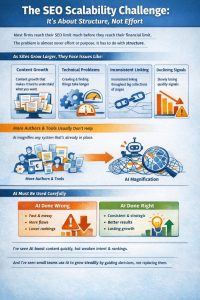
Most firms reach their SEO limit much before they reach their financial limit. The problem is almost never effort or purpose. It has to do with structure.
As sites become bigger, they start to have trouble with:
- Content growth that makes it hard to understand what you want
- Technical problems that make crawling and finding things take longer
- Inconsistent linking throughout big collections of pages
- Slowly losing quality signals
At this point, adding additional authors, tools, or procedures doesn’t usually help. AI comes into play as a technique to deal with complexity, but it makes any system that is currently in place bigger.
AI may help teams stay consistent without lowering quality if used correctly. If you don’t use it well, it makes flaws worse quicker than manual processes ever could.
I’ve seen companies increase their content production using AI and yet lose ranks since every new page made the intent weaker instead than stronger. I have also seen small teams grow in a way that lasts by simply employing AI to help them make decisions, not to replace them.
How AI Actually Supports SEO Scalability
AI becomes genuinely useful in business SEO when it supports repeatable processes, not outcomes. The moment it is expected to deliver rankings on its own, it starts working against long-term growth.
Scaling Research Without Repeating Strategy
People use AI a lot to find new keywords, group topics together, and find gaps. This is useful on a large scale. It makes things easier by showing patterns that are hard to see in thousands of inquiries.
The failure point comes up when strategy is taken out of the loop.
This is what a common pattern looks like in audits:
- Thousands of keywords grouped together appropriately
- Hundreds of pages made quickly and easily
- Not much difference in placement or purpose
AI finds opportunities, but it doesn’t choose which ones are strategically important. When organizations let volume decide direction, SEO scalability becomes internal rivalry instead of cumulative growth.
AI helps with prioritizing on the sites that scale well, but it doesn’t replace it.
Search-Led Growth Depends on Intent Precision
Search-led growth sees organic traffic as a feedback loop instead than merely a way to get people to your site. Metrics like rankings, impressions, and engagement show how effectively a brand knows what users want on a large scale.
AI can look at SERPs and find patterns that happen again and over again, but it still needs human judgment to figure out what people want. Search engines are starting to prefer information that clears up confusion over content that just repeats search phrases.
In fact, I’ve seen AI-assisted sites do great at first, but eventually they stop working since they just answer “what” and don’t explain “why” or tell people “what next.” The material seems full, but it doesn’t help the user go ahead.
When content is developed around keywords instead of genuine user demands, search-led growth stops working.
Where AI Fits in Content Optimization at Scale
When AI for business operates as a quality amplifier instead of a content engine, it does the best job of optimizing content.
AI can assist with the following at scale:
- Finding thin or repeating parts in big groupings of pages
- Pointing out when material overlaps before it turns into cannibalization
- Making the structure more consistent
- Marking information that is old or no longer useful
It doesn’t work since it’s not original. When companies use AI to “fill gaps” instead of improving their skills, the material becomes the same.
The most scalable content systems all had one thing in common: they imposed editorial standards once AI was involved, not before. AI helped with the process, but people choose what to say.
AI and Technical SEO: Insight Over Execution

Businesses typically expect AI to “solve” difficulties in technical SEO. In fact, AI is far better at recognizing patterns than putting them into action.
AI can help with:
- Look into crawl trends on big sites
- Finding patterns in log files
- Finding problems with indexation
- Pointing up holes in internal connections
It can’t accurately figure out what will happen to the building. I’ve seen AI-driven suggestions used without any context, which led to broken crawl routes or too much trimming. You still need to know how modifications effect hierarchy, discovery, and long-term visibility in order to do technical SEO on a large scale.
AI helps with technical SEO when it helps people make judgments. It becomes dangerous when it does them on its own.
How Search Behavior Has Shifted Alongside AI
One of the most important effects of AI on corporate marketing that people don’t talk about enough is how it has transformed what people anticipate.
Users now:
- Make inquiries more specific
- Expect more clarification earlier on the page
- Give up results sooner when purpose is not fulfilled
- You may compare more than one result in a matter of seconds.
This makes it important for SEO material to be relevant right away. Long introductions, unclear framing, and general explanations that used to work well but don’t anymore.
In Search Console statistics, this generally looks like steady impressions with lower click-through rates and shorter stay times. These are not punishments. They are behavioral cues that change how search engines judge usefulness over time.
Content Quality Is Judged Over Time, Not at Publish
A common tendency with AI-assisted material is that it gets indexed quickly and then slowly goes down. Pages go up, become ranked for a short time, and then fade away.
This frequently goes hand in hand with:
- Not having firsthand knowledge
- Weak audience distinction
- Explanations that are too broad
- Repetition of information that is easy to find
After finding anything, search engines seem to reevaluate how beneficial it is. Even if they were technically fine when they first came out, pages that don’t show depth or perspective lose momentum.
This deterioration is hard to see, which is why many teams don’t notice it until visibility has already dropped.
What Commonly Goes Wrong When Businesses Scale SEO With AI
Too Much Standardization
One common error is using consistency as a way to rate things. Companies use the same templates on thousands of sites, thinking that search engines would reward them for being the same. They don’t.
Search engines want consistent structure, not consistent reasoning.
Mistaking Output for Impact
Instead of performance, AI makes it easier to quantify productivity. I’ve seen teams celebrate publishing milestones even while their organic traffic stayed the same. The issue wasn’t lack of effort. It was mismatched purpose on a large scale.
Ignoring Signals of Content Aging
Monitoring how pages age is important for search-led development. Pages that use AI generally seem good at first, but then they become worse. Companies who don’t keep track of post-publish signals misinterpret this decay for feedback instead of volatility.
A Practical Framework for AI-Supported SEO Growth
From real-world work, a simple structure helps keep AI on track with SEO results that may grow:
- Use AI to find patterns, not make decisions.
- Check insights against actual SERPs and how real users act
- People should make the ultimate judgments on content and architecture.
- Keep an eye on how interaction and impressions change over time.
- When quality signals drop, cut down on output.
This approach stops AI from pushing growth measures that don’t lead to visibility.
How AI Influences Long-Term Search Visibility
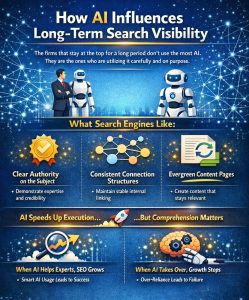
The firms that stay at the top for a long period don’t use the most AI. They are the ones who are utilizing it carefully and on purpose.
It seems like search engines like:
- Clear authority on the subject
- Structures for connection that stay the same
- Pages that don’t need to be rewritten all the time to stay fresh
AI speeds up execution, but search engines still value comprehension. When AI helps experts, SEO grows. When it takes over, growth stops.
FAQs
1. How can AI help firms grow their SEO?
AI helps firms grow their SEO by helping with research, content analysis, and finding technical patterns. It cuts down on the amount of labor that has to be done by hand, which lets teams handle bigger sites, but it doesn’t take the role of strategic judgment.
2. Can AI help businesses thrive by making search work better?
AI may help search-led growth by making intent more accurate, content more consistent, and technical knowledge better. Not only automation, but also how effectively AI outputs are understood and used will determine growth.
3. Does content generated by AI hurt the potential of SEO to grow?
Content generated by AI doesn’t always hurt SEO. But when done on a large scale, it frequently leads to sameness. Without effective editorial monitoring, engagement drops and rankings become shaky.
4. How can firms utilize AI to improve their technical SEO?
Detecting crawl, indexation, and linking patterns is what AI does best. To prevent long-term visibility problems, people still need to be in charge of implementation choices.
5. Why do certain SEO techniques that work at first fail later on?
A lot of scalable solutions fail because they place more value on production than usefulness. Search engines change their minds about quality over time, and sites that aren’t deep or clear about their purpose lose traffic.
6. Is AI needed for SEO at the business level?
AI isn’t required, but it becomes more useful as things get more complicated. Its job is to help with analysis and consistency, not to take the position of SEO knowledge.
Conclusion
AI for business has revolutionized how SEO may be improved, but it hasn’t changed what search engines reward in the end. Search-led development still has to be clear, have a specific aim, and be trusted.
It’s clear to see the primary point: AI only improves SEO when it helps humans make choices instead of making them. Companies who think about AI as infrastructure instead of a strategy are more likely to get greater exposure. People who automate things without understanding what they’re doing usually get up faster but fall behind faster.
You need to establish a balance between speed and expertise if you want your SEO to stay.