


SEO project management rarely fails because people don’t know what to do.
It doesn’t work since the job isn’t planned, scheduled, or done in a way that search engines can understand.
Real audits show tendencies that can be predicted. Keyword research that works. The content is fine. Most of the time, technical SEO audits are clean. Nothing looks wrong on paper. But traffic, rankings, and impressions stay the same. The problem with execution history is fragmentation, not strategy.
Tasks that are out of sequence. Content is published before crawl paths are configured. After looking at and mostly ignoring pages, internal linkages are created. Tech solutions come weeks after options for indexing. It is recorded what was moved, not what was given, put off, or never done. There is SEO work, but it doesn’t all fit together.
Here, SEO project management separates work from results.
SEO doesn’t reward doing nothing. It rewards being in queue over time. Search engines look at changes that have happened throughout time. Fixing one issue doesn’t usually help. Sequences that work together. When engineers fix one thing, journalists write another, and analysts report on another, Google picks up on the noise instead of the purpose.
So, SEO checklists never work as well as they should. Long-term SEO includes things like development cycles, content pipelines, UX decisions, interpreting data, and even legal or compliance limits. Each layer has an effect on trust, signal processing, and reinforcement.
Without structure, even the best SEO decisions won’t work. They arrive late, compete, or never become stronger. SEO project management gives search engines options in a form that they can understand, assess, and act on. This makes them grow over time.
SEO Project Management vs Traditional Project Management
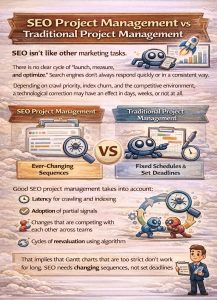
SEO isn’t like other marketing tasks.
There is no clear cycle of “launch, measure, and optimize.” Search engines don’t always respond quickly or in a consistent way. Depending on crawl priority, index churn, and the competitive environment, a technological correction may have an effect in days, weeks, or not at all.
Good SEO project management takes into account:
- Latency for crawling and indexing
- Adoption of partial signals
- Changes that are competing with each other across teams
- Cycles of reevaluation using algorithm
That implies that Gantt charts that are too strict don’t work for long. SEO needs changing sequences, not set deadlines.
The Core SEO Workflow That Actually Scales
Across dozens of sites, the SEO workflow that consistently holds up looks like this:
1. Baseline Diagnostics (Before Any Execution)
Before assigning tasks, you need to know:
-
What Google can crawl consistently
-
What it indexes but doesn’t trust
-
What ranks but doesn’t convert
-
What never gets surfaced at all
This is where crawl logs, index coverage patterns, and internal link depth matter more than keyword volume.
2. Constraint Identification
SEO performance is limited by its weakest layer:
-
Crawlability
-
Indexability
-
Relevance
-
Authority
-
Satisfaction
Good project management identifies which layer is currently binding — and ignores the rest temporarily.
3. Sequenced Execution
Fixing content before crawl issues is wasted effort.
Building links to URLs Google barely indexes is noise.
Execution must follow dependency order:
-
Crawl & rendering stability
-
Index consistency
-
Internal signal clarity
-
Content alignment
-
Authority reinforcement
What Commonly Goes Wrong (What I See in Audits)
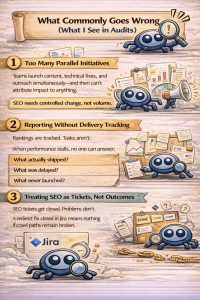
1. Too Many Parallel Initiatives
Teams launch content, technical fixes, and outreach simultaneously—and then can’t attribute impact to anything.
SEO needs controlled change, not volume.
2. Reporting Without Delivery Tracking
Rankings are tracked. Tasks aren’t.
When performance stalls, no one can answer:
-
What actually shipped?
-
What was delayed?
-
What never launched?
3. Treating SEO as Tasks, Not Outcomes
SEO tickets get closed. Problems don’t.
A redirect fix closed in Jira means nothing if crawl paths remain broken.
Agile SEO Management (When It Works and When It Doesn’t)
Agile frameworks can work for SEO — but only if adapted.
What works:
-
Sprint-based technical fixes
-
Short content iterations
-
Regular re-prioritization based on crawl feedback
What doesn’t:
-
Fixed sprint velocity expectations
-
Feature-style “definition of done”
-
Output-based success metrics
SEO success is signal adoption, not task completion.
SEO Task Management That Survives Scale
In mature teams, SEO task management separates work into the following:
-
Structural tasks (one-time, high impact)
-
Maintenance tasks (recurring, low visibility)
-
Exploratory tasks (testing, hypotheses)
Lumping them together guarantees misprioritization.
Managing Content Optimization as a System
Content SEO fails when treated as publishing.
Effective SEO project management treats content as
-
An indexable asset
-
A retrievable entity
-
A competitive response
That means content tasks are tied to:
-
Existing index gaps
-
Query instability
-
Internal cannibalization patterns
Not editorial calendars.
Backlink Outreach Management (Without Chaos)
Link building collapses when disconnected from:
-
Index status
-
Anchor dilution
-
URL longevity
Project-managed outreach targets:
-
URLs Google already trusts
-
Pages with internal reinforcement
-
Topics with sustained demand
SEO Reporting That Actually Supports Decisions
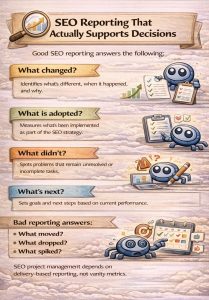
Good SEO reporting answers the following:
-
What changed?
-
What is adopted?
-
What didn’t?
-
What’s next?
Bad reporting answers:
-
What moved?
-
What dropped?
-
What spiked?
SEO project management depends on delivery-based reporting, not vanity metrics.
A Practical SEO Project Management Checklist
Before starting any SEO initiative:
-
Do we know what Google crawls most?
-
Are index patterns stable?
-
Is this task upstream or downstream?
-
What must happen before this matters?
-
How will we know if it worked?
If you can’t answer these, don’t schedule the work.
Real-World Scenario from SEO Audits
In one multi-category site, rankings stagnated despite heavy content investment.
The issue wasn’t content quality.
It was an execution order.
Hundreds of pages were published while internal linking was broken and crawl depth exceeded five levels. Google indexed selectively, dropped URLs quietly, and never reevaluated the rest.
Once project management shifted to
-
Crawl path repair
-
Internal consolidation
-
Content pruning
-
Then publishing
Traffic recovered without adding new keywords.
SEO Sprints vs SEO Roadmaps
Roadmaps show intent.
Sprints deliver reality.
Effective SEO teams use:
-
Loose quarterly roadmaps
-
Tight bi-weekly execution windows
-
Monthly reassessment based on index behavior
FAQs
What is SEO project management?
SEO project management is the structured planning, sequencing, and execution of SEO work based on crawl behavior, indexing patterns, and signal adoption — not just task completion.
Why is SEO project management important?
Because SEO results depend on order and dependency. Without proper management, even correct SEO tasks fail to produce results.
How does SEO project management differ from normal marketing PM?
SEO requires adapting to delayed feedback, partial adoption, and algorithmic interpretation, not fixed timelines.
Can small teams use SEO project management?
Yes. In fact, smaller teams benefit more because prioritization errors are costlier.
What tools are best for SEO task management?
Any tool works if it tracks dependencies, delivery status, and outcomes—tools don’t replace sequencing logic.
Conclusion
SEO project management isn’t about control, dashboards, or policing tasks.
It’s about respect—for how search engines actually process change over time.
Search engines don’t respond to isolated fixes. They respond to patterns. They notice whether a site improves consistently, whether changes reinforce each other, and whether signals arrive in a logical sequence. Project management is what makes that possible. Without it, even good SEO work lands as disconnected noise.
The best-performing sites I work with aren’t doing more SEO. They’re doing less, more deliberately. They know when to pause content production because crawl efficiency is broken. Know when internal linking matters more than publishing something new. They know when reporting is lying because execution quality hasn’t caught up to strategy.
That discipline doesn’t come from tools. It comes from managing SEO as a system.
When SEO work is sequenced properly—technical foundations first, then content, then reinforcement—changes compound instead of resetting. Indexing stabilizes. Rankings stop oscillating. Traffic grows in steps rather than spikes. Teams stop chasing symptoms and start preventing them.
This is also where SEO stops feeling fragile. Instead of every algorithm update triggering panic, performance becomes more predictable. You can explain why something worked. You can forecast impact with more confidence. And when things dip, you know where to look—because the system is documented, not improvised.
SEO project management doesn’t make search engines easier. It makes your work legible to them.
That’s the real advantage.
When SEO is treated as ongoing execution—not a collection of tactics—you stop reacting to search engines and start collaborating with them. And that’s when SEO shifts from a recurring fix into a durable growth engine.