

For much of its existence, SEO traffic projections were not required. You began working, kept an eye on the rankings, and made changes as the results came in. The growth slowed down. The SERPs were easier. After that, it was usually easy to figure out traffic patterns. If the numbers went up, the work was credited. Their outage was mainly caused by technological debt, broken links, or bad content.
That environment is no longer there.
These days, non-ranking elements have an effect on organic performance. When changes show up depends on how long it takes to crawl. Pre-page SERP features stop clicks. AI-generated answers do what they need to do without going. Delays in indexing make impact windows longer. Keyword tools can’t show intent, which changes more quickly. None of these always decreases ranks.
In audits, I regularly see rankings stay the same, impressions go up, and traffic drop without anybody noticing. No crawl problems, penalties, or errors in indexing. Traditional SEO thinks everything is “fine.” The issue is not the execution, but the expectation. Teams think that traffic won’t decline if rankings don’t. That assumption is now dangerous.
This is why it’s important to know how many people will visit your site via search engines. To get a sense of what results are possible given the current search conditions and when they may actually happen, not to guess particular numbers or growth. When making predictions, you need to think about latency, volatility, and the layers of presentation that are between ranking and clicks.
A good prognosis doesn’t get rid of doubt. Shows it. It makes risks, timelines, and circumstances clearer. That one shift changes how SEO is planned, defended, and evaluated.
It’s not about confidence when you make predictions in SEO these days.
The problem is control.
What forecasting SEO traffic actually means in real SEO work
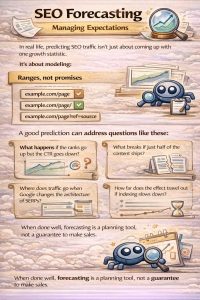
In real life, predicting SEO traffic isn’t just about coming up with one growth statistic.
It’s about modeling:
- Ranges, not promises
- Delay, not immediate effect
- Not ideal instances, but scenarios
A good prediction can address questions like these:
- What happens if the ranks go up but the CTR goes down?
- What breaks if just half of the content ships?
- Where does traffic go when Google changes the architecture of SERPs?
- How far does the effect travel out if indexing slows down?
When done well, forecasting is a planning tool, not a guarantee to make sales.
Why most SEO traffic forecasts fail (audit patterns)
1. Assumptions on linear growth
SEO development doesn’t happen in smooth curves; it happens in increments. Forecasts that expect even little growth from month to month frequently fail early.
2. Rankings thought to be true
People think that rankings will become better after the task is done. In reality, rankings are temporary and are often checked again.
3. Static CTR assumptions
SERP characteristics influence how people click. Forecasts that don’t take PAA, highlighted snippets, or AI summaries into account change swiftly.
4. Not paying attention to crawl and indexing slowness
Content doesn’t usually bring in traffic right away. Forecasts that don’t take lag into account exaggerate early performance.
The forecasting mindset that actually works
I don’t say, “How much traffic will we get?”
I say:
- What makes growth happen?
- What does the model not work?
- What makes impact slower?
- What makes things go faster?
Forecasting SEO traffic is not a way to make decisions; it’s a way to help you make decisions.
Core inputs for forecasting SEO traffic
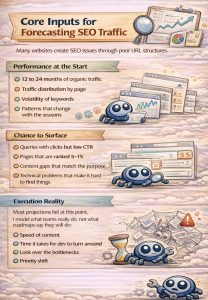
Performance at the start
- 12 to 24 months of organic traffic
- Traffic distribution by page
- Volatility of keywords
- Patterns that change with the seasons
Chance to surface
- Queries with clicks but low CTR
- Pages that are ranked 5–15
- Content gaps that match the purpose
- Technical problems that make it hard to find things
Execution reality
Most projections fail at this point.
I model what teams really do, not what roadmaps say they will do:
- Speed of content
- Time it takes for dev to turn around
- Look over the bottlenecks
- Priority shift
SEO traffic forecasting spreadsheet structure (practical)
A basic yet accurate forecasting sheet has:
1: Baseline
- URL of the page
- Traffic this month
- Main query group
- Average ranking range
- Presence of SERP features
2: Modelling Opportunities
- Target questions
- What kind of intent
- Current situation
- Range of realistic positions
- Expected CTR range
3: Timeline for Execution
- Type of content or fix
- Date of publishing or deployment
- Estimate of indexing lag
- Time frame for expected effect
4: Situations
- Conservative
- Expected
- Angry
Not simply volume, but also CTR, ranks, and execution success change in each circumstance.
This framework keeps predictions based on facts and easy to understand.
Client-ready explanation of SEO forecasting
When explaining forecasts to clients or stakeholders, I frame it like this:
“SEO forecasting doesn’t predict traffic the way paid media predicts spend. It models how search engines typically respond to changes over time. The numbers represent probable ranges, not guarantees. The goal is to reduce surprise, not promise outcomes.”
This explanation prevents misaligned expectations and protects trust.
Forecasting after Google updates
Re-baselining is the first step in post-update forecasting:
- Separate structural loss from volatility
- Find out which sorts of pages are impacted.
- Predict recovery only when the signs say it’s possible
If automatic recovery isn’t predicting, it’s hope.
E-commerce vs. Content site forecasting
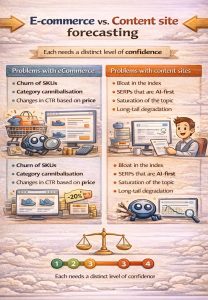
Problems with eCommerce:
- Churn of SKUs
- Category cannibalisation
- Changes in CTR based on price
Problems with content sites:
- Bloat in the index
- SERPs that are AI-first
- Saturation of the topic
- Long-tail degradation
Each needs a distinct level of confidence.
A quick SEO forecasting diagnostic
Before you believe a prediction, ask:
- Does it have an effect on SERP features?
- Does it show how long it takes to index?
- Does it presuppose that everything will go perfectly?
- Does it indicate a danger of loss?
- Can it be described in a simple way?
If not, it can’t be used.
FAQs
1. What does it mean to “forecast SEO traffic”?
Instead of making guesses, forecasting SEO traffic uses past performance data, keyword visibility trends, SERP behaviour, and realistic execution schedules to make predictions about future organic performance.
2. Is it possible to correctly estimate SEO traffic?
It is not possible to accurately estimate SEO traffic. Predictions are not accurate; they are based on probabilities and are meant to show potential ranges rather than guarantee results.
3. How does SEO forecasting function in real life?
SEO forecasting uses past traffic patterns, keyword position possibilities, CTR curves, seasonality, and estimated implementation delays to guess how things will go in the future.
4. What makes SEO traffic predictions less accurate?
The accuracy of search results is affected by how often they are crawled, how long it takes to index them, how often SERP features change, how often algorithms are updated, how much competition changes, how quickly new material is added, and how consistently it is executed.
5. How reliable are predictions of SEO traffic?
SEO predictions are not exact. They help with planning and decrease uncertainty, but they can’t take into consideration every outside factor that affects search visibility.
6. How do you figure out how much SEO traffic you may expect?
To figure up traffic forecasts, you look at the possible traffic for each term, use realistic CTR models, and make changes for seasonality, competition, and rollout schedules.
7. How do you predict SEO for websites that are new?
For new sites, forecasting is based on benchmark data, an examination of competitors, predictions about how quickly material will be added, crawl/indexing schedules, and cautious growth curves.
8. How long does it take to predict SEO?
For established locations, the first prediction usually takes one to two weeks. Updates to ongoing forecasts are normally done once a month or once a quarter.
Conclusion
Forecasting SEO traffic doesn’t predict SEO. Increases manageability.
Forecasting modern search systems is difficult because of their complexity and variability. Results no longer rely on rankings. Crawl behavior, indexing time, SERP features, AI-generated answers, and intent changes determine traffic arrival. SEO traffic forecasting incorporates these.
Foresight teams don’t predict one future. They model ranges. Prepare for best-case, expected, and constrained scenarios. They know growth usually happens late, plateaus, or fluctuates. That understanding reduces reactivity to numbers and short-term gain-induced optimism.
Forecasting distinguishes reactive and strategic SEO for practitioners. Reactive teams follow weekly movements, justify performance later, and shift direction too often. Strategic teams use forecasts to set expectations, protect schedules, and evaluate search outcomes against the framework.
Forecasting replaces speculation with probability. Fear is replaced with preparation. It lets SEO executives express uncertainties without seeming hesitant and defend decisions when results lag despite solid execution.
Importantly, SEO traffic predictions are not accurate. Resilience is needed. Because they’ve considered alternative possibilities, teams with projections respond calmly when circumstances change, which they frequently do.
Growing potential—how far, fast, and within limits—is more important than traffic estimates for SEO success in 2026 and beyond.
SEO traffic isn’t expected to rule.
When the future misbehaves, you forecast better decisions.