

Published: 13 December 2025 | Last Updated: 21 July 2026
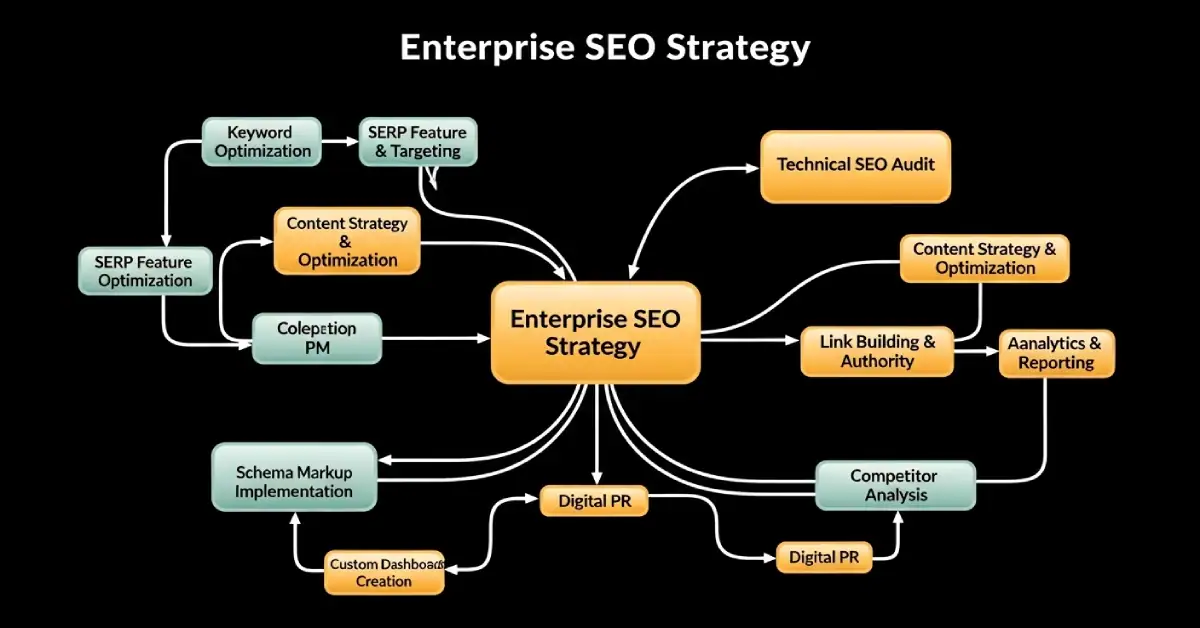
An enterprise SEO strategy isn’t simply “SEO, but bigger.” In practice, enterprise SEO is a distinct discipline. The problems aren’t badly written pages or missing keywords. They’re scale, complexity, and unintended side effects.
I’m Zohanuddin Shaikh, an SEO consultant based in Karachi, Pakistan, with 8 years of experience. I’ve audited large sites where millions of URLs existed but only a small fraction genuinely influenced search performance—while Googlebot spent most of its time crawling URLs that provided almost no value. I’ve also seen enterprise sites with strong brands and real authority struggle to rank, simply because their internal architecture made it impossible for search engines to identify what mattered most.
At enterprise scale, SEO problems rarely show up as obvious mistakes. Instead, they appear as
- Partial indexing across large sections
- Ranking instability that shifts between templates
- Strong pages underperforming for no visible reason
- Traffic rising in one section while quietly falling in another
What makes enterprise SEO genuinely difficult is that every change has consequences. Adjusting templates, navigation, filters, or internal links can alter crawler behavior across thousands or millions of URLs at once.
This guide covers enterprise SEO strategy from a practical, audit-based perspective: how search engines actually handle large sites, what consistently breaks in complex structures, and how to build a strategy that scales without becoming unmanageable. It builds on the foundations in my SEO growth strategy guide.
What Is an Enterprise SEO Strategy?
An enterprise SEO strategy is a governance-driven approach to controlling how search engines crawl, index, and rank large websites—managing site architecture, internal linking, content creation, and indexing rules across thousands or millions of URLs, rather than optimizing pages individually.
The defining characteristic is control rather than optimization. On a small site, SEO work means improving individual pages. At enterprise scale, individual page work barely registers. What matters is whether the system as a whole tells search engines which sections deserve attention and how authority should flow.
An enterprise SEO strategy addresses four things simultaneously:
- Crawl allocation — which URLs search engines spend their limited resources on
- Index control — which pages should exist in search results at all
- Intent assignment — what each template and section is responsible for
- Change governance—how SEO impact is evaluated before releases ship
Enterprise SEO succeeds or fails on these four, not on keyword density or meta descriptions. When they’re managed well, scale becomes an advantage. When they aren’t, scale amplifies every existing weakness.
What Makes Enterprise SEO Different From Traditional SEO
Enterprise SEO is more about rules than improvements. Problems at scale don’t come from neglecting best practices—they come from complexity itself.
Factor |
Traditional SEO |
Enterprise SEO |
|
Primary work |
Optimizing individual pages | Governing systems and templates |
|
Scale of a mistake |
Affects a handful of pages | Affects entire sections |
|
Main constraint |
Content quality and links | Crawl budget and intent conflicts |
| Who’s involved | One person or small team |
Multiple teams, often siloed |
| Change process | Edit and publish |
Requires impact modeling before release |
| Typical failure | Pages don’t rank |
Sections rank inconsistently |
| Biggest lever | Better content |
Clearer architecture |
The core difference is captured in one principle: search engines evaluate enterprise websites as systems, not collections of pages.
That’s why enterprise problems often trace back to organizational structure rather than SEO knowledge. Different teams own different sections. Technical decisions get made without SEO input. Templates get updated for business reasons that ripple across millions of URLs. The strategy has to account for how the organization works, not just how search engines work.
What Commonly Goes Wrong in Enterprise SEO Audits
Four problems appear in nearly every enterprise audit I run. None of them look like errors, which is exactly why they persist.
Crawl Budget Wasted on Low-Value URLs
This is the most common enterprise SEO problem by a wide margin. Common sources include faceted navigation, parameter URLs, internal search result pages, and accidentally indexed filter combinations.
Google isn’t penalizing these sites. It’s simply saturated. Crawlers visit important pages less frequently, which slows indexing and delays ranking updates for the content that actually matters. On a large site, this can mean genuinely important pages get recrawled weeks apart while thousands of parameter URLs get crawled daily.
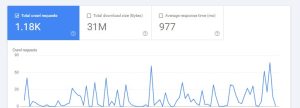
principles — crawl frequency, response time, request volume — apply at
enterprise scale, just with much larger numbers.
For the mechanics of this, see my faceted navigation SEO guide and SEO-friendly URLs guide.
Internal Linking Without Priority Signals
Enterprise sites typically have mega menus linking to everything, identical footer links on every page, and automated internal links generated without contextual understanding.
The result is a completely flattened hierarchy. When every page links to nearly every other page with similar prominence, search engines lose the ability to determine which pages the site itself considers important. Ironically, enterprise sites often have too many internal links rather than too few — and the fix is subtraction, not addition. For a complete process, see my internal linking SEO guide.
Keyword Cannibalization at Scale
On large sites, cannibalization doesn’t happen one keyword at a time. It happens by section.
Common patterns include category pages competing with subcategories, editorial content competing with product listings, and regional or country sites targeting identical intent. When cannibalization occurs at this scale, the symptom isn’t a ranking drop — it’s persistent ranking instability, with different URLs from the same site alternating for the same queries. For the full diagnostic process, see my keyword cannibalization guide.
Technical Changes Without SEO Impact Modeling
Enterprise teams routinely ship URL structure changes, JavaScript framework updates, and pagination or infinite scroll modifications — without fully understanding how these affect crawl paths, indexing signals, or internal authority distribution.
This is arguably the most expensive enterprise SEO failure, because the damage is already deployed across millions of URLs before anyone notices. For the rendering side of this risk, see my JavaScript rendering guide.
Enterprise Site Architecture: Where SEO Is Won or Lost
At enterprise scale, architecture matters more than content quality. Site architecture is the structural organization of URLs, navigation, and internal links that determines how search engines discover and prioritize content across a large site.
Strong enterprise architectures share consistent traits:
Strong Architecture |
Weak Architecture |
|
Clear, shallow hierarchy for important pages |
High-value pages buried or orphaned |
|
Logical, predictable URL structures |
Inconsistent patterns across sections |
| Deliberate index control |
Low-value areas over-indexed |
| Navigation aligned with priorities |
Navigation that flattens everything |
| Consistent internal signals |
Conflicting signals between templates |
In audits, architectural adjustments almost always outperform content initiatives—because architecture determines whether search engines can interpret everything else correctly. A perfectly written page buried six clicks deep with no contextual internal links will underperform a mediocre page that the site’s structure clearly prioritizes.
The practical implication for enterprise teams: before commissioning new content, verify that existing high-value content is structurally discoverable. On most large sites, there’s more ranking potential locked in poorly linked existing pages than in anything new. For the broader technical foundation, see my technical SEO audit guide.
Enterprise Keyword Strategy Is About Intent Control, Not Volume
At scale, traditional keyword research breaks down. Enterprise keyword strategy means assigning one clear purpose to each URL and template so sections don’t compete—rather than finding more keywords to target.
The hardest work in enterprise SEO is the following:
- Assigning each URL a single primary purpose
- Preventing overlap between sections and templates
- Deciding which URLs should not appear in search results at all
That third point is the one most teams resist, and it’s often the highest-leverage decision available. On a site with millions of URLs, choosing what to exclude matters more than choosing what to optimize.
A functioning enterprise keyword strategy focuses on the following:
Element |
What It Means |
|
Intent mapping across templates |
Each template type serves one intent category |
| Canonical purpose per page type |
Category, product, and editorial roles are distinct |
| Clear separation of intent |
Informational, transactional, and navigational pages don’t overlap |
When intent isn’t governed, adding more keywords doesn’t help—it accelerates cannibalization. For the four intent types in detail, see my search intent classification guide.
Scalable Content Strategy for Enterprise SEO
Enterprise content strategies fail predictably when every team publishes independently, editorial content ignores site structure, and old content is never consolidated or retired.
What works instead:
- Centralized content governance — one set of rules everyone follows
- Clear rules for creating new URLs — including who can create them
- Regular consolidation of overlapping content on a schedule
- Defined ownership for each topic cluster
I’ve seen enterprise websites increase organic traffic by consolidating and reorganizing existing content without publishing anything new. That result is counterintuitive but consistent: on large sites, removing ambiguity often delivers more than adding content.
The governance point deserves emphasis. Most enterprise content problems are organizational, not editorial. When five teams can each create pages targeting the same intent without any coordination, cannibalization isn’t a risk — it’s a certainty. The fix is a process, not a keyword tool. For the strategic layer, see my SaaS SEO strategies guide.
Enterprise Technical SEO: The Non-Negotiable
At enterprise scale, technical SEO isn’t optional — it’s the foundation everything else depends on.
Requirement |
Why It’s Critical at Scale |
|
Crawl path efficiency |
Determines what gets discovered and refreshed |
|
Index control (noindex, canonical, robots) |
Prevents millions of low-value URLs entering the index |
| Consistent internal signals |
Stops templates from contradicting each other |
| Server stability and response time |
Directly affects how much crawling Google performs |
| JavaScript rendering clarity |
Determines whether content is seen at all |
Technical debt at enterprise scale doesn’t just slow pages down. It confuses search engines — and confusion at scale becomes ranking instability across entire sections.
Server response time deserves particular attention here because it’s often treated as an infrastructure concern rather than an SEO one. On large sites, slower responses directly reduce how many URLs Google crawls in a given window, which means technical performance and crawl budget are the same problem viewed from different angles. For canonical handling specifically, see my canonicalization SEO guide.
Automation in Enterprise SEO: Where It Helps and Where It Hurts
Automation becomes necessary at scale, but applying it without judgment is genuinely risky.
Helpful Automation |
Risky Automation |
|
Monitoring crawl and index trends |
Mass content generation |
|
Detecting anomalies across templates |
Automatic keyword insertion |
| Surfacing internal linking opportunities |
Untested template-level SEO changes |
| Flagging indexing status changes |
Auto-generated pages without intent rules |
The pattern is clear: automation works well for detection and poorly for decision-making. Monitoring millions of URLs manually is impossible, so automated anomaly detection is genuinely valuable. But automated content creation and untested template changes tend to scale mistakes rather than solve problems.
In audits, I frequently find that automation amplified pre-existing issues rather than fixing them. A template-level automated internal linking rule, deployed across a site that already had a flat hierarchy, made the hierarchy flatter. The automation worked exactly as designed — the design was the problem. Test automation on a subset before deploying at scale, always.
Enterprise SEO Governance: The Missing Layer
Governance is the set of rules, ownership assignments, and review processes that determine who can change what on a large site—and how SEO impact is evaluated before those changes ship.
This is the layer most enterprise SEO programs lack, and its absence explains most recurring problems. Without governance, the same issues return after every fix, because nothing prevents them from being reintroduced.
Effective enterprise SEO governance defines:
Governance Element |
What It Controls |
|
URL creation rules |
Who can create new URLs and under what conditions |
|
Template change review |
SEO sign-off before template-level changes deploy |
| Section ownership |
Which team is accountable for which content area |
| Index policy |
Documented rules for what should and shouldn’t be indexed |
| Release impact modeling |
Required SEO assessment before major releases |
The release impact modeling requirement is the highest-value item on that list. Most enterprise SEO disasters are entirely preventable—they happen because a technical or product decision is shipped without anyone asking how it would affect crawling and indexing.
Governance isn’t glamorous work, and it’s often resisted because it adds process. But at enterprise scale, process is what converts one-time fixes into durable improvements. Without it, you’re permanently re-solving the same problems. For turning this into an actual operational workflow, see my SEO project management guide.
How to Measure Enterprise SEO Success
Enterprise SEO measurement differs from small-site measurement, because sitewide traffic totals hide what’s actually happening. A site can grow overall while critical sections decline.
Metrics that matter at enterprise scale:
Metric |
What It Reveals |
|
Crawl requests to priority URLs |
Whether crawl budget reaches what matters |
|
Indexed vs. submitted ratio by section |
Where indexing is failing |
| Section-level traffic trends |
Growth or decline hidden by sitewide totals |
| Ranking stability, not just position |
Whether cannibalization is being resolved |
| Time from publication to index |
How efficiently the site is being processed |
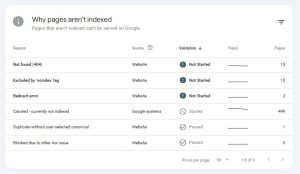
The key discipline is segmentation. Enterprise reporting that only shows sitewide totals is close to useless, because it averages away the signal. A site with growing blog traffic and declining category traffic looks flat overall—while an entire revenue-driving section quietly erodes.
Ranking stability deserves specific mention as a success metric. When cannibalization is genuinely resolved, the first observable improvement is usually reduced volatility rather than higher positions. Pages settling into consistent rankings is the leading indicator that structural fixes are working. For projecting what these improvements are worth, see my SEO traffic forecasting guide.
Enterprise SEO in AI-Driven Search
AI overviews and AI-driven search have raised the stakes for enterprise architecture because AI systems must determine which page on a large site authoritatively covers a topic before they can cite it.
For enterprise sites, this creates a specific challenge. When five pages across three sections cover overlapping ground, AI systems face the same ambiguity that causes traditional ranking instability—and tend to resolve it by citing a competitor with clearer structure instead.
What helps enterprise sites in AI-driven search:
- Unambiguous topical ownership — one clear page per topic across the entire site
- Consistent entity terminology — the same terms used the same way across sections
- Self-contained, extractable sections — content that doesn’t depend on surrounding context
- Clean structural signals — architecture that makes hierarchy obvious
There’s an important convergence here: the governance work that fixes crawl efficiency and cannibalization also makes enterprise content more usable by AI systems. Both problems reduce to the same question — which page reliably owns this topic? Enterprise sites that answer it clearly gain in both environments simultaneously.
Large organizations also face a distinct risk: because AI systems synthesize from many sources, a brand’s own pages may not be the primary input for how it’s described. For more on managing that, see my brand sovereignty in AI search guide.
A Practical Enterprise SEO Diagnostic Framework
When assessing enterprise SEO health, I work through five diagnostic questions in order. Each isolates a different failure mode.
|
# |
Diagnostic | Question to Answer |
|
1 |
Crawl efficiency | Are important pages crawled frequently? |
|
2 |
Indexing confidence | Are the indexed pages the ones that matter? |
| 3 | Intent clarity |
Does each section have a clearly defined role? |
| 4 | Internal authority flow |
Do internal links reinforce actual priorities? |
| 5 | Change control |
Are SEO impacts evaluated before releases ship? |
If any of these fail, growth becomes unstable regardless of how much content or optimization work happens elsewhere.
The order matters. Crawl efficiency comes first because nothing downstream works if search engines never reach your important pages. Change control comes last because it’s the layer that keeps the other four from degrading again—a site can pass the first four diagnostics today and fail all of them in six months without it.
Common Enterprise SEO Strategy Mistakes
These patterns appear repeatedly across enterprise audits, and most involve scaling activity rather than scaling clarity.
Mistake |
Why It Hurts at Scale |
|
Optimizing pages before fixing architecture |
Improvements get buried by structural problems |
|
Linking everything to everything |
Flattens hierarchy; priorities become invisible |
|
Publishing without index rules |
Millions of low-value URLs consume crawl budget |
| Shipping technical changes without SEO review |
Damage deploys across the whole site at once |
| Reporting only sitewide totals |
Hides section-level decline behind averages |
| Treating automation as strategy |
Scales existing mistakes efficiently |
The connecting thread: each of these treats enterprise SEO as traditional SEO applied more times. It isn’t. The work that produces results at scale is subtractive and structural — removing ambiguity, consolidating overlap, restricting what gets indexed, and clarifying what each section owns.
FAQs
1. What is an enterprise SEO strategy?
An enterprise SEO strategy is a governance-driven approach to controlling how search engines crawl, index, and rank large websites at scale. Rather than optimizing individual pages, it manages site architecture, internal linking, content creation rules, and indexing policy across thousands or millions of URLs—ensuring search engines understand which sections matter most and how authority should flow through the site.
2. How is enterprise SEO different from traditional SEO?
The core difference is that the primary challenge is scale, not optimization fundamentals. On large sites, small code or structural changes can affect entire sections at once. Enterprise SEO focuses on governance, intent control, and consistency across teams, templates, and systems—rather than optimizing individual pages in isolation. Mistakes affect thousands of URLs, not a handful.
3. Can enterprise SEO be automated?
Parts of it can. Automation works well for monitoring crawl activity, detecting indexing anomalies, and reporting performance trends across large URL sets. But strategy cannot be automated. Decisions about intent mapping, URL prioritization, and structural changes require human judgment — particularly at scale, where automated mistakes propagate across millions of pages before anyone notices.
4. What is the biggest SEO problem for large websites?
Wasted crawl budget combined with unclear intent hierarchy. Search engines spend their limited crawling resources on low-value or duplicate URLs—faceted navigation, parameters, and internal search pages—while high-value content gets crawled infrequently. This produces partial indexing, unstable rankings, and traffic that grows in some sections while quietly declining in others.
5. Does a strong brand guarantee enterprise SEO success?
No. Brand authority alone doesn’t guarantee search performance. In audits, I’ve seen powerful brands struggle because unclear architecture, overlapping intent, and weak internal signaling made it impossible for search engines to determine what mattered most. Authority helps, but structure determines whether that authority translates into visibility.
6. How do you fix crawl budget problems on a large site?
Start by identifying where crawl activity actually goes using Search Console Crawl Stats and server logs. Then restrict low-value URL patterns — faceted combinations, internal search results, and parameter variations — using robots.txt, noindex, and canonical tags appropriately. Improving server response time also directly increases how many URLs Google crawls in a given window.
7. How do you prevent keyword cannibalization at enterprise scale?
Prevention requires governance, not cleanup. Assign each template and section a single primary intent, document rules for who can create new URLs, and require intent checks before publishing. At scale, cannibalization is an organizational problem—when multiple teams can independently create pages targeting the same queries, overlap becomes inevitable without process controls.
8. What should enterprise SEO reporting measure?
Report by section, not sitewide. Track crawl requests to priority URLs, indexed-versus-submitted ratios per section, section-level traffic trends, ranking stability rather than just position, and time from publish to index. Sitewide totals average away the signal — a site can appear flat overall while a revenue-critical section declines significantly.
Final Thoughts
An enterprise SEO strategy isn’t about growth hacks, algorithm tricks, or new tooling. Real-world success requires managing complexity rather than adding to it. At scale, SEO problems rarely come from insufficient effort. They come from too many moving parts and no clear prioritization.
From what I’ve seen, enterprise sites that perform well don’t produce the most content or run the most optimization projects. They make the clearest decisions. They determine which URLs get indexed, which sections get crawled, and which areas get deprioritized or restricted. Most importantly, they ensure team, template, and system decisions align with each other. SEO stops being reactive and becomes governed.
With proper governance, search engines stop hesitating. The site makes it obvious where to focus, so crawl behavior becomes predictable. Indexing becomes deliberate rather than accidental. Ranking gains are slower, but they persist. Performance becomes stable instead of spiking in one section while falling in another.
Enterprise SEO strategy doesn’t fail because teams lack skill. It fails because complexity outgrows control. Even large organizations struggle to gain search visibility without clear rules for URLs, internal linking, and intent.
Fix governance, and scale starts working for you. Scale amplifies strengths rather than weaknesses. The crawl budget goes where it should. Authority consolidates instead of fragmenting. Predictable growth replaces volatility. Managed properly, complexity stops being a liability and becomes a genuine competitive advantage — because most competitors never solve it.
For questions about auditing SEO on a large or complex site, feel free to reach out through my Contact page.
For more SEO guides, browse Search Engine Realm.
Published: 13 December 2025 | Last Updated: 21 July 2026