


If you’ve ever asked how long does it take to learn SEO, you’re not alone. It’s one of the most common questions among beginners and even professionals shifting into digital marketing.
The challenge is that SEO doesn’t follow a fixed timeline. Some parts are quick to learn, while others take months—or even years—of practical experience. That’s because SEO is not just about knowledge. It’s about applying that knowledge in real situations, where results take time to appear and often require careful observation before making the next decision.
In the early stages, progress can feel fast. You learn concepts like keywords, on-page SEO, and search intent, and everything seems clear. But as you begin working on real websites, you start to see that outcomes are not always immediate or predictable. Small changes can take weeks to show results, and sometimes improvements don’t work the way you expected.
From experience, the biggest mistake people make is expecting fast results without understanding how SEO actually works. When expectations are unrealistic, it often leads to frustration or rushed decisions that don’t help long-term growth. For example, constantly changing strategies or over-optimizing pages can create confusion for search engines instead of improving performance.
A better approach is to treat SEO as a long-term process. By focusing on consistent learning, testing, and refining your strategy, you gradually build the skills needed to handle more complex situations with confidence.
How long does it take to learn SEO?
- Basics: 1–3 months
- Practical skills: 6–12 months
- Advanced understanding: 1–2+ years
These timelines vary depending on consistency, practice, and real-world experience.
Why Learning SEO Takes Time
SEO involves multiple areas working together:
- search intent
- content marketing
- technical SEO
- user experience
- analytics and data interpretation
Unlike some skills, SEO results are delayed. You may make changes today but see the impact weeks later. This delay is what makes learning feel slower.
Stage 1: Learning SEO Basics (Month 1–2)
At this stage, you focus on understanding core concepts.
What you learn:
- how search engines crawl and index pages
- keyword research basics
- on-page SEO (titles, headings, structure)
- introduction to backlinks
What you can do:
- understand SEO terminology
- follow simple checklists
- make basic optimizations
This stage builds your foundation, but it doesn’t yet prepare you for complex decisions.
Stage 2: Applying SEO to Content (Month 2–4)
Once the basics are clear, you begin applying them.
Key focus areas:
- writing content aligned with search intent
- improving page structure
- using internal linking effectively
- understanding content performance
Practical example:
You might optimize a blog post by improving headings, adding relevant keywords naturally, and linking to related pages.
This stage helps you see how SEO works in practice.
Stage 3: Technical SEO Understanding (Month 4–9)
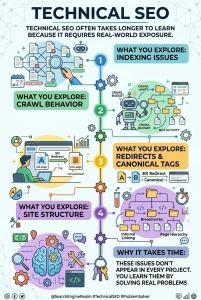
Technical SEO often takes longer to learn because it requires real-world exposure.
What you explore:
- indexing issues
- crawl behavior
- redirects and canonical tags
- site structure
Why it takes time:
These issues don’t appear in every project. You learn them by solving real problems.
Stage 4: Off-Page SEO and Authority (Month 6–12)
At this stage, you understand how websites build credibility.
Key topics:
- backlinks and authority
- trust signals
- content reputation
Important insight:
Links matter, but they are not always the main factor. Content quality and structure often play a bigger role.
Stage 5: Building SEO Judgment (Year 1–2)
This is where real growth happens.
Instead of just following rules, you start making decisions based on:
- context
- priorities
- trade-offs
Example:
Knowing when to update content versus when to leave it unchanged.
This stage is what separates beginners from experienced practitioners.
A Simple SEO Learning Framework
To learn SEO effectively, follow this process:
- Learn the basics
- Apply them to a real project
- observe results over time
- make small improvements
- repeat the process
This cycle helps turn knowledge into skill.
How Search Intent Shapes SEO Learning
Understanding search intent is essential.
Types of intent include:
- informational
- navigational
- transactional
When your content matches intent:
- rankings improve
- engagement increases
- learning becomes clearer
Common Mistakes When Learning SEO
1. Rushing the Process
Trying advanced strategies too early leads to confusion.
2. Relying Only on Tools
Tools provide data, but interpretation matters more.
3. Ignoring Real Projects
Practice is essential for learning.
4. Expecting Immediate Results
SEO requires patience.
How Many Hours Per Day to Learn SEO?
Consistency matters more than time.
- 1–2 focused hours daily → steady progress
- regular practice → better understanding
Spending time analyzing results is more valuable than just reading guides.
FAQs
1. How long does it take to learn SEO from scratch?
Most people learn basics in 1–3 months and practical skills in 6–12 months.
2. Can I learn SEO in 3 months?
Yes, you can learn fundamentals, but not advanced skills.
3. Is SEO difficult to learn?
The concepts are simple, but applying them correctly takes time.
4. Do I need technical skills to learn SEO?
Basic knowledge helps, but you can start without advanced technical skills.
5. Can I learn SEO without a website?
You can learn theory, but practical experience requires real projects.
6. How long before I see results from SEO?
Results often take weeks or months, depending on competition and strategy.
7. What is the fastest way to learn SEO?
Combine learning with real practice and consistent testing.
Conclusion
Understanding how long does it take to learn SEO is less about finding a fixed timeline and more about setting realistic expectations. There isn’t a single point where you can say you’ve “finished” learning SEO. Instead, it’s an ongoing process where each stage builds on the last.
From experience, SEO learning is gradual. It starts with basic knowledge, grows through practical application, and improves with consistent observation. In the beginning, you focus on understanding concepts like keywords, search intent, and on-page optimization. As you apply these ideas to real websites, you begin to notice patterns—what works, what doesn’t, and why certain changes take time to show results. The process may feel slow at first, but it becomes more predictable as you gain experience.
The key is consistency. Small improvements, repeated over time, lead to meaningful progress. For example, updating content, refining internal links, or improving page structure may seem minor individually, but together they build a stronger foundation.
Instead of focusing on speed, it’s more useful to focus on understanding how search engines and users interact with content. When you develop that understanding, decision-making becomes easier, and your SEO efforts become more effective and sustainable over time.