

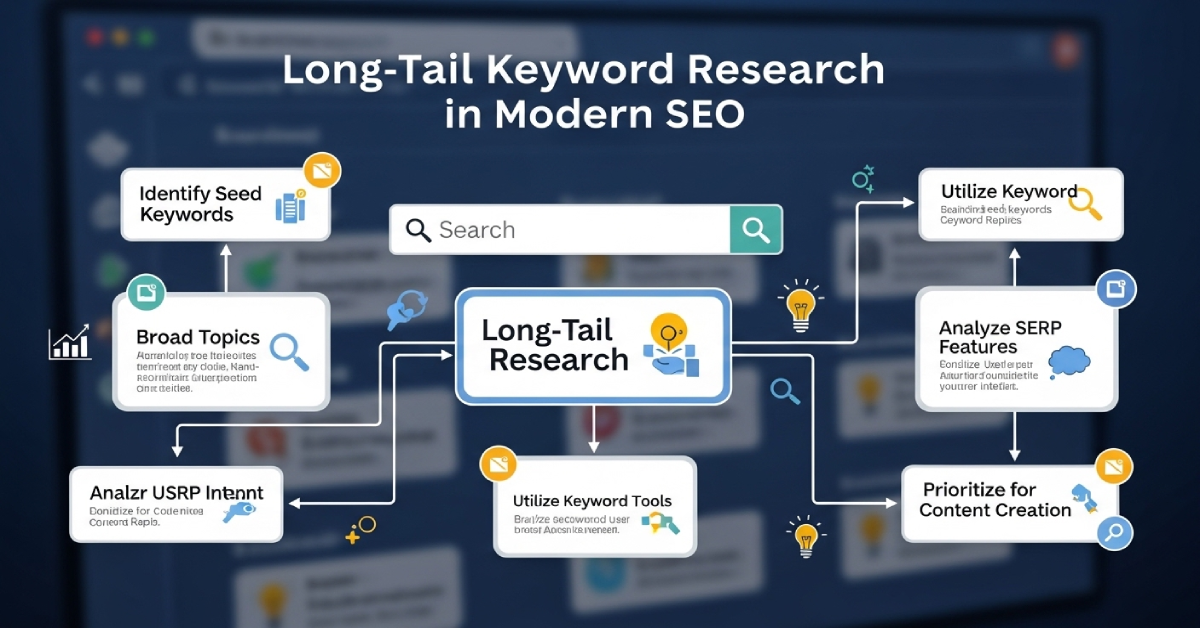
Long-tail keywords are longer, more specific search phrases that usually have lower search volume but higher conversion potential. Instead of targeting “running shoes,” you’d target “best running shoes for flat-footed women”—a long-tail keyword.
For most websites, especially newer ones, long-tail keywords are the fastest path to ranking on Google. They’re less competitive, more specific, and often bring visitors who know exactly what they want.
This guide explains what long-tail keywords are, why they matter, and how to find them—even with free tools.
I’m Zohanuddin Shaikh, an SEO consultant based in Karachi, Pakistan. I’ve worked in SEO for 8 years, and long-tail keywords have been the foundation of ranking strategies for almost every new site I’ve worked on. You can read more about my background on the About Us page.
What Are Long-Tail Keywords?
Long-tail keywords are search queries that are longer and more specific than common “head” keywords. They typically contain 3 or more words and target a narrow, specific intent.
The name “long-tail” comes from the search demand curve. A few keywords get massive search volume (the “head”), while millions of specific keywords each get small amounts of traffic (the “long tail”).
When you add up all those small-volume long-tail keywords, they actually account for the majority of all searches on Google — around 70% of all search traffic.
Head Keywords vs Long-Tail Keywords
Here’s a clear side-by-side comparison:
Keyword Type |
Example |
Search Volume |
Competition |
|
Head keyword |
“shoes” | Very high | Very high |
|
Body keyword |
“running shoes” | High |
High |
| Long-tail keyword | “best running shoes for flat feet” | Low |
Low |
The name “long-tail” comes from the search demand curve. A few keywords get massive search volume (the “head”), while millions of specific keywords each get small amounts of traffic (the “long tail”).
When you add up all those small-volume long-tail keywords, they actually account for the majority of all searches on Google — around 70% of all search traffic.
Why Long-Tail Keywords Matter
Long-tail keywords offer several advantages, especially for newer or smaller websites.
1. Lower Competition
Big websites compete fiercely for head keywords like “SEO” or “marketing.” A new site has almost no chance of ranking for these. But long-tail keywords like “SEO tips for Pakistani small businesses” face far less competition.
2. Higher Conversion Rates
Long-tail searchers usually know what they want. Someone searching “buy Nike Air Zoom Pegasus size 9” is much closer to purchasing than someone searching “shoes.” Specific queries mean specific intent.
3. Easier to Rank
For new websites without much authority, long-tail keywords are often the only realistic path to page 1. You can rank for dozens of long-tail keywords while building authority to eventually compete for bigger terms.
4. Better Content Focus
Long-tail keywords force you to create focused, specific content that genuinely answers a question. This naturally produces better content than vague articles targeting broad keywords.
5. Voice Search Optimization
Voice searches are naturally long-tail. People speak in full sentences: “Hey Google, what’s the best budget smartphone under 30000 rupees?” Optimizing for long-tail keywords helps capture voice search traffic.
How to Find Long-Tail Keywords (Free Methods)
You don’t need expensive tools to find long-tail keywords. Here are practical free methods. I use:
Method 1: Google Autocomplete
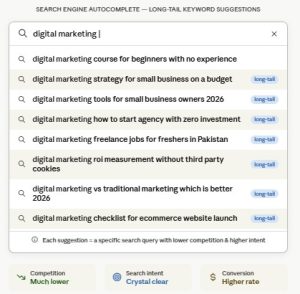
The simplest method. Start typing your topic in Google’s search bar and watch the suggestions appear.
- Open Google (incognito mode for unbiased results)
- Type your main keyword
- Note all autocomplete suggestions
- Add letters (a, b, c…) after your keyword for more variations
- Add words like “best,” “how,” “for” to get more
Method 2: People Also Ask
The “People Also Ask” box on Google shows real questions people search.
- Search your main keyword
- Find the “People Also Ask” box
- Note the questions (these are long-tail keywords)
- Click “questions” to reveal more related questions
These question-based long-tail keywords are perfect for FAQ sections and blog posts.
Method 3: Google Related Searches
Scroll to the bottom of any Google results page to find “Related searches.”
- Search your keyword
- Scroll to the page bottom
- Note the 8 related searches shown
- Click any related search to find more
These are keywords Google itself associates with your topic.
Method 4: AnswerThePublic
This free tool (with limited daily searches) visualizes questions and phrases around your keyword.
- Go to AnswerThePublic.com
- Enter your main keyword
- Get questions, prepositions, and comparisons
- Export the long-tail keyword ideas
Method 5: Reddit and Forums
Real people ask real questions on Reddit, Quora, and niche forums. These questions are goldmines for long-tail keywords.
- Search “[your topic] reddit” on Google
- Read through relevant threads
- Note the specific questions people ask
- Turn those questions into content
This method finds long-tail keywords that tools often miss.
How to Use Long-Tail Keywords in Content
Finding long-tail keywords is only half the work. Using them effectively matters more.
Place Keywords Naturally
Use your long-tail keyword in the page title (H1), at least one subheading (H2 or H3), the first 100 words, the meta description, naturally throughout the content, and image alt text. But never force keywords. Write for humans first, then optimize.
Match Search Intent
Make sure your content matches what the searcher wants. If someone searches “how to fix slow WordPress site,” they want a tutorial, not a product page. Always check the search intent behind your long-tail keyword.
Create Comprehensive Content
Even though long-tail keywords are specific, your content should thoroughly answer the question. A 1,500-word article that completely answers a specific question beats a 300-word thin page.
Group Related Long-Tail Keywords
Often, multiple long-tail keywords can be answered in one article. For example, “best budget laptop for students,” “cheap laptop for college,” and “affordable student laptop” can all be covered in one comprehensive article. This is more efficient than creating separate thin pages for each variation.
Long-Tail Keyword Mistakes to Avoid
After 8 years in SEO, here are mistakes I see repeatedly:
Creating Too Many Thin Pages
Some people create a separate 300-word page for every long-tail keyword variation. This creates thin content that Google doesn’t value. Instead, group similar keywords into comprehensive articles.
Ignoring Search Intent
Targeting a long-tail keyword without checking what searchers actually want leads to content that doesn’t rank. Always look at what’s currently ranking for that keyword.
Keyword Stuffing
Repeating your long-tail keyword unnaturally throughout content hurts readability and rankings. Use it naturally where it fits.
Choosing Zero-Volume Keywords
Some long-tail keywords are so specific that nobody searches them. Verify there’s at least some search interest before creating content.
Only Targeting Long-Tail Forever
Long-tail keywords are great for building initial traffic and authority. But don’t ignore your growth toward more competitive terms as your site gains authority.
For more on how I approach content quality, see my Editorial Team page.
Long-Tail Keywords and Topical Authority
Long-tail keywords play a key role in building topical authority—Google’s measure of how knowledgeable your site is on a topic.
When you create comprehensive content covering many long-tail keywords within a topic, Google recognizes your site as an authority. This connects directly to semantic SEO and topic clusters.
For example, if you cover dozens of specific long-tail keywords about “WordPress SEO,” Google starts seeing your site as a WordPress SEO authority. This helps you rank for both the long-tail keywords AND eventually the more competitive head keywords.
For a deeper understanding of this approach, see my guide on semantic keyword research.
FAQs
What is a long-tail keyword?
A long-tail keyword is a longer, more specific search phrase, usually 3 or more words, that has lower search volume but more specific intent. For example, “running shoes” is a head keyword, while “best running shoes for flat-footed women” is a long-tail keyword. They’re easier to rank for and often convert better.
Why are they called long-tail keywords?
The name comes from the search demand curve. A small number of popular keywords get massive search volume (the “head”), while millions of specific, low-volume keywords form a long “tail” on the graph. Together, these long-tail keywords account for about 70% of all searches.
Are long-tail keywords easier to rank for?
Yes, generally. They have less competition because fewer websites target them specifically. For new or smaller websites without much authority, long-tail keywords are often the most realistic path to ranking on page 1 of Google.
How many words is a long-tail keyword?
These keywords typically contain 3 or more words, though there’s no strict rule. The defining characteristic is specificity and lower search volume, not just word count. “Cheap flights to Dubai from Karachi” is a long-tail keyword regardless of exact word count.
Do long-tail keywords get traffic?
Yes. While each individual long-tail keyword gets low search volume, they collectively account for the majority of all searches. A site ranking for hundreds of long-tail keywords can get substantial total traffic, often more than ranking for a few competitive head terms.
How do I find long-tail keywords for free?
Use Google Autocomplete (type your keyword and note suggestions), People Also Ask boxes, Google Related Searches at the page bottom, AnswerThePublic’s free tier, and Reddit/Quora questions. These free methods provide plenty of long-tail keyword ideas without paid tools.
Should I create separate pages for each long-tail keyword?
Usually no. Many similar long-tail keywords share the same intent and can be covered in one comprehensive article. Creating separate thin pages for each variation often creates low-value content. Group related keywords into thorough, valuable articles instead.
What’s the difference between long-tail and short-tail keywords?
Short-tail (or head) keywords are broad, 1-2 word terms with high search volume and high competition (like “shoes”). They are specific, 3+ word phrases with lower volume but lower competition and clearer intent (like “waterproof hiking shoes for women”). Long-tail keywords are usually easier to rank for.
Do long-tail keywords help with voice search?
Yes. Voice searches are naturally long-tail and conversational. People speak full questions like “What’s the best pizza place near me that’s open now?” Optimizing for long-tail, question-based keywords helps capture this growing voice search traffic.
How do long-tail keywords convert better?
Long-tail searchers usually have clearer, more specific intent. Someone searching “buy iPhone 15 Pro 256GB blue” is much closer to purchasing than someone searching “phones.” This specific intent means long-tail keywords often have higher conversion rates despite lower traffic.
Final Thoughts on Long-Tail Keywords
Long-tail keywords remain one of the most effective SEO strategies in 2026, especially for newer websites and smaller businesses competing against established players.
The key takeaways are specific, lower-competition phrases; they’re easier to rank for than head keywords; they often convert better due to specific intent; free tools are enough to find them; you should group similar keywords into comprehensive content; and they build topical authority over time.
Start by targeting long-tail keywords relevant to your audience, create genuinely helpful content, and build authority gradually. Over time, you’ll rank for both long-tail keywords and the more competitive terms.
All information in this article has been verified against current SEO practices. For more on how I verify information, see my Fact-Checking Policy.
If you have questions about finding long-tail keywords for your specific niche, feel free to reach out via my contact page. I respond to legitimate questions within 48 hours. If you spot any factual errors in this guide, please let me know—I aim to verify and correct errors promptly, as detailed in my Correction Policy.
For more SEO guides, browse the rest of Search Engine Realm.
Last Updated: May 22, 2026