

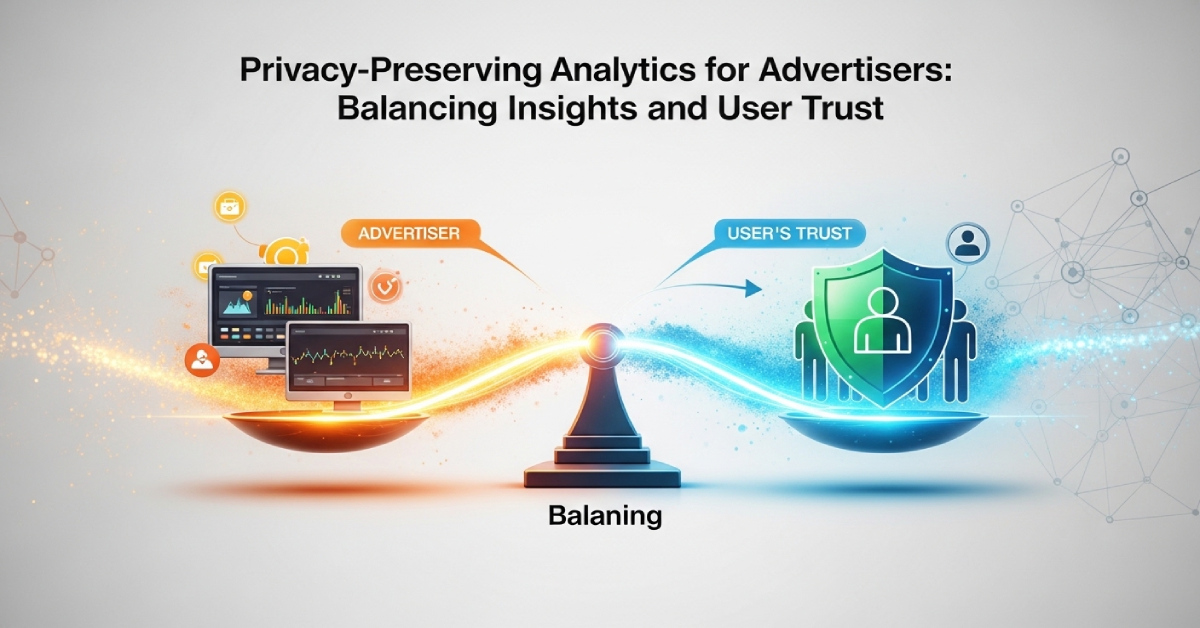
Analytics was the most steady part of SEO job for a long time. You crawled, improved, published, measured, and made changes. It was easy to see that loop coming. That same loop is now noisy, incomplete, and, in some instances, even deceptive because of Privacy-Preserving Analytics, which is changing how data is collected and understood.
I see this happen virtually every week in actual audits. Search Console shows that traffic is good and rankings haven’t dropped, but it’s not apparent where conversions are coming from. The number of sessions doesn’t match up between platforms. Insights about the audience don’t feel very deep. When advertisers start to wonder whether SEO is “still working,” the true difficulty isn’t exposure; it’s measuring under stricter privacy rules.
This is when Privacy-Preserving Analytics really comes in handy. Not as a term, but as a reaction to a measuring approach that doesn’t work anymore. Browser-level limits, permission frameworks, regional data regulations, and AI-driven data management have all silently chipped away at conventional analytics. Even if rankings stay the same, SEO choices become riskier as measurement becomes worse.
This isn’t about getting rid of analytics tools. It’s about knowing how analytics works differently today and how marketers and SEOs need to change their expectations and processes without breaking trust or the law.
What privacy-preserving analytics actually means (in practice)
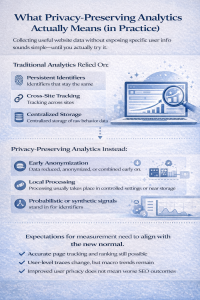
Privacy-preserving analytics is all about getting information without explicitly showing specific user data. That seems easy until you try to do it.
Traditional analytics depended on the following:
- Identifiers that stay the same
- Tracking across sites
- Centralised storage of raw behaviour data
Privacy-preserving analytics changes that model:
- Data is reduced, anonymized, or combined early on.
- Processing usually takes place in controlled settings or close to where the data is stored.
- Probabilistic or synthetic signals take the role of identifiers.
- This doesn’t affect whether SEO works, but it does change what you can reliably measure.
I’ve seen sites freak out during audits when user-level routes go missing. But the ranks stayed the same. The frequency of crawling didn’t change. Indexation remained strong. The problem was that expectations for measurements were not in line with reality.
How privacy-preserving analytics works under the hood
Most systems rely on a mix of privacy-enhancing technologies rather than a single method.
Common mechanisms include:
Data minimization and anonymization
Instead of storing full datasets, systems strip identifiers early. This reduces exposure but also removes granularity. You gain safety and lose detail.
Differential privacy
Noise is intentionally added to datasets. Individually, the data becomes fuzzy. At scale, patterns remain usable. This is common in aggregated reporting.
Federated learning
Data stays on the device or local environment. Models learn from patterns, not raw data. I’ve seen this used in personalization systems tied loosely to SEO landing pages.
Secure multiparty computation
Multiple parties compute insights together without sharing raw data. Useful in cross-platform analytics, but complex to deploy.
Confidential computing
Processing happens in isolated hardware environments. This is increasingly relevant for secure AI training on private data.
None of these are perfect. Each introduces trade-offs SEOs need to understand before blaming “SEO performance.”
Privacy-preserving analytics vs traditional analytics: the real differences
| Dimension | Traditional Analytics | Privacy-Preserving Analytics |
|---|---|---|
| Data Granularity | High granularity with detailed user-level tracking | Lower granularity with aggregated or reduced data |
| Attribution Model | Strong attribution chains across sessions and devices | Probabilistic attribution using modeled signals |
| User Identification | Persistent identifiers (cookies, device IDs) | Identifiers minimized or replaced with statistical signals |
| Privacy Risk | Higher privacy exposure and regulatory concerns | Designed to reduce privacy risks |
| Compliance & Regulation | Increasing legal friction (GDPR, platform restrictions, browser limits) | Stronger compliance posture with privacy-first design |
| Measurement Style | Precision-focused measurement | Interpretation-focused measurement |
| Data Collection Model | Centralized storage of raw behavioral data | Early anonymization, aggregation, and local processing |
| Decision Framework | Session-level certainty and detailed user journeys | Trend-based insights and directional analysis |
| Practical Limitation | Increasingly restricted by browsers and platforms | Less precise but more sustainable long-term |
What This Means for SEO Decisions Today
Modern SEO analysis increasingly relies on:
| Modern SEO Measurement Approach |
|---|
| Trend validation rather than exact user paths |
| Directional confidence instead of perfect attribution |
| Cross-signal correlation using logs, rankings, and crawl data |
Key Takeaway
Expecting session-level certainty in modern analytics environments is unrealistic.
Successful SEO teams now focus on patterns, correlations, and trends rather than perfect tracking.
What I often see going wrong in audits
This is where theory meets reality.
1. Misinterpreting data loss as SEO decline
Traffic looks “lower” because tracking changed, not because rankings dropped. Search Console often tells a different story.
2. Mixing privacy-safe and legacy analytics
Some pages use modern consent-aware tracking, others don’t. The result is inconsistent reporting and bad decisions.
3. Over-correcting content strategy
Teams rewrite or remove content based on incomplete data. I’ve seen strong pages killed because attribution looked weak under new models.
4. Ignoring server-side signals
Log files, crawl behavior, and indexation patterns matter more now. Many teams still don’t look at them.
Privacy-preserving machine learning and SEO measurement
Machine learning now underpins many analytics platforms. The question is how privacy is maintained during training.
Key techniques include:
-
Training on anonymized or synthetic datasets
-
Federated learning models
-
Confidential computing environments
-
Secure data sharing agreements
From an SEO angle, this affects:
-
Audience modeling
-
Conversion prediction
-
Content performance forecasting
The models are less precise individually, but often more stable over time.
Synthetic data: useful, but not magic
Synthetic data is often pitched as a fix-all. In practice, it’s a supplement.
I’ve seen synthetic datasets help with:
-
Trend simulation
-
Scenario planning
-
Testing attribution models
But synthetic data cannot replace real crawl signals, ranking data, or indexing feedback. It reflects assumptions. If those assumptions are wrong, conclusions drift.
Use it carefully.
Federated analytics vs centralized analytics
Federated analytics reduces privacy risk but increases complexity.
Pros
-
Strong privacy posture
-
Local data control
-
Better compliance alignment
Cons
-
Slower insights
-
Harder debugging
-
Limited cross-site correlation
For large advertisers with multiple domains, this trade-off must be intentional. I’ve seen migrations fail because teams underestimated operational overhead.
Industry-specific realities
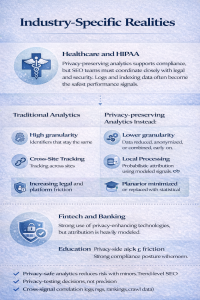
Healthcare and HIPAA
Privacy-preserving analytics supports compliance, but SEO teams must coordinate closely with legal and security. Logs and indexing data often become the safest performance signals.
Fintech and banking
Strong use of privacy-enhancing technologies, but attribution is heavily modeled. SEO success is often judged by visibility and engagement proxies.
Education
Privacy-safe analytics reduces risk with minors. Trend-level SEO reporting becomes the norm.
A practical decision framework I use
When advising advertisers, I ask:
-
What decisions actually require precision?
-
Which metrics are directional, not exact?
-
What data creates legal or trust risk?
-
Where can server-side or crawl data fill gaps?
-
What can we stop measuring without harming SEO decisions?
This reframes analytics as decision support, not surveillance.
How to implement privacy-preserving analytics without breaking SEO
From experience:
-
Start with consent-aware measurement
-
Validate SEO performance through Search Console and crawl logs
-
Accept attribution uncertainty early
-
Document data limitations clearly
-
Align analytics changes with content and technical releases
Trying to retrofit privacy later is painful.
FAQs
1. What is privacy-preserving analytics?
It’s a set of methods that allow insight extraction without exposing individual user data directly.
2. How does privacy-preserving analytics affect SEO reporting?
It reduces granularity but improves compliance and long-term trust. SEO relies more on trends than exact paths.
3. Is privacy-preserving analytics required for compliance?
Often yes, especially under GDPR and emerging AI regulations, depending on implementation.
4. Does this reduce advertising effectiveness?
It changes attribution models, not necessarily performance. Interpretation becomes more important.
5. Can privacy-preserving analytics replace traditional tools?
In many cases, yes—but only if teams adjust expectations and workflows.
Conclusion
Privacy-preserving analytics isn’t about giving up insight or flying blind. It’s about learning to work with a different class of signals. SEO hasn’t stopped functioning just because measurement has changed. Rankings still respond to relevance and technical quality. Crawl behavior still tells you whether Google can access, understand, and prioritize your pages. Indexation patterns still reveal structural problems long before traffic graphs do. What’s changed is the level of certainty you can attach to individual user actions and conversion paths.
In practice, this forces a shift in how SEO decisions are made. You can no longer rely on one dashboard or one attribution model to explain performance. Instead, you correlate multiple imperfect signals—Search Console trends, crawl logs, index coverage, query patterns, and page-level visibility—to reach a conclusion that’s directionally sound, even if it isn’t mathematically precise. That’s uncomfortable for teams used to clean numbers, but it’s closer to how search actually works.
The teams that adapt fastest aren’t trying to rebuild the old analytics world under new rules. They accept its limits. They design measurement systems that respect user privacy, hold up under regulatory scrutiny, and still provide enough clarity to guide SEO strategy. That ability to balance insight with trust isn’t optional anymore. It has become a core part of technical SEO, whether we like it or not.