


I believe that many people associate SEO copywriting with just loading content with keywords or generating persuasive prose. It goes far further than that, based on my observations of genuine SEO work.
Pages that do not index properly, rankings that vary for no apparent reason, or traffic that does not convert into meaningful engagement are all indicators that something is wrong.
Even with a strong technological foundation, such as fast load times, clear structure, and suitable indexing, I’ve seen sites’ performance stagnate. The copy was often the determining element. I don’t believe it was poorly written, but it didn’t express the desired meaning, purpose, or relevance.
Search engines do more than merely analyze content at face value. They decode the messages. Many of these indications are derived from the material’s structure and wording.
What SEO Copywriting Really Means
The objective of search engine optimization copywriting is to create material that search engines can readily understand and confidently rank.
According to my experience, it is critical that each page answers three main questions:
- Give me a breakdown of this website.
- Please inform me who this is for.
- How does it link to the rest of the website?
When queries like these lack clarity, the results are unpredictable.
Pages that try to do too much at once are a common issue. An instructive article that converts into a sales page is one example, as is a landing page that provides extensive instructional content. It delivers the incorrect message.
While search engines may be reticent to penalize this behavior, it is not always the case. When individuals are reluctant, the rankings may become unstable.
Why SEO Copywriting Impacts Rankings
SEO copywriting directly influences how search engines read your site.
Well-structured material benefits search engines:
- Understand the key theme.
- Identify relevance to search queries.
- Assess the page’s fit inside the site
- Ensure it meets user intent.
When material is confusing or excessively broad, search engines struggle to rank it accurately.
This is why clarity typically outperforms complexity.
SEO Copywriting and Indexing
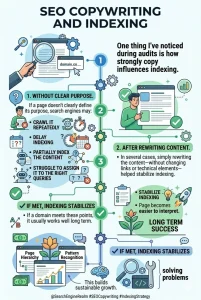
One thing I’ve noticed during audits is how strongly copy influences indexing.
If a page doesn’t clearly define its purpose, search engines may
- crawl it repeatedly
- delay indexing
- partially index the content
- struggle to assign it to the right queries
In several cases, simply rewriting the content—without changing links or technical elements—helped stabilize indexing.
This happens because the page becomes easier to interpret.
The Role of Semantic SEO in Copywriting
Semantic SEO is often misunderstood.
It’s not about adding as many related keywords as possible. It’s about choosing the right focus.
A common mistake is trying to cover too many topics in one page. For example, a page about SEO copywriting might also include deep sections on
- content marketing
- technical SEO
- AI tools
- conversion optimization
Each of these topics can be valuable, but combining them without structure creates confusion.
A better approach is the following:
- define one clear primary topic
- support it with relevant subtopics
- avoid unnecessary overlap
This keeps the page focused and easier to rank.
Common SEO Copywriting Mistakes
From experience, these issues appear frequently:
1. Trying to rank for too many keywords
Pages lose clarity when they attempt to target multiple intents at once.
2. Over-optimization
Forcing keywords into content often reduces readability and doesn’t improve rankings.
3. Lack of structure
Poor headings and organization make it harder for both users and search engines to follow the content.
4. AI-generated content without editing
AI can help with drafting, but without human direction, it often introduces vague or repetitive sections.
5. Misalignment with internal linking
If a page claims authority but isn’t supported by internal links, search engines may treat it differently.
A Simple SEO Copywriting Framework
When writing or reviewing content, I use a simple framework:
- Can the page be summarized in one sentence?
- Does the introduction match the search intent?
- Do headings support the same topic?
- Is the content consistent throughout?
- Does the page have a clear role on the site?
If any of these are unclear, the content usually needs refinement.
Writing SEO Copy for LLMs and AI Search
Modern search is evolving. AI systems now play a role in how content is discovered and summarized.
To make SEO copywriting effective in this environment:
- use clear and direct language
- avoid unnecessary complexity
- keep terminology consistent
- structure content logically
- answer questions directly
AI systems tend to favor content that is easy to interpret and well-organized.
This doesn’t mean writing for machines—it means reducing ambiguity.
How SEO Copywriting Improves Performance Over Time
Good SEO copywriting doesn’t always create instant results, but it improves consistency.
Over time, you may notice:
- more stable rankings
- better indexing behavior
- improved user engagement
- clearer topic authority
- less need for constant updates
This happens because search engines better understand your content and trust it more.
FAQs
1. What is SEO copywriting?
SEO copywriting is the process of writing content in a way that clearly communicates its purpose, relevance, and value to search engines while remaining useful to readers.
2. Is SEO copywriting different from content writing?
Yes. Content writing focuses on readability and engagement, while SEO copywriting also considers how search engines interpret structure, intent, and context.
3. Does SEO copywriting require keywords?
Keywords still matter, but they should be used naturally. Clarity and intent are more important than repetition.
4. Can SEO copywriting improve rankings without backlinks?
In many cases, yes—especially for less competitive topics. Clear and focused content can help pages perform better even without strong link signals.
5. Does AI replace SEO copywriting?
No. AI can assist with drafting, but human input is needed to define intent, structure, and strategy.
6. Why do some pages not rank despite good content?
Often, the issue is unclear intent or mixed signals. SEO copywriting helps resolve this by making the page’s purpose more obvious.
7. How long does SEO copywriting take to show results?
It varies. Some improvements appear within weeks, especially in indexing and clarity, while others take longer depending on competition.
Conclusion
It’s not about clever wording or keyword placement. It’s about clarity.
From experience, the sites that perform consistently are not necessarily the ones with the most content but the ones where every page has a clear purpose. Each piece of content supports a defined topic, and nothing feels confusing or out of place.
When SEO copywriting is done well, the results are gradual but stable. Pages become easier to index, rankings fluctuate less, and content aligns more closely with what users are actually searching for.
Instead of trying to impress with complexity, effective SEO copywriting focuses on making things easier to understand—for both users and search engines.
That clarity is what builds long-term performance.