


For a long time, it was rather easy to determine out what was wrong with SEO until retrieval augmented generation came along. Google either couldn’t crawl a page, couldn’t index it properly, or simply didn’t think it was worth ranking. When performance dropped, it was usually straightforward to pinpoint the cause. Server logs, index coverage reports, gaps in internal linking, or obvious content errors almost always indicated what was wrong.
That clarity has started to fade over the last year or two.
In audits, I frequently find sites that are completely crawlable, indexed, technically clean, and relevant to the topic, but they don’t show up where you think they should. At the same time, other sites that aren’t as well optimized come up in search results where they shouldn’t. This isn’t random or shaky. It indicates a bigger change in how relevance is determined.
This is where retrieval-augmented generation becomes important for SEO. It’s not simply a trend in AI; it’s a shift in how information is selected before ranking signals are applied. As retrieval algorithms become more semantic, layered, and aware of context, previous concepts about targeting keywords, covering a wide range of subjects, and even site structure start to break down.
You need to know about this change if you are in charge of search performance today. It directly affects why certain pages are seen as important and others are quietly left out.
What Retrieval Augmented Generation actually is (without the hype)
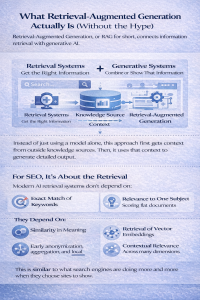
RAG, which stands for retrieval-augmented generation, is a combination of two systems that used to function on their own.
Systems for getting the proper information back
Generative systems that mix or illustrate that data
In short, the system doesn’t only employ a trained model to come up with answers. Instead, it first takes context from a source of information and then utilizes that context to generate output.
The most important element for SEO is not the generation. It’s the getting back.
The following things don’t matter to modern AI retrieval systems:
- Exact match of the words.
- Related to one topic’
- Scoring flat papers’
- They rely on: Similarity in connotation.
- Getting vector embeddings back.
- Contextual significance in a lot of different ways.
This is like what search engines are doing more and more when they choose which sites to display.
Why semantic retrieval changes how SEO actually works
If a page is conventional SEO, it believes that:
- Well-optimized.
- It’s clear that it’s significant.
- It will at least be in the running for the ranking if it has internal support.
That concept is not true when it comes to semantic retrieval.
In systems that employ retrieval first, pages could be left out long before ranking signals are applied. A page will never be looked at, no matter how well it is linked or put up technically, if its semantic representation doesn’t fit the query context.
I’ve seen this happen on sites that have a lot of material. Pages that try to answer more than one question at a time usually don’t load correctly. In the meanwhile, pages that are smaller and have clearer semantic borders are becoming common.
The article is OK; this isn’t an issue with it. It’s hard to get things back.
From lexical search to neural retrieval models
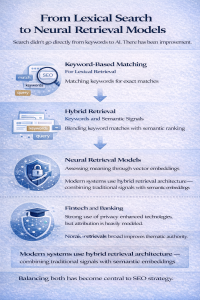
Search didn’t move straight from keywords to AI. Things have gotten better.
- Keyword-based matching for lexical retrieval
- Hybrid retrieval: keywords and signals that mean something
- Neural retrieval models: similarity based on vectors
More and more current systems use a hybrid retrieval architecture, which mixes classical signals with semantic embeddings. That means that your stuff is being looked at in more than one way at the same time.
From an SEO point of view, this makes things tense:
- Broad content makes a theme more authoritative.
- Narrow content makes it easier to find the right information.
Finding a balance between the two is one of the hardest parts of SEO strategy right now.
What commonly goes wrong in real audits
This is where I think most sites have trouble.
1. Pages that are too busy and don’t have a clear semantic emphasis
Pages attempt to rank for too many things at once. When you use semantic retrieval, this generally gives you a lot of weak signals instead of one powerful one.
2. Content clusters that don’t have a defined order
Topical clustering is good for people, but retrieval systems still need to be clear. If every page seems equally significant, none of them will come up neatly.
3. Thin content that supports
RAG-style retrieval works best with significant context. Pages that are too thin don’t have enough semantic depth to be chosen.
4. Internal linkages that make things less clear
Internal anchors that frame the same page differently on various parts of the site might make it hard to understand what they mean.
A real audit scenario
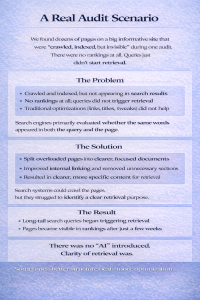
During one audit, we uncovered dozens of pages on a large informational site that were “crawled, indexed, but invisible.” There were no ranks at all. Queries merely didn’t start the retrieval.
It didn’t work with more links or better titles. We split several pages that were overly full into clearer ones based on what they were supposed to do. We also made the links between pages stronger and got rid of parts that weren’t essential. Within weeks, the sites started to come up again for long-tail searches.
There was no “AI” added. It was clear how to get it back.
How Retrieval Augmented Generation mirrors modern search behavior
Search engines are moving toward systems that:
- Get context right now
- Check for meaning relevance
- Don’t put too much stock in rankings that don’t change
This is like a knowledge base and LLM setup, where retrieval leads to creation. Even when Google doesn’t provide you an answer right away, it’s using retrieval logic to find out what is important.
That’s why:
- Even after optimization, several pages still appear to be hidden.
- Some people come to ask questions that aren’t expected.
- Things go worse more fast.
Retrieval is now the gatekeeper.
The role of vector embedding retrieval in SEO
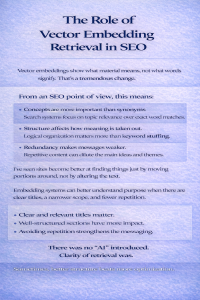
Vector embeddings reveal what things mean, not what words imply. That’s a huge difference.
From an SEO point of view, this means:
- Ideas are more significant than words that mean the same thing.
- The way something is structured impacts how meaning is pulled out.
- Messages are less clear when they are redundant.
I’ve seen that sites can find things better merely by shifting things around, not by changing the wording. When there are clear names, a limited scope, and less repetition, embedding systems can better comprehend what they are for.
Contextual data retrieval vs static relevance
Static relevance is a good fit for traditional SEO. Semantic retrieval works best when it fits with the situation.
That difference is what makes:
- The same site will show up in different searches over time.
- Changes in rankings happen without any clear reason.
- Freshness and relevance don’t mean the same thing.
The situation changes. Changes to retrieval
Memory-driven generation and its SEO implications
Some RAG systems employ memory-driven generation, which implies that how information is retrieved is based on past experiences. Google doesn’t state this directly, but behavior indications and patterns of interaction are becoming increasingly crucial in what it finds.
This makes SEO stronger:
- Signs of persistent happiness
- Clearly in line with what the user wants
- Not using names that are misleading
Low engagement doesn’t only hurt your rankings; it could also make it harder for you to find information.
How this changes content strategy (practically)
There are certain tendencies that are beginning to show up in the work:
- It’s preferable to have fewer, clearer pages than a lot of coverage.
- Deep content is what supports has to be.
- Internal links should do more than just show that you are an expert.
- Technical SEO is still vital, but making it easy to find is even more crucial.
This doesn’t mean you should stop becoming an expert on the subject. Things entail putting things in order.
A practical diagnostic framework
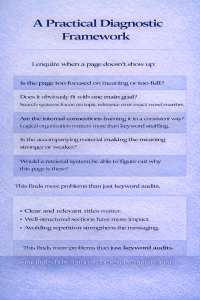
When a page doesn’t come up, I ask:
- Is the page overly crowded or too focused on meaning?
- Is it clear that it fits with one key goal?
- Are the internal links framing it in a manner that makes sense?
- Does the extra content make the message stronger or weaker?
- Could a retrieval system figure out why this site exists?
This identifies more errors than merely checking keywords.
Trade-offs SEOs need to accept
Semantic retrieval isn’t friendly to:
-
Mass content scaling
-
Keyword permutations
-
Shallow clustering
It favors:
-
Precision
-
Intent clarity
-
Strong contextual signals
That’s uncomfortable, especially for sites built on volume.
FAQs
1. In SEO, what does “Retrieval Augmented Generation” mean?
It means systems that use retrieval first, where semantic relevance decides whether material is even looked at before ranking.
2. Is RAG better than regular SEO?
No, it doesn’t affect whether SEO basics important; it changes how relevance is measured.
3. Why do certain sites cease ranking even when there are no errors?
They may not be able to get cleanly for the query context anymore.
4. Is it still effective to optimize keywords?
Yes, but only as a second signal. Semantic alignment is more important.
5. Can connecting to other pages on your site influence semantic retrieval?
For sure. Internal context has a big impact on how meaning is extracted.
Conclusion
Retrieval Augmented Generation (RAG) doesn’t make SEO meaningless, and it doesn’t get rid of the core things that most sites still require. What it does is make search far more selective earlier on. Pages don’t only fight for authority, link signals, and on-page optimization anymore. They argue over whether their message is clear enough to be found. Semantic clarity is no longer a nice thing to have; it’s a need.
This affects the key question that SEO professionals ask in real life. “Why would a retrieval system choose this page in the first place?” is a better question than “How do I rank this page higher?” That’s a little change in how you think, but it makes a significant difference. Before ranking signals are utilized, pages that have too much content, don’t make their goal clear, or have a structure that isn’t clear often fail. Even without deliberate optimization, pages that are focused, well-organized, and have support from inside tend to come up more frequently.
I’ve seen sites that keep their search exposure stable by not providing more content but instead doing less with more purpose. Cleaning up the internal context, cutting down on overlap, and making the goal clearer can do more than adding more pages. Sites that continually striving to become larger without addressing retrieval clarity often have flaws that aren’t obvious and don’t need to be corrected.
The future of search isn’t just about obtaining better answers. It’s important to choose the right sources to reply to. Today, such selection procedure happens at the retrieval layer. That’s when the real SEO decision begins to be made.