


For years, AdSense compliance followed a predictable path. As long as publishers avoided scraped pages, misleading layouts, and obvious policy violations, revenue stayed relatively stable. SEO teams focused on search rankings, while monetization teams tracked ad layouts and RPMs. The two disciplines rarely overlapped, and of course, AI-generated content wasn’t part of the conversation yet.
That balance shattered once AI writing tools became mainstream and widely accessible.
Over the past year, I’ve audited multiple sites that looked perfectly healthy on paper. They boasted technically clean setups, solid organic visibility, and zero manual actions in Google Search Console. Yet, without warning, they lost their AdSense approval or faced heavily limited ad serving. Why? The common thread wasn’t poor page speed, toxic backlinks, or bad keyword targeting. Instead, the issue traced directly back to how the site produced, scaled, and presented its content.
Let’s clear something up: Google isn’t simply “banning” AI content. That narrative completely misses the mark. The reality is that mass-producing articles exposes the exact weaknesses AdSense systems are designed to catch. When you generate dozens or hundreds of pages overnight, issues like repetitive structures, unclear authorship, weak trust signals, and low value per page become glaringly obvious.
These problems might not trigger an immediate drop in search rankings, but they fundamentally change how Google classifies your site for monetization. When these quality issues pile up, your AdSense revenue becomes incredibly fragile—long before your search traffic actually collapses.
What AdSense actually evaluates (beyond traffic and clicks)
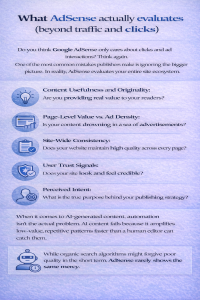
Do you think Google AdSense only cares about clicks and ad interactions? Think again. One of the most common mistakes publishers make is ignoring the bigger picture. In reality, AdSense evaluates your entire site ecosystem.
During audits and policy reviews, AdSense systems closely examine:
- Content usefulness and originality: Are you providing real value to your readers?
- Page-level value versus ad density: Is your content drowning in a sea of advertisements?
- Site-wide consistency: Does your website maintain high quality across every page?
- User trust signals: Does your site look and feel credible?
- Perceived intent: What is the true purpose behind your publishing strategy?
When it comes to AI-generated content, automation isn’t the actual problem. AI content fails because it amplifies low-value, repetitive patterns faster than a human editor can catch them.
While organic search algorithms might forgive poor quality in the short term, AdSense rarely shows the same mercy.
How AI generated content changes risk at scale
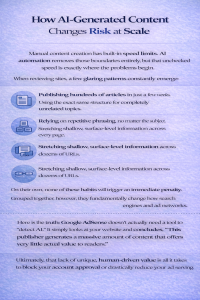
Manual content creation has built-in speed limits. AI automation removes those boundaries entirely, but that unchecked speed is exactly where the problems begin.
When reviewing sites, a few glaring patterns constantly emerge:
- Publishing hundreds of articles in just a few weeks.
- Using the exact same structure for completely unrelated topics.
- Relying on repetitive phrasing, no matter the subject.
- Stretching shallow, surface-level information across dozens of URLs.
On their own, none of these habits will trigger an immediate penalty. Grouped together, however, they fundamentally change how search engines and ad networks classify your website.
Here is the truth: Google AdSense doesn’t actually need a tool to “detect AI.” It simply looks at your website and concludes, “This publisher generates a massive amount of content that offers very little actual value to readers.”
Ultimately, that lack of unique, human-driven value is all it takes to block your account approval or drastically reduce your ad serving.
The difference between AI-assisted and AI-dependent sites
Are you using AI to help you write, or are you letting AI do all the work? The distinction between AI-assisted and AI-dependent content matters much more than most people realize.
AI-Assisted Content:
- Uses automation as a helpful tool for drafting, outlining, or researching.
- Relies on human editorial decisions, careful pruning, and thoughtful rewriting.
- Demonstrates clear topical intent and genuine depth.
AI-Dependent Content:
- Publishes raw or lightly edited machine outputs.
- Scales production much faster than human editorial oversight can manage.
- Prioritizes sheer volume over clarity and value.
Why does this matter? When it comes time for website audits, AI-assisted sites typically pass AdSense reviews without an issue. On the other hand, AI-dependent sites frequently face rejection, even if they manage to drive decent traffic.
Ultimately, relying entirely on automation leaves a footprint. You can clearly see the difference in four key metrics:
- Time on page: Readers quickly abandon robotic, repetitive text.
- Content decay rate: Generic, automated information loses its value fast.
- Internal linking quality: Machines often struggle to build logical, helpful link structures.
- Reader trust signals: Real people usually know when a machine wrote the article they are reading, and they bounce accordingly.
What commonly goes wrong (from real AdSense-related audits)
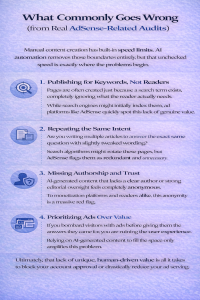
1. Publishing for Keywords, Not Readers
Pages are often created just because a search term exists, completely ignoring what the reader actually needs. While search engines might initially index them, ad platforms like AdSense quickly spot this lack of genuine value.
2. Repeating the Same Intent
Are you writing multiple articles to answer the exact same question with slightly tweaked wording? Search algorithms might rotate these pages, but AdSense flags them as redundant and unnecessary.
3. Missing Authorship and Trust
AI-generated content that lacks a clear author or strong editorial oversight feels completely anonymous. To monetization platforms and readers alike, this anonymity is a massive red flag.
4. Prioritizing Ads Over Value
If you bombard visitors with ads before giving them the answers they came for, you are ruining the user experience. Relying on AI-generated content to fill the space only amplifies this problem.
A realistic scenario I’ve seen more than once
Imagine a publisher launching a niche site powered entirely by automated blog writing. At first, everything seems perfect. Traffic grows slowly but steadily, and Google Search Console looks completely clean with zero warnings in sight.
But then, the roadblocks hit:
- AdSense approval gets rejected.
- Ad serving is suddenly limited.
- RPM drops without warning.
The publisher naturally assumes the issue lies with traffic quality. The reality, however, is much simpler: AdSense classified the site as low-value at scale. It wasn’t deemed unsafe or spammy—it simply wasn’t considered worth monetizing heavily.
Nothing was technically “wrong” with the site. The business model itself was the problem.
How Google’s quality systems intersect with AdSense
Ever wonder why your monetization drops before your search rankings do? AdSense doesn’t operate in a vacuum. Instead, it continuously evaluates a variety of broader quality signals to determine the true value of your website. These signals include:
- Page experience: How easily can users navigate your site?
- Content usefulness: Does your writing actually solve the reader’s problem?
- Site reputation: Is your domain trusted within your niche?
- Engagement patterns: Are visitors interacting with your pages, or bouncing immediately?
While low-quality or AI-generated content might temporarily hold its ground in search engine results, it rarely satisfies real users. Because monetization systems rely heavily on immediate user satisfaction and engagement, they catch on much faster than search algorithms.
Ultimately, this is why AdSense warnings and revenue drops usually serve as the canary in the coal mine, appearing long before you ever see an SEO penalty.
AI content creation and E-E-A-T expectations
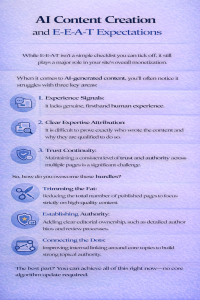
While E-E-A-T isn’t a simple checklist you can tick off, it still plays a major role in your site’s overall monetization.
When it comes to AI-generated content, you’ll often notice it struggles with three key areas:
- Experience signals: It lacks genuine, firsthand human experience.
- Clear expertise attribution: It is difficult to prove exactly who wrote the content and why they are qualified to do so.
- Trust continuity: Maintaining a consistent level of trust and authority across multiple pages is a significant challenge.
So, how do you overcome these hurdles? I’ve seen websites successfully secure Google AdSense approvals by making a few strategic adjustments:
- Trimming the fat: Reducing the total number of published pages to focus strictly on high-quality content.
- Establishing authority: Adding clear editorial ownership, such as detailed author bios and review processes.
- Connecting the dots: Improving internal linking around core topics to build strong topical authority.
The best part? You can achieve all of this right now—no core algorithm update required.
Content velocity as a hidden risk factor
Did you know that AdSense systems closely monitor your publishing speed?
If you publish five strong, unique posts a week, everything looks completely normal. But if you suddenly pump out 50 similar posts in that same timeframe, you will likely raise some major red flags.
High publishing velocity isn’t a violation on its own, but combining that speed with highly repetitive content certainly is. With the rise of AI content automation, crossing that line accidentally has never been easier.
To keep your account safe, always prioritize quality and variety over sheer volume. Take a moment to review your automated publishing schedules and ensure your content remains fresh and distinct.
How automated blog writing affects site-wide evaluation
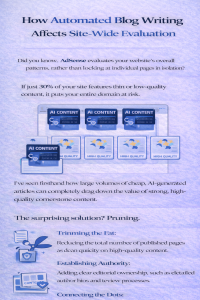
Did you know AdSense evaluates your website’s overall patterns, rather than looking at individual pages in isolation?
If just 30% of your site features thin or low-quality content, it puts your entire domain at risk. I’ve seen firsthand how large volumes of cheap, AI-generated articles can completely drag down the value of strong, high-quality cornerstone content.
The surprising solution? Pruning. In many cases, deleting or consolidating weak content improves your monetization far more effectively than constantly publishing new posts.
The Ultimate Compliance Checklist (SEO & AdSense Safe)
Before hitting “publish” on AI-generated content, ask yourself these five critical questions:
- Would this page still exist if we removed all the ads?
- Does it fully answer one specific question?
- Is it meaningfully different from similar pages on your site?
- Can a human editor easily explain why this content is useful?
- Are the author’s identity and the site’s purpose clear?
If you answered “no” to more than two of these questions, your page is a compliance risk.
The 2025 Publisher’s Dilemma: Scale vs. Stability
AI tools offer massive scale, but platforms like Google AdSense reward restraint. Every publisher faces a choice.
You can choose faster publishing and broader coverage, but you risk sacrificing monetization stability and long-term trust.
Ultimately, publishers who accept slower, more deliberate growth often see higher earnings over time.
How to Use AI Writing Tools Safely
Based on our hands-on audits, safe AI usage boils down to intent. Use AI for:
- Drafting, not publishing directly.
- Outlining, not scaling mindlessly.
- Assisting human experts, not replacing them.
AI writing assistants deliver the best results when the final product clearly reflects human editorial intent.
Frequently Asked Questions
1. Does AdSense allow AI-generated content?
Yes, there is no blanket ban on AI content. Search engines and ad networks care more about the quality and value of the content than how you produced it.
2. Why do sites relying heavily on AI lose AdSense approval?
Rejections usually stem from thin content, heavy repetition, or an unclear site purpose—not the use of automation itself.
3. Does AdSense actively detect AI content?
Detection isn’t the main goal; pattern recognition is. AdSense looks for recurring patterns of low-value content.
4. Can AI content rank well on Google but still fail AdSense?
Yes. In fact, this scenario is becoming increasingly common.
5. Should I delete my existing AI content?
Only delete content if it offers zero value to your readers or heavily overlaps with other pages on your site.
Conclusion
AI-generated content isn’t inherently dangerous for monetization. The real risk comes from unchecked scale without human oversight. When content production outpaces human review and quality assurance, weak patterns quickly multiply. While search engines might tolerate these patterns temporarily, AdSense usually reacts much faster. Why? Because AdSense needs to know your pages consistently deliver genuine value in exchange for a user’s attention.
To maintain stable monetization in 2025, publishers must shift their mindset. Stop asking, “Can I publish this page?” and start asking, “Should this page exist at all?”
Many AI-generated pages aren’t actively harmful, but they simply add nothing new. Over time, this repetitive fluff erodes trust signals and makes your entire domain feel less authoritative. AdSense doesn’t even need a strict policy violation to reduce its confidence in your site; pattern recognition alone is enough to hurt your earnings.
The websites that survive and thrive aren’t the ones publishing the highest volume or reacting fastest to every fleeting trend. They are the sites with a clear, strong editorial spine. Every piece of content has a distinct reason to exist, fits a defined scope, and reinforces a consistent brand identity. Even when heavily relying on AI tools, their output feels intentional rather than automated.
AI is a powerful tool that can speed up research, drafting, and iteration. But it can also quietly sabotage your site by encouraging sheer volume over careful judgment. The difference isn’t technological—it’s editorial. Publishers who grasp this distinction will secure both their search visibility and their AdSense revenue for the long haul.