


Visibility in SEO used to follow a pattern that was easy to recognize and fix. A page was crawled. It was indexed if nothing stopped it. It rated whether it matched the aim and had adequate authority. Traffic came next. You could generally find a real reason for changes in performance, including technological debt, content quality, link signals, or purpose mismatch, even when algorithms changed. Generative Engine Optimization now questions that whole way of thinking.
That model is beginning to break down without making a sound.
In the last year, I’ve checked out a lot of sites where all the usual signals appeared good. Crawling pages was possible. The index coverage stayed the same. Rankings stayed the same across all key inquiries. No manual work. There don’t seem to be any noticeable modifications to the algorithm. But organic traffic still went down, slowly, unevenly, and without the typical signals that SEOs look for.
The issue wasn’t a typical SEO failure. It was what transpired following the ranking.
Search engines don’t only choose which sites should show up anymore. They’re choosing which pieces of information are worth pulling out, summarizing, and employing again in AI-generated responses and conversations. Your content doesn’t crash when it’s not chosen at that tier. It just doesn’t come up anymore.
That’s when you have to use Generative Engine Optimization. Not as a buzzword or a substitute for basic SEO, but as a new mechanism that controls visibility. If your information is technically correct but not included in AI-generated summaries and answers, you won’t get any warnings or mistakes. Traffic erosion develops slowly, so you can’t think of it as a short-term change until it’s too late.
What Generative Engine Optimization Looks Like in Real SEO Work

In real life, generative engine optimization isn’t about playing games. It’s about knowing how contemporary search engines utilize old material.
A common question in traditional SEO is, “Can this page rank for a query?”
GEO poses a separate question: Is it possible to take bits of this site and use them again without the whole of it?
That distinction affects how you judge material. Your whole essay isn’t needed by generative systems. They don’t care about how you start or how you convey a tale. They want solutions that are limited—clear, self-contained explanations that still make sense when taken out of their original context.
I care less about the number of words on a page now and more about how broken it is. I read each paragraph and ask the following:
- Is this part of the solution to something?
- Could it exist independently of its context?
- Is the meaning clear?
- Is it clear who authored this and why they are trustworthy?
AI-generated results typically don’t show pages that rank high yet fail these tests. Sometimes, pages that pass them are utilized again, even if they don’t rank high.
How AI-Driven Search Systems Actually Evaluate Content
One error I see teams make is thinking that generative systems “read” information the same way people do. No, they don’t. And they don’t rank as old algorithms used to.
To put it simply, these systems usually
- Parse intent from several sources simultaneously, rather than sequentially per page.
- Look for patterns of agreement in areas they already trust.
- Choose stuff that clears up confusion immediately and with confidence.
- Hedging, confused purpose, or wording that is too careful should be avoided.
This is why extended, unfocused manuals don’t do well in AI-first settings. They could be thorough, but they can’t make up their minds. They talk about everything, but they don’t really solve anything.
One thing I notice a lot in audits is text that is tailored for coverage instead of resolution. It checks off every subtopic, but no one part is powerful enough to utilize again with confidence. Generative systems skip it, not because it’s incorrect, but because it’s not obvious.
Where Generative Engine Optimization Breaks Down Most Often
1. Pages That Try to Meet All Needs at Once
AI systems want things to be exact. Pages that mix together informative, comparative, and transactional purposes are pulled out right away. This happens a lot with “ultimate guides” that strive to be everything.
2. Attribution that is weak or not clear
Anonymous material, generic author profiles, or ambiguous ownership of a subject makes people less likely to reuse anything. Even great stuff is afraid to come out when attribution signals are weak.
3. Language that is too optimized and based on templates
I’ve seen text crafted to please SEO tools do worse in AI summaries in many audits. It’s simple to see and disregard repetitive wording, evident keyword structuring, and formulaic transitions.
4. Unclear Structure
If the best answer is buried halfway down the page or hidden in a story, it becomes hard to find. AI systems like clear anchoring.
GEO vs Traditional SEO: How the Reward Systems Differ

Traditional SEO still gives points for:
- Relevance at the page level
- Accumulation of authority throughout time
- Links and signs of trust
Generative engine optimization gives something else a reward:
- Clarity at the answer level
- How quickly you can resolve your intent
- Consistency across related content
- Repeating signals that are dependable
These systems are both in use. There is still ranking. It simply ceases being the last gate. Sites that solely optimize for one layer will ultimately reach a limit.
Practical GEO Strategies That Actually Hold Up
Design Content for Extraction, Not Consumption
Some of your information will be quoted without any context. Make sure that important explanations don’t depend on the paragraphs around them to make sense.
Reinforce Intent Early and Often
The first 10–15% of a page currently has too much weight. If the purpose isn’t clear right away, the chance of reuse goes down a lot.
Limit the scope to boost confidence
In AI summary, a page that answers one question well generally trumps a page that answers 10 questions in a vague way.
Make Entity and Consistency Signals Stronger
Systems can better categorize and trust your material when you use clear definitions, consistent language, and internal links between similar sites.
What I Often See in GEO-Related Audits
When traffic drops, teams post more content. This cycle keeps happening. More keywords, guidelines, and news.
But the true problem is generally structural.
I’ve seen sites with hundreds of ranking pages receive no AI reuse because the answers weren’t properly separated. After changing the structure of the current material without adding new pages, the visibility went up, but the rankings remained the same.
That’s what makes GEO so annoying. You don’t always get feedback right away when you use conventional technologies. The benefits are not readily visible: traffic that stays steady, better branded search, and being present in AI responses that you don’t control.
A Practical GEO Diagnostic You Can Use Today
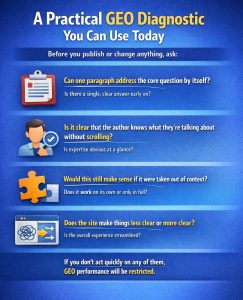
Before you publish or change anything, ask:
- Can one paragraph address the core question by itself?
- Is it clear that the author knows what they’re talking about without scrolling?
- Would this still make sense if it were taken out of context?
- Does the site make things less clear or more clear?
If you don’t act quickly on any of them, GEO performance will be restricted.
FAQs
1. What does it mean to optimize a generative engine?
Generative engine optimization is all about organizing material such that AI-driven search engines can easily find it, summarize it, and utilize it in their own results.
2. Is GEO taking the place of regular SEO?
No, GEO is better than regular SEO. Ranking is still important, but reuse is what makes anything visible in AI-first search.
3. Why do AI results not show ranked content?
Because ranking doesn’t mean that anything can be extracted, is clear, or is trustworthy. AI systems give more weight to certain signals.
4. How long does it take for GEO optimization to have an effect?
It usually takes a few weeks, although this depends on how often the system is updated, how well changes are understood, and how often the system is crawled.
5. Does GEO need content that was produced by machines?
No. In reality, well-written information by people works better since it makes the purpose clearer.
Conclusion
Speed, size, or smart tactics don’t get you points in generative engine optimization. It pays off to be careful.
Search engines that use AI are discriminating by design. They don’t need any additional material. They require material that clearly, consistently, and confidently meets their needs.
This alters the task from an SEO point of view. Impressions and rankings are still important, but they are no longer the main purpose. The only true way to tell whether you’ve succeeded is if people choose your work as a source of truth, not merely as a consequence.
GEO doesn’t take the role of SEO basics. It shows whether you really have them.