


Perplexity AI vs. ChatGPT highlights how AI-powered tools have transformed modern research—replacing manual browsing of dozens of websites with platforms that instantly summarize, analyze, and generate actionable insights.
However, many users face a critical problem:
👉 Which tool should you trust for accurate, reliable, and scalable research?
Some prefer Perplexity for its real-time sourcing, while others rely on ChatGPT for deeper reasoning and structured outputs. The confusion arises because both tools serve different research purposes, yet they are often compared as direct competitors.
This guide breaks down the real differences between Perplexity AI vs. ChatGPT, helping you understand when to use each tool for maximum research efficiency.
Perplexity AI is better for real-time research with source citations, while ChatGPT excels in deep analysis, structured explanations, and reasoning. For fact-based queries, Perplexity is more reliable, but for complex insights, strategy, and content synthesis, ChatGPT provides more detailed and flexible outputs.
Perplexity AI and ChatGPT differ mainly in research approach. Perplexity AI focuses on real-time web data and source citations, making it ideal for factual queries. ChatGPT specializes in deep reasoning, structured responses, and content generation, making it better for analysis, strategy, and complex problem-solving tasks.
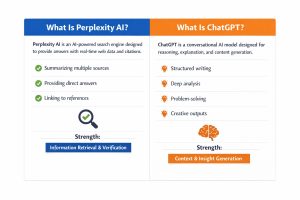
What Is Perplexity AI?
Perplexity AI is an AI-powered search engine designed to provide answers with real-time web data and citations.
It functions similarly to a search engine but enhances results by:
- summarizing multiple sources
- providing direct answers
- linking to references
Its primary strength lies in information retrieval and verification.
What Is ChatGPT?
ChatGPT is a conversational AI model designed for reasoning, explanation, and content generation.
It excels at:
- structured writing
- deep analysis
- problem-solving
- creative outputs
Unlike Perplexity, ChatGPT focuses more on understanding context and generating insights rather than retrieving real-time data.
Why Does This Comparison Matter for Research?
Many users assume both tools perform the same function.
In reality, they serve different research layers:
- Perplexity → data discovery
- ChatGPT → data interpretation
Using the wrong tool leads to:
- incomplete research
- surface-level insights
- unreliable conclusions
Understanding this distinction improves both research quality and efficiency.
How Do AI Tools Interpret Research Queries?
Modern AI tools process queries differently.
Perplexity AI Approach
- retrieves real-time data
- aggregates multiple sources
- prioritizes factual accuracy
ChatGPT Approach
- interprets intent
- generates structured responses
- builds logical explanations
This difference reflects two layers of research:
Retrieval vs. reasoning
Perplexity AI vs ChatGPT: Core Differences
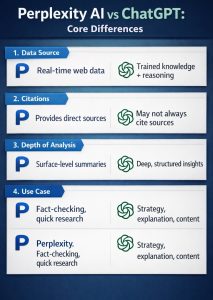
1. Data Source
Perplexity: Real-time web data
ChatGPT: Trained knowledge + reasoning
2. Citations
Perplexity: Provides direct sources
ChatGPT: May not always cite sources
3. Depth of Analysis
Perplexity: Surface-level summaries
ChatGPT: Deep, structured insights
4. Use Case
Perplexity: Fact-checking, quick research
ChatGPT: Strategy, explanation, content
Which Tool Is Better for Accuracy?
Accuracy depends on context.
Perplexity AI
Better for:
- current events
- statistics
- recent updates
Because it pulls from live sources.
ChatGPT
Better for:
- conceptual understanding
- frameworks
- structured explanations
But may require validation for real-time data.
Which Tool Is Better for Deep Research?
For deep research, ChatGPT performs better.
It can:
- connect ideas
- explain concepts
- build frameworks
- generate insights
Perplexity, while accurate, often stops at summarization.
Real SEO & Research Insights
In real SEO workflows, I often use both tools together.
Workflow Example
Step 1: Use Perplexity
→ gather data and sources
Step 2: Use ChatGPT
→ analyze and structure insights
This hybrid approach produces:
- higher accuracy
- deeper understanding
- better content quality
Practical Framework: When to Use Each Tool
Perplexity AI When
- you need verified sources
- researching current topics
- validating data
ChatGPT When
- building strategies
- writing content
- analyzing complex topics
Use Both Together. When
- conducting professional research
- creating SEO content
- developing reports
Common Mistakes When Using AI for Research
Relying on One Tool Only
Using a single tool limits research depth.
Ignoring Source Validation
Even AI-generated answers require verification.
Confusing Summaries with Insights
Summaries ≠ understanding.
Overtrusting AI Outputs
AI can generate confident but incomplete answers.
Future of AI Research Tools
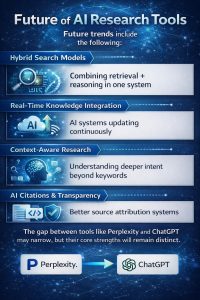
AI research tools are evolving rapidly.
Future trends include the following:
Hybrid Search Models
Combining retrieval + reasoning in one system.
Real-Time Knowledge Integration
AI systems updating continuously.
Context-Aware Research
Understanding deeper intent beyond keywords.
AI Citations & Transparency
Better source attribution systems.
The gap between tools like Perplexity and ChatGPT may narrow, but their core strengths will remain distinct.
FAQs
Which is better for research, Perplexity AI or ChatGPT?
Perplexity is better for factual data and citations, while ChatGPT is better for analysis and structured insights.
Can I use both tools together?
Yes. Combining both tools provides better research accuracy and depth.
Is Perplexity more reliable than ChatGPT?
For real-time data, yes. For reasoning and explanations, ChatGPT is stronger.
Does ChatGPT provide sources?
Sometimes, but not consistently like Perplexity.
Which AI tool is better for SEO research?
Using both together produces the best results for SEO research and content creation.
Are AI tools replacing traditional research?
No. They enhance research but still require human validation.
Conclusions
The debate around Perplexity AI vs. ChatGPT is not about choosing one over the other—it is about understanding how each tool fits into the modern research workflow. Both tools serve different but complementary roles, and using them strategically can significantly improve research quality and efficiency.
Perplexity excels at discovering and validating information in real time, making it highly effective for fact-based queries and source-backed answers. On the other hand, ChatGPT shines when it comes to interpreting information, structuring ideas, and generating deeper insights. It helps transform raw data into meaningful understanding.
Together, they create a powerful research system that combines accurate data retrieval with intelligent analysis. Instead of replacing traditional research methods, they enhance them by reducing manual effort and accelerating the discovery process.
As AI continues to evolve, the advantage will not lie in simply using these tools but in how effectively they are combined. Successful researchers will focus on building workflows that leverage both speed and depth—using Perplexity for validation and ChatGPT for interpretation. This balanced approach ensures not only accurate information but also actionable insights, which are essential for high-quality research in 2026 and beyond.