


For the last ten years, the main idea behind SEO strategy has been that Google is search. To understand visibility, you need to know how Google’s crawler, index, and ranking work. That assumption had an effect on how the site was designed, what material was planned, and how success was measured. It isn’t perfect, but it does have some truth. The rise of alternative search engines has proved that merely using Google isn’t enough.
In recent years, real audits of publishers, SaaS platforms, and sites with a lot of content have shown a clear pattern. Google traffic goes up and down without any problems with technology. Stats for a clean crawl. There are no major problems with index coverage. No decline in ranks. Discovery doesn’t appear as strong as we thought it would be. Teams start to receive lower amounts of traffic from search engines that concentrate on privacy, regional engines, specialist discovery platforms, and search features built into browsers.
These providers don’t often beat Google in terms of volume. More crucially, they show us things we can’t see. It becomes clear that the internal connections are weak. The desire to duplicate material seems to happen faster. It’s rare to locate pages that leverage brand bias or personalization. Content that is clear in structure and focused on a theme does better.
As alternative discovery systems with different goals, restrictions, and evaluation models, independent search engines become essential, not as competitors to Google. They show things in different ways, crawl less forgivingly, and put clarity over authority.
Knowing about independent and alternative search engines might help you figure out SEO problems. It makes you think about how search engines see, sort, and trust your information in ways other than rankings.
What “independent search engines” really mean
People generally don’t understand what the phrase “independent search engines” means. It doesn’t necessarily imply “anti-Google” or “tiny.”
There are a number of different types of independent search engines in real life:
- Engines that work outside of Google’s environment
- Engines that put privacy or decentralization first
- Engines made for certain areas or specialties
- Engines that employ different ways to rank things
Some depend on their own indexes. Some use a mix of free data, community signals, or licensed sources. The fact that they don’t depend just on Google’s ranking mechanism or customization layer is what brings them together.
This independence is good for SEO. These engines show material in various ways, crawl in other ways, and show vulnerabilities that Google sometimes hides.
Why independent search engines matter more in 2026
Google still gets the most search traffic. That hasn’t changed. What has changed is how people seek.
People now search across:
- Browsers that protect your privacy
- Search for OS and devices built-in
- Tools for finding things on certain platforms
- Engines that are popular in certain areas
This fragmentation shows up in audits as:
- Google rankings that stay the same yet engagement goes down
- Long-tail content coming back in other places
- Evergreen pages become popular outside of Google
Search engines that are not affiliated with a business don’t normally cause traffic surges. They make the signals stand out from each other. They demonstrate what your site appears like without too much customisation, brand bias, or past success.
That makes them useful for diagnosing problems.
A technical SEO lens on independent search engines
From a technological point of view, independent search engines are usually:
- Not as forgiving of poor construction
- More reliant on clear purpose
- Not as swayed by brand authority
- Slower to use complicated rendering
This is vital.
In many audits, I’ve encountered pages that do well on Google but not so well on other sites because:
- It’s not apparent how internal linking works.
- The aim of the content is quite similar.
- JavaScript rendering is what makes pages work.
- The metadata doesn’t match the actual page scope.
Google fixes a lot of these problems. Engines that are not part of a system frequently don’t.
Categories of independent search engines
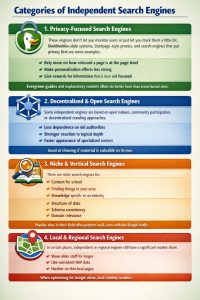
1. Privacy-focused search engines
These engines don’t let you monitor users or just let you track them a little bit. DuckDuckGo-style systems, Start page-style proxies, and search engines that put privacy first are some examples.
When it comes to SEO, engines that concentrate on privacy:
- Rely more on how relevant a page is at the page level
- Make personalization effects less strong
- Give rewards for information that is clear and focused
In real life, evergreen guides and explanatory material frequently do better here than sites that are based on trends.
2. Decentralized and open search engines
Some independent engines are based on open indexes, community participation, or decentralized crawling approaches.
What I’ve seen in early adoption:
- Less dependence on old authorities
- More stronger reaction to topical depth
- Faster appearance of specialized content
These systems frequently have trouble with scalability, but they are great at showing if material is good on its own.
3. Niche and vertical search engines
There are niche search engines for:
- Content for school
- Finding things in your area
- Knowledge that is particular to an industry
These engines don’t care as much about standard SEO recommended practices as they do about:
- Structure of data
- Schema consistency
- Domain relevance
In audits, sites that are very popular in their field sometimes fare well here, even if their Google traffic is low.
4. Local and regional search engines
In certain places, independent or regional engines still have a significant market share.
Local SEO specialists frequently don’t pay attention to these systems, yet they can:
- Show older stuff for longer
- Like consistent NAP data
- Be harsher on thin local pages
When optimization is primarily for Google, local visibility gets weak.
What commonly goes wrong when optimizing for independent engines
These problems keep coming up in audits:
1. Putting too much faith in Google’s forgiveness
Google makes up for a poor framework. Engines that work on their own don’t.
2. Bad hierarchy within
When it’s not clear how important a page is, discovery stops.
3. Same or similar purpose
Independent engines may get rid of redundancy faster.
4. Rendering that uses a lot of JavaScript
Some engines still depend on raw HTML a lot.
A real-world audit observation
Google traffic stayed the same for months during one publisher audit. No fines. No mistakes in the code.
But:
- Engines that concentrate on privacy grew steadily.
- Old evergreen content came back up
- New content had a hard time everywhere
The problem wasn’t the ranking; it was the clarity of the information. After the pages that were overlapping were combined and the internal connections were made clearer, all engines, including Google, worked better.
Earlier, independent search engines pointed out the issue.
How independent engines change SEO strategy
When you add in independent search engines, SEO changes in little ways:
- Being clear is better than being smart.
- Structure is better than volume.
- Intent is more important than keywords
- Being consistent is better than being new.
These engines reward basic skills that work well at scale.
A practical diagnostic framework
When looking at performance outside of Google, ask:
- Would this page still make sense if it weren’t personalized?
- Is it clear what it wants to do right away?
- Does it compete with another page on the same site?
- Can it be found by logical linking?
- Would taking it away make topical authority weaker?
If the solution isn’t obvious, independent engines will be hesitant.
Independent search engines as early warning systems
One duty of independent engines that doesn’t get enough credit is finding problems early.
They do this a lot:
- Stop showing poor content sooner
- Faster exposure of narrow portions
- Show crawl problems sooner
This is helpful input for SEO professionals, not lost traffic.
Search engine competition and long-term resilience
It’s not just about market share when it comes to search engine competitiveness. It’s about several ways to evaluate.
Sites that do quite well in:
- Engines for privacy
- Engines for specific needs
tend to be:
- Sound in structure
- Focused on the subject
- Not as unstable during updates
This strength is more important than going for little wins.
FAQs
1. Is it worth it to optimize for independent search engines?
Yes, not for bulk, but for clarity and strength.
2. Do they need separate SEO strategies?
Not distinct strategies, just stronger basics.
3. Will optimizing for them damage Google’s rankings?
No. Most of the time, it makes them better.
4. Are decentralized search engines ready for the general public?
Some are still new, but their ranking models are useful.
5. Do tiny sites need to bother about independent engines?
More often than big sites, since clarity is more important than authority
Conclusion
Independent search engines don’t replace Google. They challenge SEO norms.
Remove Google’s brand bias, personalization, and historical authority forgiveness. Size and backlinks seldom cause a site’s poor independent search engine performance. Uncertain content, organization, or goal are often to blame. As diagnostic mirrors and traffic sources, these engines help SEO.
Audit stress testing often incorporate non-Google performance. A page that only works when Google “knows” the brand is dangerous. It shows frequently in smaller or privacy-focused engines due to its simple structure, focused topics, and obvious relevance. These sites adapt well to Google updates.
In 2026, Google-only SEO is outmoded. Blind spots may lead to volatility—ranking swings, poor indexing, or traffic too dependent on a few searches. Search engine differences don’t complicate SEO. Sharpens. It makes you consider content discovery, not ranking.
Successful companies don’t pursue every platform or traffic source. They offer contextless content and structure for search engines. This clarity persists across engines and algorithm updates, making SEO decisions more deliberate.