

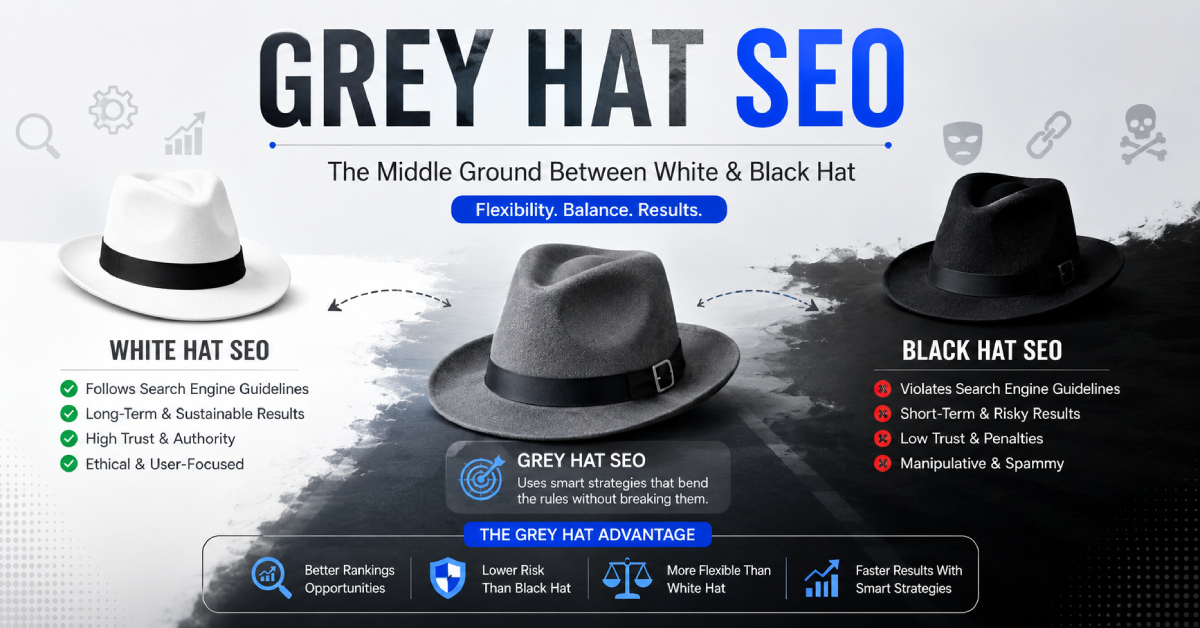
If you’ve spent any time in the SEO world, you’ve probably heard the terms “white hat” and “black hat” constantly. “White hat” means playing by Google’s rules. “Black hat” means ignoring them entirely. But there’s a whole grey area in between—and that’s exactly where grey hat SEO lives.
“Grey hat SEO” refers to tactics that aren’t explicitly banned by Google but aren’t entirely endorsed either. They sit in a murky middle ground where the rules are unclear, the risks are real, and the results — when they work — can be significant.
I’m Zohanuddin Shaikh, an SEO consultant based in Karachi, Pakistan, with 8 years of experience. In this guide, I’ll break down what grey hat SEO actually involves, walk through real examples of how these tactics get used, explain the genuine risks, and help you decide whether any of these approaches make sense for your situation. Let’s talk honestly about what gray hat SEO is, rather than pretending it doesn’t exist.
What Exactly Is Grey Hat SEO?
Grey hat SEO is a set of techniques that aren’t directly forbidden by search engine guidelines but still attempt to manipulate rankings in ways that go against their intended purpose.
In simple terms, it operates in the “unclear zone” between approved (white hat) and prohibited (black hat) practices—using methods that exploit gaps or limitations in how search algorithms work.
These tactics often aim to gain an advantage without triggering obvious penalties, but they carry risk because guidelines evolve over time. What’s considered acceptable today may become penalized in the future, making grey hat SEO an unstable, short-term strategy for long-term growth. The core tension is simple: you’re betting that Google won’t catch — or won’t decide to penalize — what you’re doing before you’ve gotten the value out of it.
Grey Hat vs White Hat vs Black Hat SEO
Understanding where grey hat sits requires seeing all three approaches side by side. Here’s an honest breakdown across the metrics that matter most to a real business.
Category |
White Hat |
Grey Hat |
Black Hat |
|
Google Guidelines |
Fully compliant | Borderline / unclear | Direct violations |
|
Typical Tactics |
Quality content, E-E-A-T | PBNs, expired domains | Cloaking, link schemes |
|
Short-Term Results |
Slow but stable | Faster initial gains | Quick spikes |
| Long-Term Risk | Very low | Medium to high |
Very high |
| Penalty Risk | Minimal | Possible (algorithm) |
Near certain |
| Recommended For | All businesses | Experienced SEOs only |
Not recommended |
| Sustainability | High | Low to medium |
None |
The pattern is clear: grey hats trade sustainability for speed. It sits close enough to black hat that a single algorithm update can reclassify your “clever” tactic as a penalized one—with no warning.
Common Grey Hat SEO Tactics — Explained Honestly
Let’s walk through the most widely used gray hat techniques. Understanding them matters even if you decide not to use them—because you need to recognize them when an agency proposes them or when a competitor uses them against you.
1. Private Blog Networks (PBNs)
A private blog network is a collection of websites built specifically to link to a main “money site” to boost its rankings. The sites are typically built on expired domains that already have some authority and backlink history.
The logic is straightforward: Google uses backlinks as a major ranking signal, so more high-quality backlinks generally means higher rankings. A PBN artificially creates those backlinks without earning them through genuine content or relationships.
PBNs are technically against Google’s guidelines (link schemes are explicitly mentioned), which puts them in disputed territory between grey and black hat. Whether they’re caught depends entirely on how well they’re disguised—and Google’s detection keeps improving.
A common real-world pattern: a site invests thousands building a PBN, sees strong results for a year or more, then loses the majority of its organic traffic within weeks when an algorithm update identifies the footprint. Recovery typically takes many months of cleanup work — often longer than the period the PBN actually helped.
2. Expired Domain Acquisition
When a domain expires and isn’t renewed, it sometimes retains its historical backlink profile and domain authority. Buying these expired domains and either redirecting them to your main site or rebuilding content on them is a classic grey-hat move.
Done carefully, it can pass genuine authority. Done sloppily, the redirected domain looks spammy to Google and can actually harm the receiving site. The quality of the expired domain’s historical link profile matters enormously—and it’s easy to misjudge.
3. Parasite SEO
Parasite SEO involves publishing content on high-authority third-party platforms—Medium, LinkedIn articles, Quora Spaces, Substack, and even large news sites with contributor programs—and optimizing that content to rank for competitive keywords.
The idea is that Google already trusts these platforms, so your content on them can rank faster than content on your own domain. You then link back to your main site.
This is genuinely gray because the tactic itself isn’t banned—publishing content on other platforms is completely normal. The line gets crossed when the content is thin, keyword-stuffed, or created purely for the backlink rather than for the platform’s audience. Parasite SEO done with genuinely useful content is arguably just smart content distribution. Done with AI-generated filler, it crosses into black-hat territory.
4. Tiered Link Building
Standard link building means getting websites to link to your site. Tiered link building adds another layer: you build links to the pages that already link to your site, amplifying their authority before it passes to you.
Tier 1 links are high-quality backlinks pointing directly to your site. Tier 2 links point to those tier 1 pages. Sometimes tier 3 links point to tier 2 pages. The lower tiers often involve lower-quality sources—which is where the grey hat element enters and where the risk accumulates.
5. Click-Through Rate Manipulation
Google uses click-through rate as one of many ranking signals — if your result gets clicked more than others for a given search, that’s a positive signal. Some SEOs attempt to manipulate this using click farms (networks of real or automated users who search for a keyword and click a specific result) to artificially inflate CTR.
This is deeply risky. Google has specifically built systems to detect unnatural click patterns, and being caught engaging in CTR manipulation can result in a manual penalty.
6. Keyword-Targeted Micro sites
Creating small, tightly focused websites targeting specific high-value keywords and linking them back to a main site. This differs from a PBN in that the micro-sites often have legitimate content and genuine audiences—but they’re still created primarily as link vehicles rather than as standalone businesses. That primary intent is what places them in grey territory.
When Grey Hat SEO Goes Right and Wrong: Real Patterns
Abstract risk descriptions don’t capture what actually happens. Here are two common patterns I’ve observed across the industry.
The PBN Success That Collapsed
A common pattern: an agency or business builds its entire ranking strategy around PBN-assisted SEO. For a few years, they consistently rank on page one for highly competitive terms, and the traffic drives steady leads.
Then a link spam update hits. The site drops from a top position to page four or five for its main keyword almost overnight. Within weeks, organic leads dry up almost completely. The business has to pivot to paid advertising while rebuilding authority the legitimate way—a process that takes over a year.
The painful irony in the agency version of this story: an SEO agency that can’t fix its own rankings because the methods that built those rankings have become a liability.
The Parasite SEO Done Responsibly
A contrasting pattern: a small e-commerce brand with a new website and essentially no domain authority. Instead of waiting 12 to 18 months to build authority from scratch, they publish genuinely detailed, useful buying guides on Medium and LinkedIn — content they’re proud of and that their target audience finds valuable.
Each article links naturally back to relevant product pages. Over several months, some of these articles rank on page one for medium-competition keywords, driving consistent referral traffic while helping the main site build authority faster.
Was this a grey hat? Technically yes, because the content was created partially as a link vehicle. But the content was genuinely good, the platforms benefited from having it, and no guidelines were violated. The risk level was very low. This is the version of gray hat closest to white hat—and it shows the line really is blurry.
The Real Risks of Grey Hat SEO
Most articles describe gray hat risks in vague terms. Let’s be specific about what can actually go wrong.
Risk |
What It Means |
|
Algorithm penalties |
Frequent updates can flag today’s tactics tomorrow, causing sudden ranking drops |
|
Manual actions |
Human reviewers can remove your site from results entirely; recovery takes months |
| Compounding technical debt |
When PBNs or redirects fail, rankings collapse and become hard to manage |
| Client and reputation risk |
Penalties on client sites damage professional relationships regardless of contracts |
The client and reputation risks deserve emphasis. If you’re an SEO professional applying gray hat tactics to client websites, you’re taking on considerable professional risk. When a penalty hits, you have to explain to a client why their organic traffic has disappeared and why the work you did is now actively harming them.
The bottom line: grey hat SEO can deliver real results in the short term, but it builds rankings on a foundation that can collapse. For most small businesses, that’s not a trade-off worth making.
Who Should (and Should Not) Consider Grey Hat SEO
It’s not a universal yes or no—it depends heavily on your situation, risk tolerance, and expertise.
Grey Hat SEO Might Make Sense If:
- You’re an experienced SEO professional who fully understands the risks and can monitor and respond quickly to algorithm changes
- You’re in a highly competitive niche where competitors already use these tactics and white hat alone can’t close the gap
- You’re working on a short-term project where long-term ranking sustainability isn’t the primary concern
- You have a large enough SEO budget to absorb a potential penalty and rebuild without catastrophic business impact
- You have clear attribution models to assess whether the ROI justifies the risk
Grey Hat SEO Is Almost Certainly a Bad Idea If:
- You’re a small business that depends on organic search traffic for a significant portion of your leads or revenue
- You don’t have the technical knowledge to monitor for penalties and respond quickly
- You’re building a long-term brand where reputation and trust are important assets
- You’re in a regulated industry (finance, healthcare, legal) where regulatory bodies scrutinize your online presence
- You hired an SEO agency and they’re suggesting these tactics without clearly explaining the risks
If an SEO agency promises fast results without explaining how they’ll achieve them, ask directly: “Do any of these tactics involve PBNs, expired domain networks, or link schemes?” A good agency will answer that question honestly.
What to Do Instead: The White Hat Path That Actually Competes
The honest truth about white-hat SEO in 2026 is that it’s more powerful than ever—because Google’s ability to reward genuinely helpful, authoritative content has improved dramatically. If you’re a small or medium business building sustainable visibility, here’s where your effort is better spent.
Build Genuine Topical Authority
Instead of building links artificially, build content that makes you the most useful resource in your niche. Google’s Helpful Content system specifically rewards sites that demonstrate deep expertise. A cluster of genuinely useful, interconnected posts on related subjects builds topical authority that compounds over time. For more, see my topical authority guide.
Earn Links Through Digital PR
The legitimate version of link building is getting journalists, bloggers, and industry publications to cite your work because it’s genuinely worth citing. Create original research, publish useful data, and share genuine expert perspectives. This takes more time, but the links are permanent and penalty-proof.
Optimize Your Local SEO Properly
For businesses with a geographic service area, local SEO delivers some of the highest ROI of any organic strategy — and it’s entirely white hat. A properly optimized Google Business Profile, consistent NAP citations, genuine customer reviews, and local content can dominate local search without any grey-hat risk.
Invest in E-E-A-T Signals
Google’s quality evaluator guidelines emphasize experience, expertise, authoritativeness, and trustworthiness. Demonstrating these through genuine author credentials, real-world case studies, expert quotes, and accurate citations builds the kind of trust that gray hat tactics can never replicate—and that holds up through every algorithm update. For a complete approach, see my white hat SEO guide.
FAQs
1. Is grey hat SEO illegal?
No, gray hat SEO isn’t illegal—it doesn’t break any laws. However, it violates the spirit of Google’s guidelines and can result in ranking penalties and traffic loss. The distinction matters: “not illegal” doesn’t mean “safe.” The consequences come from search engines, not courts, but they can still seriously damage a business that depends on organic traffic.
2. Does grey hat SEO still work in 2026?
Grey hat SEO can still work briefly, but modern algorithms detect manipulation far better than before, making results less reliable and riskier. Tactics that worked for years can be neutralized by a single update. The window between “it’s working” and “it’s penalized” keeps shrinking as Google’s detection improves, which makes grey hat an increasingly poor long-term bet.
3. How can I tell if my SEO provider is using gray-hat tactics?
Ask your provider for clear link-building details. Watch for red flags like guaranteed rankings, unusually rapid backlink growth, links from irrelevant sites, or a general lack of transparency about methods. You can verify their work using tools like Google Search Console or Ahrefs to inspect your backlink profile. A trustworthy provider explains exactly how they build authority.
4. Can I recover if my site has already been penalized?
Yes, recovery is possible. Remove harmful links (disavow if necessary), improve content quality, fix the underlying issues, and request a review if it was a manual action. Results typically take weeks to months, depending on the severity. Recovery is often slower and more expensive than the value the grey hat tactics originally provided.
5. Is guest posting a gray hat technique?
Guest posting is white hat when it adds real value — genuinely useful content on relevant, quality sites where the audience benefits. It becomes a gray hat when used purely to place low-quality backlinks on irrelevant sites, with thin content created only for the link. The intent and quality determine which side of the line it falls on.
6. What’s the difference between grey hat and black hat SEO in practice?
Black-hat SEO uses clearly banned tactics like cloaking, hidden text, and outright link schemes—direct violations that Google actively penalizes. Gray hats use risky methods that manipulate rankings while trying to avoid detection, operating in areas where guidelines are unclear. A black hat is a definite violation; a grey hat is a calculated gamble on ambiguity.
7. Is buying expired domains always a grey hat?
Not always. Buying an expired domain to build a genuine, standalone website is completely legitimate. It becomes a gray hat when the primary purpose is to redirect its historical authority to another site or use it as a link vehicle rather than building something valuable on it. The intent behind the acquisition determines the classification.
8. How risky is parasite SEO compared to PBNs?
Parasite SEO is generally lower-risk than PBNs when done with genuinely useful content, because publishing on third-party platforms is normal and legitimate. PBNs carry higher risk because they explicitly violate link scheme guidelines and leave detectable footprints. The risk in parasite SEO comes only when the content is thin or created purely for links rather than for readers.
Final Thoughts
Grey hat SEO is real, it’s widely practiced, and understanding it matters for anyone serious about organic search. Pretending it doesn’t exist leaves you vulnerable—to being misled by agencies that use these tactics without disclosing them or to being outcompeted by rivals who use them while you wonder why their rankings move faster than yours.
But knowing about grey hat SEO and using grey hat SEO are two different decisions. For most businesses — especially small businesses building for the long term — the risk-reward calculation doesn’t favor it. A single algorithm update can erase months of gray hat gains and leave you worse off than if you’d never used the tactics at all.
The businesses that consistently win at SEO over years rather than months are the ones building genuine authority: useful content, earned backlinks, strong local signals, and real relationships with their audience. That’s not the exciting answer, but it’s the honest one.
If you’re building your search presence, start with the fundamentals. Sustainable white-hat SEO isn’t just the safer path—in 2026, it’s also the more powerful one.
For questions about building a sustainable SEO strategy for your own site, feel free to reach out through my Contact page.
For more SEO guides, browse Search Engine Realm.
Last Updated: July 2026