

SEO SaaS tools have become essential as search engine optimization grows more complex and data-driven. What once worked with simple keyword tracking and manual updates is no longer enough for websites operating at scale.
If you manage a growing website, you’ve likely experienced this shift. Content expands, keywords multiply, and tracking performance becomes harder to manage manually. At some point, spreadsheets and disconnected tools stop being efficient.
I’m Zohanuddin Shaikh, an SEO consultant based in Karachi, Pakistan, with 8 years of experience. From my work, the real challenge in modern SEO isn’t finding opportunities—it’s organizing them, prioritizing them, and acting on them consistently. SEO SaaS tools are designed to help with exactly that. This guide covers what they are, their key features, how to use them for scalable keyword research, and how to avoid the common trap of over-relying on them.
What Are SEO SaaS Tools?
SEO SaaS tools are cloud-based platforms that help manage, analyze, and improve search engine optimization using centralized data, automation, and reporting systems.
In simple terms, they do three things:
- Collect SEO data in one place
- Help interpret that data
- Support better decision-making
Rather than replacing SEO knowledge, these platforms support it. They handle the organization and processing that would be impractical manually, freeing you to focus on strategy. The best way to think of them is as infrastructure — they don’t decide what to do, but they make it possible to act on data at a scale humans can’t manage alone.
Why SEO SaaS Tools Matter in Modern SEO
Search engines have evolved significantly. They now focus on user intent, content quality, technical performance, and trust signals — all at the same time. Managing all these factors manually becomes difficult as your site grows.
SEO SaaS tools help by:
- Organizing large datasets into usable structure
- Identifying patterns across thousands of data points
- Reducing repetitive, time-consuming work
This allows teams to focus more on strategy and less on manual tracking. The shift is fundamental: modern SEO involves too many moving parts—intent, quality, technical health, and trust—for spreadsheets to keep up once a site reaches meaningful scale. For a broader look at how AI fits into this, see my guide on AI and SEO.
The Core Problem: SEO at Scale
Small websites can manage SEO with basic tools. The challenge appears as sites grow.
Large websites face specific scaling problems:
Challenge |
What It Creates |
|
Thousands of keywords |
Impossible to track manually |
|
Multiple content categories |
Hard to maintain consistency |
| Technical complexity |
Issues multiply across pages |
| Frequent updates |
Constant monitoring required |
Without a system, this leads to inconsistent optimization, missed opportunities, and slower decision-making. SEO SaaS tools address this by creating a structured, organized approach to managing SEO data and workflows — turning overwhelming complexity into something manageable.
Key Features of SEO SaaS Tools
Understanding the core features helps you evaluate which tools fit your needs.
Feature |
What It Does |
Why It Matters |
|
Keyword tracking & clustering |
Groups keywords by intent and topic | Avoids overlap, builds topical authority |
|
Search intent analysis |
Classifies queries by intent type | Ensures content matches expectations |
|
Content optimization insights |
Recommends headings, structure, readability |
Improves on-page quality |
| Technical SEO monitoring | Flags crawl, indexing, speed issues |
Catches problems early |
| Competitor analysis | Tracks competitor keywords and gaps |
Reveals opportunities |
| Reporting & analytics | Centralized performance dashboards |
Speeds up decision-making |
Keyword Tracking and Clustering
These tools group keywords based on intent and topic, which helps avoid keyword overlap, improve content structure, and build topical authority. Instead of targeting keywords randomly, you organize them into logical clusters. For more, see my keyword research guide.
Search Intent Analysis
Understanding intent is critical. Tools classify queries into informational, transactional, navigational, and commercial categories, ensuring your content matches what users actually expect to find. For a deeper process, see my search intent optimization guide.
Technical SEO Monitoring
These tools identify issues like crawl errors, indexing problems, and page speed issues before they harm rankings. On large sites, this monitoring is invaluable—technical problems that would take hours to find manually surface automatically.
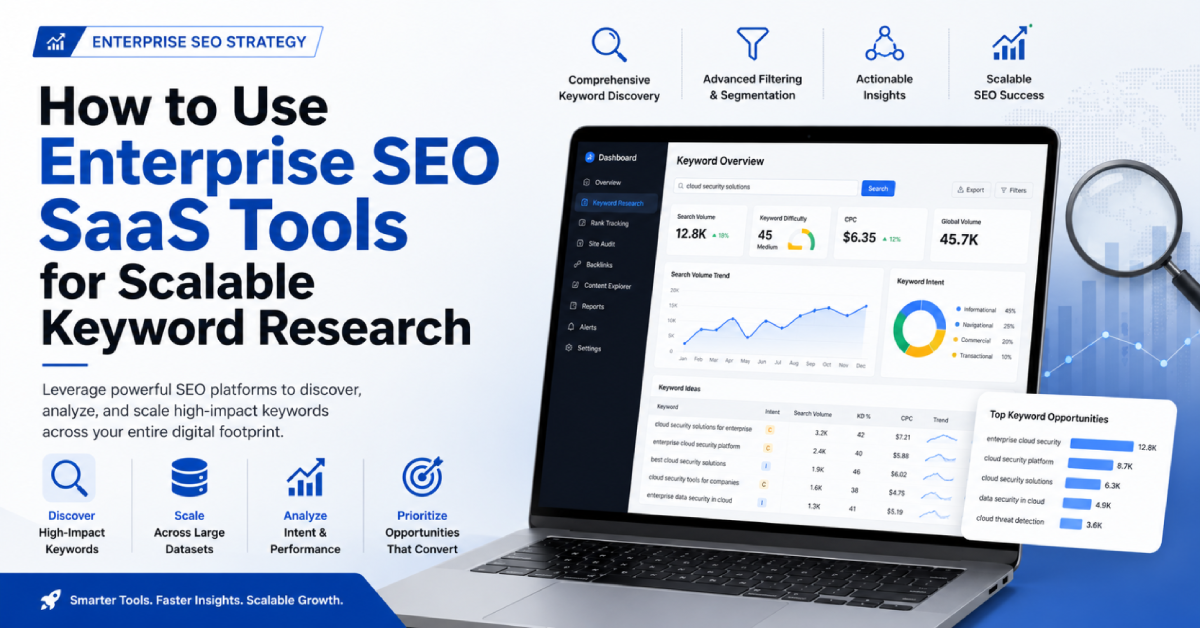
How to Use SEO SaaS Tools for Scalable Keyword Research
Keyword research is where SEO SaaS tools deliver some of their biggest value—because at scale, manual keyword research simply breaks down.
Here’s a practical approach to scalable keyword research:
- Start with seed topics, then let the tool expand them into hundreds of related queries
- Cluster keywords by intent and topic, so related terms are grouped rather than scattered
- Filter by difficulty and opportunity, prioritizing realistic wins over aspirational head terms
- Map clusters to content, deciding which deserve dedicated pages versus sections
- Track performance over time, refining clusters as data reveals what actually ranks
The advantage of doing this in a SaaS platform is consistency. Instead of researching keywords one at a time in spreadsheets, you process them in organized batches—and the tool maintains the relationships between them. This is what makes keyword research genuinely scalable rather than just faster.
How SEO SaaS Tools Improve Content Marketing
Content marketing depends on relevance and clarity. SEO SaaS tools support both.
With these tools, you can identify content gaps, plan topic clusters, and optimize existing pages—all from organized data rather than guesswork. This creates a more structured content strategy where every piece has a clear purpose and place.
The connection between keyword research and content is where these tools shine. Once keywords are clustered by intent, the content plan almost writes itself: each cluster becomes a pillar page with supporting articles. For the strategy side of this, see my content strategy guide.
A Step-by-Step Framework for Using SEO SaaS Tools
Here’s a practical framework for putting these tools to work effectively.
Step 1: Define Your Goals
Decide what you’re optimizing for — more traffic, better rankings, or higher conversions. Your goal shapes which features and metrics matter most.
Step 2: Audit Your Website
Identify technical issues, weak content, and keyword gaps. A clear baseline tells you where the biggest opportunities are.
Step 3: Build Keyword Clusters
Group keywords by topic, intent, and difficulty. This organized structure becomes the foundation of your content plan.
Step 4: Optimize Content
Improve structure, clarity, and relevance based on the tool’s insights—while applying your own judgment about what genuinely serves readers.
Step 5: Monitor Performance
Track rankings, engagement, and traffic trends over time. Consistent monitoring reveals what’s working and what needs adjustment.
Step 6: Refine Strategy
Adjust based on real results. SEO is iterative — the data from each cycle improves the next.
SEO SaaS Tools vs Traditional SEO Methods
Understanding the difference clarifies why these tools matter at scale.
Factor |
Traditional SEO |
SEO SaaS Tools |
|
Data management |
Manual tracking, spreadsheets | Centralized platform |
|
Analysis speed |
Slower, manual | Faster, automated |
| Workflow | Disconnected tools |
Scalable, integrated |
| Consistency | Varies by person |
Standardized |
| Best for | Small sites, simple needs |
Growing sites, scale |
Traditional methods work fine for small sites. But as complexity grows, the manual approach breaks down — and that’s precisely when SaaS tools justify their cost. The key is recognizing when you’ve crossed that threshold.
Practical Use Cases by Business Type
Different businesses use SEO SaaS tools in different ways.
Business Type |
Primary Uses |
|
Bloggers |
Find content ideas, optimize articles, track rankings |
|
Agencies |
Manage multiple clients, generate reports, track performance |
| E-commerce |
Optimize product pages, track seasonal trends, improve category structure |
| Local businesses |
Track local keywords, optimize listings, monitor competitors |
Agencies especially benefit, because managing SEO for multiple clients manually is nearly impossible. Centralized dashboards and automated reporting turn what would be days of work into hours — while keeping every client’s data organized and separate.
Common Mistakes to Avoid
SEO SaaS tools are powerful, but they’re easy to misuse. Here are the most common mistakes.
Mistake |
Why It’s a Problem |
|
Over-reliance on tools |
Tools provide data, not strategy |
|
Ignoring search intent |
Accurate data fails without intent alignment |
| Focusing only on metrics |
Metrics should guide decisions, not replace thinking |
| Not updating content |
SEO requires continuous improvement |
| Using too many tools |
Too many platforms create confusion |
The biggest trap is over-reliance. Tools generate data and recommendations, but they don’t understand your audience, your brand, or your market context. Treating tool output as strategy—rather than input to strategy—is how sites end up technically “optimized” but strategically lost. The best results come from combining tool data with human judgment.
SEO SaaS Tools and AI Integration
Modern SEO SaaS tools increasingly use AI to analyze patterns, predict trends, and improve recommendations. This makes them faster and more capable than earlier generations.
However, human input remains essential. AI can surface patterns and suggest actions, but it can’t replace strategic thinking, brand understanding, or creative judgment. The most effective approach uses AI to accelerate research and analysis while keeping humans in charge of strategy and final decisions. AI handles scale; humans handle meaning.
How SEO SaaS Tools Support E-E-A-T
E-E-A-T (Experience, Expertise, Authoritativeness, Trustworthiness) is central to modern SEO. SEO SaaS tools support it indirectly.
They help by improving content structure, ensuring consistency across pages, and supporting accuracy through data. While tools can’t create genuine expertise, they help you present and organize your expertise in ways that both users and search engines recognize. Clear structure, consistent quality, and accurate information all reinforce trust signals — and tools make these easier to maintain at scale.
Measuring ROI from SEO SaaS Tools
SEO SaaS tools represent an investment, so measuring their return matters.
ROI comes from improved rankings, better engagement, and increased traffic. To assess whether a tool is worth its cost, track what improves after implementation and connect those improvements to business outcomes.
Tracking helps identify what works and what needs improvement. The clearest sign a tool is delivering ROI: you’re making faster, better-informed decisions than you could manually, and those decisions are producing measurable gains in visibility and traffic. If a tool isn’t changing your decisions, it isn’t earning its cost.
The Future of SEO SaaS Tools
These tools will continue evolving alongside search itself. Key trends include:
- Deeper AI integration for analysis and recommendations
- Better search intent analysis as language models improve
- More automation, balanced with human oversight
The direction is clear: tools will handle more of the analytical heavy lifting, freeing humans to focus on strategy and creativity. But the fundamental balance won’t change—tools organize and analyze; humans decide and create. The platforms that succeed will be those that enhance human judgment rather than trying to replace it.
FAQs
1. What are SEO SaaS tools used for?
SEO SaaS tools are used to manage and improve SEO through structured data analysis, reporting, and automation. These cloud-based platforms help track keyword performance, identify technical issues, and organize content strategies in one place—making SEO more efficient and easier to scale as a website grows in size and complexity.
2. Are SEO SaaS tools necessary for small websites?
Not always at the beginning. Small sites can manage SEO with basic tools and manual tracking. However, as a website grows in content, traffic, or competition, SEO SaaS tools become increasingly useful for maintaining organization and making informed decisions. The need scales with complexity — the bigger the site, the greater the benefit.
3. Can SEO SaaS tools improve rankings?
SEO SaaS tools support ranking improvements by providing insights and recommendations, but they don’t improve rankings on their own. Results depend entirely on how effectively those insights are applied within a clear strategy. The tool identifies opportunities; your execution determines whether rankings actually improve.
4. How do SEO SaaS tools help with content marketing?
They help identify relevant topics, structure content properly, and track how well content performs over time. By clustering keywords and revealing content gaps, they make it easier to plan topic clusters and pillar content. This allows for a more structured content strategy and continuous improvement based on real performance data.
5. Do SEO SaaS tools replace SEO experts?
No. SEO SaaS tools assist with data collection, analysis, and reporting, but human expertise remains essential for strategy, creativity, and decision-making. Tools can tell you what’s happening and suggest actions, but they can’t understand your audience, brand, or market context the way an experienced SEO professional can.
6. How often should SEO data be reviewed?
SEO data should be reviewed regularly, especially after publishing new content or making significant updates. Regular review ensures performance stays aligned with your goals and helps you catch issues or opportunities early. For active sites, a consistent weekly or monthly review rhythm works well, with deeper analysis after major changes.
7. Are SEO SaaS tools suitable for beginners?
Yes, SEO SaaS tools are suitable for beginners, but having a basic understanding of SEO helps users apply insights more effectively. Without foundational knowledge, it’s easy to misinterpret data or follow recommendations blindly. Beginners get the most value when they pair the tools with ongoing SEO learning.
8. How many SEO SaaS tools should I use?
Fewer than you might think. Using too many tools creates confusion, data conflicts, and wasted spend. Most sites are better served by one or two well-chosen platforms that cover their core needs than by a fragmented stack of overlapping tools. Focus on tools that genuinely change your decisions rather than duplicating features.
Final Thoughts
SEO SaaS tools represent a shift in how optimization is managed, especially as websites grow in size and complexity. Instead of handling tasks manually, they provide structure, actionable insights, and improved efficiency across different areas of SEO.
From my experience, the most effective approach is balanced. Tools should be used to organize data, track performance, and identify opportunities—but they work best when combined with human judgment. Strategy, creativity, and decision-making still depend on understanding your audience, goals, and market context.
This balance helps avoid over-reliance on automation while still benefiting from data-driven insights. It also ensures that changes are intentional rather than reactive. A tool should sharpen your decisions, not make them for you.
In the long run, SEO success comes from clarity, consistency, and adaptability. Clear structure makes it easier to manage growth, consistent effort builds long-term results, and adaptability lets you respond to changes in search behavior and algorithms. SEO SaaS tools support all three — but only when guided by genuine SEO understanding.
For questions about choosing or using SEO tools for your own site, feel free to reach out through my Contact page.
For more SEO guides, browse Search Engine Realm.
Last Updated: July 2026