

Topical authority is one of those concepts that feels like theory—until you see what happens when it’s missing.
In real content marketing — big blogs, SaaS platforms, niche publishers, even service sites — the effect doesn’t show up as a dramatic ranking jump. It shows up as stability. Pages index faster. Rankings fluctuate less. New content finds its place more easily instead of competing with what’s already there. Organic growth compounds over time instead of resetting every few months.
I’m Zohanuddin Shaikh, an SEO consultant based in Karachi, Pakistan, with 8 years of experience. I’ve worked on sites where the content was good, the backlinks were solid, and technical SEO wasn’t obviously broken—and yet the growth stalled. The problem was almost never keyword research or publishing frequency. It was the absence of topical authority to develop, group, and reinforce content over time.
Without that structure, search engines struggle to identify which pages matter most and how topics connect. It isn’t a trend or a shortcut—it’s the underlying structure that helps search engines understand how relevant, trustworthy, and deep your content really is.
What Topical Authority Actually Is
Many people think topical authority is about “being an expert” or publishing a lot of content. Search engines don’t work that way.
In SEO terms, topical authority comes from a site that consistently demonstrates:
- Depth in a specific subject area
- Clear connections between related pages
- Stable intent mapping
- Repeated relevance signals over time
You don’t tell search engines you’re an expert—they infer it from how your content is grouped, updated, linked, and crawled.
In audits, I frequently find sites with excellent individual content that still underperform, because those pages stand alone. The content itself isn’t bad. The context around it is weak. Topical authority fixes that by making each post part of a system search engines can recognize.
Topical Authority vs Domain Authority
These two are often confused, but they’re fundamentally different.
|
Factor |
Domain Authority | Topical Authority |
|
What it is |
Third-party metric (Moz, etc.) | How search engines perceive subject depth |
|
Based on |
Backlinks and domain strength | Content structure and intent signals |
| Scope | Whole site |
Specific subject areas |
| How it’s built | Earning links over time |
Clustering and connecting related content |
| Who can win | Favors large, established sites |
Small focused sites can compete |
You can have high domain authority, strong backlinks, and good technical health—and still struggle to rank consistently if your content planning isn’t focused on specific topics.
I’ve seen small sites outperform much larger ones simply because their content was tightly clustered, each page reinforced the core topic, and internal linking signaled intent rather than just navigation. Topical authority doesn’t replace domain authority, but it can compensate for a weaker link profile — especially in competitive niches.
How Topical Authority Changes Content Planning
When a team commits to owning a subject, content planning stops being a keyword list and starts looking like a map.
Instead of asking, “What should we publish next?” the question becomes, “What subject are we trying to dominate, and what’s missing from it?”
This shift has real effects:
- Less overlap between pages
- Clearer links between pillars and clusters
- Better logic for internal linking
- Easier decisions about what not to publish
A pattern I’ve seen repeatedly: teams with a topical authority strategy publish less content but get more out of each page.
The Real Benefits of Topical Authority for Rankings
Topical authority doesn’t guarantee high rankings—but it changes how rankings behave.
Benefit 1: Rankings Stay Stable
Without topical authority, rankings tend to swing up and down. With it, they stabilize. In audits, this shows up as fewer unstable URLs, less keyword cannibalization, and clear primary pages carrying core queries. Search engines reward consistent intent mapping.
Benefit 2: New Content Ranks Faster
When a site already has authority on a subject, new content in that area often indexes faster, appears in search results sooner, and needs fewer backlinks to gain visibility. This isn’t magic — it’s accumulated relevance.
Benefit 3: Older Content Holds Longer
Ranking retention is an underrated benefit. I’ve seen older pages survive algorithm updates because they were surrounded by fresh, supportive content instead of standing alone.
How Topical Authority Improves Crawl and Indexing
This is where topical authority becomes visible in tools like Google Search Console.
Without Topical Structure |
With Strong Topical Authority |
|
Random crawl frequency |
Crawlers revisit important sections more |
|
Key pages compete with low-value URLs |
Supporting pages discovered naturally |
| Slow re-crawling of new pages |
Crawl budget used efficiently |
| Fragmented discovery |
Clear priority signals |
A common pattern: when a site groups thin pages into thematic clusters and reduces low-value indexed URLs, crawl activity on key pages increases—and rankings gradually improve, often without publishing anything “new.” That’s topical authority at work, not publishing volume.

Content Clustering: Where Topical Authority Becomes Real
How content is grouped determines whether topical authority survives or fades.
A healthy cluster usually has:
- One main pillar page for each core intent
- Supporting pages answering sub-questions
- Clear internal relationships
- Minimal overlap between pages
Over-clustering is what frequently goes wrong:
- Too many pages answering the same question
- Slightly different angles competing with each other
- Clusters that grow without ever being pruned
In audits, I often see clusters that started clean but became noisy over time because no one revisited the original intent map. Topical authority needs maintenance, not just planning.
What Commonly Goes Wrong in Real Audits
Problem |
What It Causes |
|
Targeting keywords, not subjects |
Fragmented coverage, cannibalization |
|
Letting old content decay |
Outdated pages drag down authority |
| Template-based internal linking |
Footer/automatic links don’t signal intent |
| No limits on cluster size |
Relevance dilutes as clusters grow |
The most damaging issues are subtle. Keywords should help you discover subjects — not define them. Internal links should follow intent logic, not navigation templates. And every cluster needs boundaries, or relevance fades.
Topical Authority for Small Businesses and Lean Teams
Some people assume topical authority is only for large sites. In reality, small businesses often benefit the most because they can
- Focus on fewer subjects
- Make each page count more
- Maintain content more easily
Instead of chasing broad markets, I’ve seen small sites win by completely dominating niche topics. It lets limited resources compound on each other—which is exactly what a lean team needs.
A Practical Topical Authority Diagnostic
Before adding any new content, ask these four questions:
Question |
If the Answer Is Unclear |
|
What topic does this strengthen? |
The content probably doesn’t belong |
|
Does this compete with an existing page? |
Consolidation may be better |
| Will this still make sense in a year? |
Short-lived intent weakens authority |
| How will this be reinforced internally? |
Standalone pages rarely build authority |
If these answers aren’t clear, the content probably won’t last.
How Topical Authority Fits Into Content Marketing
It connects the four parts of a content system: planning, publishing, updating and pruning, and performance analysis. It transforms content marketing from a calendar-driven activity into an ecosystem.
When topical authority is present, growth feels consistent, rankings feel earned, and decisions become clearer. When it’s absent, teams work harder for less. For a broader framework on this, see my SEO growth strategy guide.
FAQs
1. What are the main benefits of topical authority in SEO content planning?
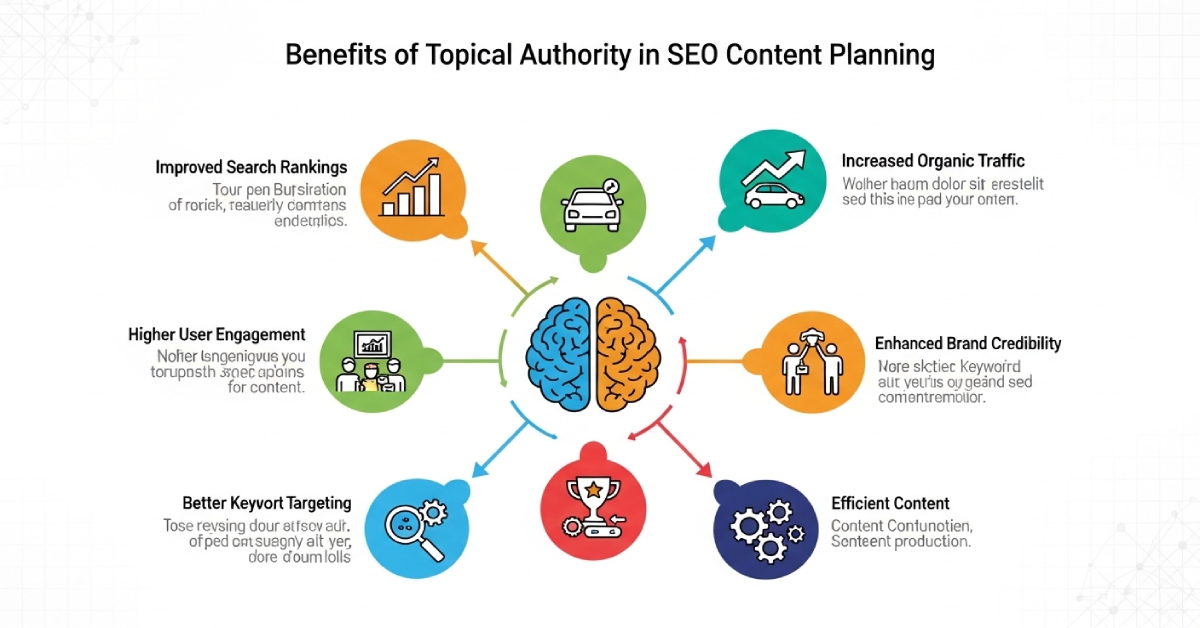
The main benefits are more stable rankings, faster indexing of new content, better intent mapping, improved crawl efficiency, and sustainable long-term organic growth. Rather than producing dramatic spikes, topical authority creates consistency — fewer ranking swings and fewer problems to fix.
2. How long does it take to build topical authority?
It typically takes months, not weeks. Topical authority compounds over time as you publish consistent, connected content within a subject area and reinforce it through internal linking. New sites can start building it early, which is easier than retrofitting it later.
3. Is topical authority a replacement for link building?
No, but it reduces how much you depend on links for every new page. With strong topical authority, new content in an established subject area can rank with fewer backlinks because the surrounding context already signals relevance. Both work best together.
4. Is topical authority helpful for new websites?
Yes — in fact, it’s easier to build early than to retrofit later. New sites that focus on a few tightly clustered topics, rather than publishing broadly across many subjects, tend to establish authority faster and rank more consistently within their niche.
5. How do you measure topical authority?
There’s no single metric. Instead, look at ranking stability, crawl behavior in Search Console, reduced internal competition (less cannibalization), and cluster-level performance. Improvement across these signals together indicates growing topical authority.
6. What’s the difference between topical authority and domain authority?
Domain authority is a third-party metric based on backlinks and overall domain strength. It is how search engines perceive your depth within a specific subject. A small site with strong topical authority can outrank a larger site with higher domain authority in a focused niche.
Final Thoughts
The benefits of topical authority rarely show up as dramatic wins or sudden ranking jumps. Instead, they show up as fewer problems to fix—fewer pages stuck in limbo, fewer cannibalization issues, and fewer unexplained traffic dips.
I’ve seen content strategies fail not because teams lacked effort, budget, or good ideas, but because the content was never organized into a structure search engines could rely on over time. Articles were published in isolation. Topics didn’t reinforce each other. Older pages slowly decayed while new ones competed for attention. Everything looked active on the surface, but the signals underneath were fragmented.
It makes a content marketing plan durable. It gives search engines a clear picture of what a site understands well, which pages matter most, and how new content fits the structure. When that map exists, indexing speeds up, rankings stabilize, and updates maintain momentum instead of restarting it.
The sites that grow steadily aren’t chasing more traffic or newer tactics. They plan coverage deliberately, build depth before breadth, and reinforce core topics before expanding. They don’t publish more—they publish the right content, reinforced consistently, until real authority accumulates.
For questions about the topic, feel free to reach out through my Contact page.
For more SEO guides, browse Search Engine Realm.
Last Updated: June 2026