

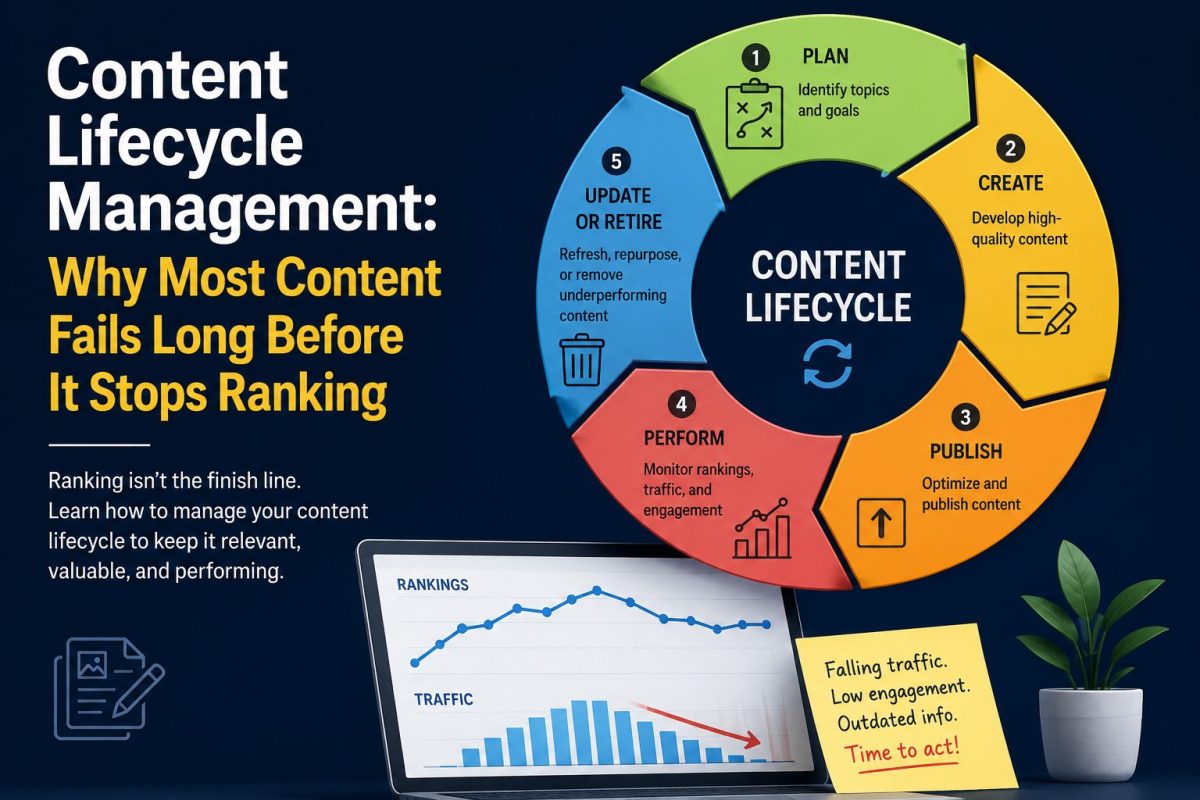
Content lifecycle management is the discipline of managing a page from creation through growth, maintenance, and eventual retirement—ensuring it stays crawled, indexed, relevant, and valuable over its entire life, not just at publication.
Most content marketing doesn’t fail because teams stop publishing. It fails because no one plans what happens after publishing. That gap is where content lifecycle management becomes essential.
I’m Zohanuddin Shaikh, an SEO consultant based in Karachi, Pakistan, with 8 years of experience. In real SEO work—large blogs, SaaS platforms, online stores, and media publishers—content doesn’t disappear when it stops performing. It stays indexed, gets crawled, and silently competes with newer pages. Over time, this buildup changes how search engines perceive a site’s relevance, focus, and overall trust.
I’ve audited sites with thousands of published URLs where 70-80% of indexed pages no longer matched what people were searching for. The rankings hadn’t collapsed, but growth had stalled. New content struggled to surface. Crawl frequency dropped in the wrong places. Trust signals became unreliable. It wasn’t a lack of effort or originality. It was neglect of the content lifecycle.
This guide covers what content lifecycle management actually is, the phases every page goes through, how to manage content decay, and the metrics that reveal problems long before traffic collapses.
What Is Content Lifecycle Management in SEO?
Content lifecycle management in SEO is the process of overseeing content from creation to decay—making sure pages are properly crawled, indexed, evaluated, maintained, and reinforced throughout their lifespan and retired when they no longer serve a purpose.
It treats content as a living system rather than a one-time deliverable. Instead of publishing and forgetting, lifecycle management asks, “What happens to this page over the next six months, year, and beyond?”
The discipline connects several SEO areas that are often treated separately:
- Topic planning
- Search intent mapping
- Technical SEO health
- Internal linking logic
- Authority reinforcement
When these work in isolation, content ages quickly. When they work in sync, content compounds in value over time.
Content Lifecycle Management vs Content Strategy
These two terms are frequently confused, but they answer different questions.
Aspect |
Content Strategy |
Content Lifecycle Management |
|
Core question |
What content should we create? | What happens to content after publishing? |
|
Focus |
Planning and creation | Maintenance, reinforcement, retirement |
|
Timeframe |
Pre-publication |
Entire lifespan of the page |
| Primary activity | Topic and keyword planning |
Auditing, updating, pruning, consolidating |
| Success measure | Content gets published |
Content stays relevant and ranks over time |
| Common tool | Editorial calendar |
Lifecycle framework + crawl/index data |
A content calendar tells you when content goes live. A lifecycle framework tells you what happens to it afterward. Content strategy tells you what to make; lifecycle management tells you how to keep it valuable. Both are necessary—but most teams only invest in the first.
Content Doesn’t Stay “Good” Just Because It Once Ranked
One of the biggest misconceptions in SEO is that ranking content stays useful forever. Every page moves through a performance lifecycle, whether you manage it or not:
- Discovery and initial indexing
- Early ranking fluctuations
- Stabilization around intent
- Gradual decay or reinforcement
Most teams only manage the first stage.
I’ve seen evergreen guides lose value not because competitors published something better but because over time the original page accumulated outdated examples, declining performance, internal competition, and drifting intent.
From an SEO perspective, uncontrolled content decay doesn’t look dramatic. It looks like this:
- Re-indexing taking longer
- Rankings softening for long-tail queries
- Less frequent crawling
- New pages taking longer to gain traction
This is exactly when managing the content lifecycle becomes more important than producing more content.
The Four Phases of the Content Lifecycle
This is the framework I use when reviewing content-heavy sites. It’s crawl-aware and index-aware—not theoretical.
Phase 1: Discovery and Qualification
Before publishing, every page should earn its place. Ask:
- Is this intent already covered elsewhere on the site?
- Does this strengthen an existing URL or compete with it?
- Will this page earn long-term relevance, or is it short-lived?
If a page doesn’t strengthen the site’s topical structure, it probably doesn’t deserve its own lifecycle. This phase prevents index bloat before it starts.
Phase 2: Early Performance Monitoring
The first 30-90 days matter more than most teams realize. During this window, monitor:
- Crawl frequency (how often Google returns)
- Index stability (does it stay indexed?)
- Query spread (how many queries it surfaces for)
- Engagement patterns (do users stay?)
Weak early signals often predict long-term underperformance. Catching them early is far cheaper than fixing decay later.
Phase 3: Stabilization or Reinforcement
Pages that stabilize should be actively reinforced through:
- Clearer internal linking
- Contextual content updates
- Performance improvements
Pages that don’t stabilize need early intervention — before they drift into decay and drag down site-wide signals.
Phase 4: Decay Management
This is where content decay management becomes critical. When a page declines, the options are:
- Refresh — update context, examples, and data
- Merge — consolidate into a stronger related page
- Redirect — strategically point to a better URL
- Remove—deindex if it no longer serves any purpose
Ignoring decay creates index bloat, which weakens the entire site’s trust signals.
How to Manage Content Decay
Content decay is the gradual decline in a page’s rankings, traffic, and relevance over time. Managing it means diagnosing why a page is declining and choosing the right intervention.
The common causes of content decay:
Cause |
What Happens |
Best Fix |
|
Outdated information |
Examples, stats, or facts become stale | Refresh with current data |
|
Intent drift |
What users want has shifted | Realign content to new intent |
| Internal competition | Multiple pages target the same query |
Merge or differentiate |
| Declining performance | Slow load, poor UX |
Technical improvements |
| Stronger competitors | Better content now ranks |
Add genuine depth and value |
The key is diagnosis before action. Refreshing a page that’s actually suffering from internal competition won’t help — you’d need to consolidate instead. Matching the fix to the cause is what separates effective decay management from busywork.
When to Update vs Merge vs Delete Content
One of the most common questions in content lifecycle management is what to do with an underperforming page. Here’s a clear decision framework.
Situation |
Recommended Action |
Why |
|
Intent still valid, content outdated |
Update / Refresh | The page still serves a purpose |
|
Two pages target the same intent |
Merge / Consolidate | Stops internal competition |
| The page has authority but wrong URL | Redirect |
Preserves earned authority |
| The page serves no intent, no traffic, no links | Remove / Deindex |
Cleans up index bloat |
| Page is strong and stable | Reinforce |
Strengthen with internal links |
The general principle: update when intent is still valid but execution has aged; merge when pages compete; redirect when authority should be preserved; remove only when a page adds nothing and dilutes site-wide quality.
Content Audit and Pruning: Not About Deleting Pages
Many people assume pruning means deleting large amounts of content. In reality, content auditing and pruning are about maintaining index quality—and deletion is only one of several tools.
Pruning a content library means systematically reviewing every indexed page and deciding whether to keep, improve, consolidate, or remove it based on its contribution to the site’s overall authority.
I’ve seen corporate and SaaS sites restore crawl efficiency and ranking stability simply by merging similar pages and clarifying intent hierarchies—without deleting much at all. When done well, pruning doesn’t weaken authority; it concentrates it.
A healthy pruning process:
- Identifies pages that are indexed but serve no current intent
- Consolidates overlapping pages into stronger single resources
- Redirects retired URLs to preserve any earned authority
- Removes only genuinely valueless pages from the index
The goal isn’t a smaller site — it’s a clearer, more focused one that search engines can evaluate with confidence.
Content Lifecycle Analytics That Actually Matter
Most dashboards track pageviews, rankings, and conversions. Those are lagging indicators — by the time they drop, decay has already happened.
For lifecycle management, the leading indicators matter more:
Metric |
What It Reveals |
Why It Matters |
|
Crawl frequency trends |
How often Google revisits pages | Declining crawls signal fading relevance |
|
Index coverage stability |
Whether pages stay indexed |
Drops reveal quality or signal issues |
| Query overlap between URLs | Internal competition |
High overlap = cannibalization risk |
| Internal competition signals | Pages fighting for the same query |
Identifies merge candidates |
These metrics tell you when content is aging poorly long before traffic collapses. Watching them is the difference between proactive lifecycle management and reactive damage control.
What Usually Goes Wrong (From Real Audits)
Across many content-heavy audits, the same mistakes repeat.
Mistake 1: Confusing Content Decay with Algorithm Volatility
Teams often blame ranking drops on algorithm updates. But when you map the affected URLs, the pattern is usually consistent: outdated examples, drifting intent, slower performance, and newer internal competitors. That’s not an algorithm problem — it’s mismanaged lifecycle decay.
Mistake 2: Never Actually Updating “Evergreen” Content
“Evergreen” too often means “never looked at again.” In reality, evergreen content needs more lifecycle maintenance, not less. Without updates, evergreen pages gradually lose trust signals and semantic relevance.
Mistake 3: Auditing Traffic Instead of Index Quality
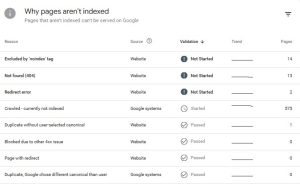
Many audits only review traffic stats. They miss pages that are still crawled, indexed, and evaluated but contribute nothing of value. These pages weaken site-wide signals and waste crawl budget.
Mistake 4: Publishing More Instead of Fixing Structure
When growth slows, the instinct is to publish more. In practice, I’ve repeatedly seen organic growth improve after reducing indexed pages and reinforcing key URLs—the opposite of publishing more.
The Trade-Off: Publishing Velocity vs Content Longevity
There’s a real tension in content marketing between speed and durability.
Approach |
Strength |
Weakness |
|
High publishing velocity |
Quick visibility, fresh content |
Spreads resources thin, creates bloat |
| Lifecycle focus (longevity) | Durable authority, stable rankings |
Slower initial visibility |
Publishing quickly creates short-term visibility. Long-term authority comes from lifecycle management. You can’t maximize both forever.
From what I’ve seen, teams that deliberately slow publishing to reinforce existing content outperform volume-focused teams over time. This is especially true for SaaS and enterprise content lifecycle management, where trust and consistency matter more than novelty.
A Simple Content Lifecycle Diagnostic
Before approving or reviewing any page, run it through these five questions:
- Does this page still satisfy the most common search intent for its target?
- Is it supported internally (links) or externally (backlinks)?
- Is it technically healthy (speed, crawlability, indexing)?
- Does it strengthen or weaken topical authority?
- Is there a clear maintenance plan for it?
If you can’t confidently answer at least three of these, the page is probably creating long-term drag on the site.
How Content Lifecycle Management Supports Organic Growth
Organic growth doesn’t come from constant publishing — it comes from clearer signals over time.
In real audits, I’ve seen growth accelerate after:
- Consolidating pages targeting the same intent
- Refreshing high-authority URLs with current information
- Removing low-value indexed content
- Improving crawl efficiency across the site
None of this looks exciting on a content calendar. But it consistently works—because it strengthens the signals search engines actually rely on.
For a broader framework on building durable authority, see my topical authority guide, and for the technical foundation, my technical SEO audit guide.
FAQs
1. What does content lifecycle management mean in SEO?
Content lifecycle management in SEO is the process of managing content from creation through decay—ensuring pages are properly crawled, indexed, evaluated, and reinforced over time and retired when they no longer serve a purpose. It treats content as a living system that needs ongoing maintenance, not a one-time publication.
2. How is content lifecycle management different from content strategy?
Content strategy tells you what content to create and why. Content lifecycle management tells you what happens to that content after it’s published — when to update it, merge it, redirect it, or remove it. Strategy is pre-publication planning; lifecycle management is the ongoing stewardship that keeps content valuable.
3. Do all pages need lifecycle management?
Not every page needs active, hands-on management — but every indexed page affects site-wide signals. That’s the key distinction. Even a forgotten, low-value page influences how search engines evaluate your site’s overall quality and focus, which is why index-level awareness matters for the whole library.
4. When should content be updated instead of replaced?
Update content when the search intent is still valid but the context, performance, or clarity has declined—e.g., outdated examples, stale statistics, or weaker structure. Replace or merge content only when the intent itself has shifted or when multiple pages compete for the same query and consolidation would be stronger.
5. Does removing content help SEO?
Yes—when removal improves index quality, speeds up crawling, and clarifies internal structure. Deleting or deindexing genuinely valueless pages can strengthen the signals around your important pages. However, removal should preserve any earned authority through strategic redirects when the URL has backlinks or historical value.
6. What metrics indicate content decay?
The strongest leading indicators are declining crawl frequency, unstable index coverage, increasing query overlap between URLs, and internal competition signals. These reveal aging content long before traffic drops. Traditional metrics like pageviews and rankings are lagging indicators — by the time they fall, decay has already set in.
7. How often should I audit my content lifecycle?
For active, content-heavy sites, a lighter review every quarter and a deeper audit once or twice a year works well. The cadence should match your publishing speed — sites that publish frequently accumulate lifecycle issues faster and benefit from more regular reviews to prevent index bloat from building up unnoticed.
8. What is content pruning, and is it safe?
Content pruning is the systematic review of indexed pages to decide whether to keep, improve, consolidate, or remove each one based on its value. Done correctly, it’s safe and beneficial — it concentrates authority rather than weakening it. The risk comes from deleting pages with backlinks or historical authority without proper redirects.
Final Thoughts (H2)
Content marketing goes beyond ideas and publishing. The real differentiator is stewardship — taking ongoing responsibility for content after it goes live.
The best-performing sites I’ve worked with didn’t publish the fastest. They improved existing pages, consolidated overlapping topics, and reinforced authoritative URLs. They prioritized clarity—clear intent, clear thematic boundaries, and clear internal signals search engines could trust—over raw volume.
Content lifecycle management is what quietly separates sites that grow steadily from those that stall despite constant effort. It governs how content ages, stays relevant, and builds trust at scale. Without it, even good content competes against itself, fragmenting signals and slowing organic growth.
Louder publishing schedules and bigger calendars rarely drive lasting organic success. What drives it is control, consistency, and the willingness to revisit, merge, or retire content deliberately. Content that is actively managed — updated, consolidated, or retired with purpose — is what maintains search visibility, rankings, and growth over the long term.
For questions about managing your own content lifecycle, feel free to reach out through my contact page.
For more SEO guides, browse Search Engine Realm.
Last Updated: June 2026