


Most consumers are unaware that search behavior has altered significantly. Users are no longer browsing leisurely or comparing numerous sites in depth. Instead, people make hasty judgments based on the first piece of material that seems relevant and valuable. This is precisely when Google micro-moments become significant.
A Google micro-moment occurs when someone uses search to meet a specific and urgent need, such as learning something, completing a task, finding a location, or making a choice. These are quick yet powerful moments. Users demand quick responses, and if they do not get them straight away, they go on. People have limited tolerance for confusing or delayed information.
From my perspective, many SEO difficulties nowadays do not begin with rankings. They start with a missed intent. A site may be indexed, technically optimized, and even rank on the first page, yet it still fails to catch attention at the appropriate time. This frequently occurs when the material does not immediately meet the user’s demands.
Over time, this mismatch causes a progressive reduction in traffic rather than dramatic declines. It gets more difficult to detect since everything seems “fine” on the surface.
Understanding Google micro-moments helps to narrow the gap. It moves the emphasis from just ranking better to being valuable at the precise time a person searches.
What Are Google Micro Moments?
Google micro-moments are brief, high-intent search interactions where users expect quick and relevant answers.
These moments usually fall into four categories:
- I want to know learning or researching
- I want to go finding a location
- I want to complete a task
- I want to make a decision
In real scenarios, these often overlap. A user might research, compare, and decide within minutes.
Simple Definition (Featured Snippet Style)
Google micro-moments are short, intent-driven searches where users expect immediate answers or solutions with minimal effort.
Why Google Micro Moments Matter for SEO
Search engines are now focused on speed, clarity, and usefulness.
Instead of only ranking pages based on keywords, they evaluate:
- how quickly a page answers a question
- whether users stay or leave quickly
- if users need to search again
If your content delays answers or feels unclear, it may lose visibility—even if it ranks.
This is why Google micro-moments are closely tied to the following:
- search intent
- user experience
- content structure
How Google Evaluates Micro Moments
Search engines don’t directly label micro-moments. Instead, they observe behavior signals such as the following:
- time to first interaction
- scroll behavior
- query refinement
- return-to-search actions
For example, if a user clicks a page and quickly goes back to search, it signals that the content didn’t meet expectations.
This is often caused by:
- long introductions
- unclear headings
- delayed answers
Common Mistakes That Miss Google Micro-Moments
From practical audits, these issues appear frequently:
1. Delaying the Answer
Users want quick confirmation. Long intros can reduce engagement.
2. Overloading Content
Trying to cover everything can reduce clarity.
3. Ignoring Mobile Behavior
Most micro-moments happen on mobile, where attention is limited.
4. Weak Structure
Poor headings make it harder for users and AI systems to scan content.
5. Missing Next Step
Content solves one problem but doesn’t guide users forward.
Google Micro Moments vs Keywords
Keywords describe what people search.
Google micro-moments explain why they search.
This difference is important.
A keyword-focused page may rank, but it might not perform well if it doesn’t match intent.
For example:
- Keyword: “best running shoes”
- Micro moment: user ready to compare and buy
If the page only provides general information, it misses the moment.
How to Optimize for Google Micro Moments
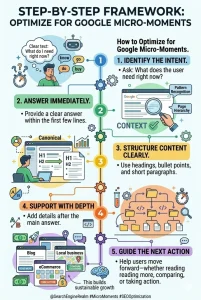
Here is a simple framework you can apply:
Step 1: Identify the Intent
Ask: What does the user need right now?
Step 2: Answer Immediately
Provide a clear answer within the first few lines.
Step 3: Structure Content Clearly
Use headings, bullet points, and short paragraphs.
Step 4: Support With Depth
Add details after the main answer.
Step 5: Guide the Next Action
Help users move forward—whether reading more, comparing, or taking action.
Content Structure That Works for Micro Moments
A strong structure often follows this pattern:
- Quick answer (above the fold)
- Clear explanation
- Supporting details
- Actionable steps
- Related information
This helps both users and AI systems understand your content quickly.
Google Micro Moments and AI Search
AI tools like ChatGPT, Google Gemini, and Perplexity rely on clear and structured content.
To optimize for AI:
- use simple and direct language
- avoid vague explanations
- keep ideas focused
- organize content logically
AI systems tend to prefer content that is
- easy to summarize
- fact-based
- clearly structured
This aligns closely with Google micro-moments.
Real Example of Micro Moment Optimization
Consider a service page targeting urgent queries.
Before optimization:
- long introduction
- contact info buried
- unclear location details
After optimization:
- clear headline
- immediate answer
- visible contact options
- location highlighted
The result is often better engagement and improved conversions—even without major ranking changes.
FAQs
1. What are Google micro-moments in SEO?
Google micro-moments are short, intent-driven searches where users expect immediate answers or solutions.
2. How do Google micro-moments affect rankings?
They influence engagement signals, which can impact visibility and long-term ranking performance.
3. Are Google micro-moments only for mobile users?
No, but they are more common on mobile due to urgency and convenience.
4. How can I optimize content for micro-moments?
Focus on fast answers, clear structure, and matching user intent.
5. Do micro-moments replace keyword research?
No. Keywords are still important, but intent matters more in modern SEO.
6. Why do pages rank but still get low traffic?
Often because they don’t match the user’s micro-moment or fail to deliver quick value.
7. Can small websites benefit from micro-moments?
Yes. Smaller sites can compete effectively by focusing on clarity and intent.
Conclusion
Google micro-moments have changed how SEO works in practice. They’ve shifted the focus away from traditional ranking metrics alone and toward real-time usefulness. It’s no longer just about appearing in search results—it’s about being helpful at the exact moment a user needs something.
Today, users expect immediate clarity. They don’t want to scroll through long introductions or figure things out on their own. Pages that provide quick, direct, and relevant answers are more likely to hold attention and perform consistently over time. Even strong content can underperform if it delays value or creates confusion.
From experience, the most effective approach is straightforward: understand why someone is searching and respond without delay. This means identifying the intent behind the query and structuring content so the answer is easy to find within seconds.
It also involves thinking beyond the first interaction. After answering the main question, the page should guide the user toward the next logical step—whether that’s learning more, comparing options, or taking action.
When content aligns with intent and removes friction, it becomes easier for both users and search engines to trust it. Over time, this builds stronger engagement, more stable visibility, and a more reliable SEO foundation that doesn’t depend on constant adjustments.