


A robust content optimization strategy is sometimes misinterpreted as being difficult or requiring regular publication. According to my experience with actual SEO work, growth seldom comes from doing more; rather, it comes from correcting what is already there.
Large traffic improvements are seldom the result of a single technique. Instead, they come from resolving structural issues that quietly limit performance over time. These difficulties are not always clear. A site may seem busy, with plenty of material and consistent impressions, yet it will still struggle to expand.
That’s when a concentrated content optimization plan comes in handy.
When Traffic Isn’t Low—Just Stuck
Many projects’ problems do not stem from a lack of substance. It is underperformance.
You could see:
- Pages rank on page 2 or 3 with few impressions and few clicks.
- Multiple pages addressing the same issue
- With good material disguised behind bad structure.
From the outside, everything looks to be fine. However, the website’s underlying structure is unclear. Search engines can crawl the pages, but they struggle to identify which are most important.
A content optimization approach helps eliminate the misunderstanding.
1. Start With Intent, Not Keywords
One of the most important shifts is focusing on intent instead of just keywords.
Instead of asking, “Which keywords should this page target?”, I ask:
- What is the purpose of this page?
- What problem does it solve?
- What type of query does it match?
In many cases, multiple pages target similar intent without clear differentiation. This creates internal competition.
The solution is not always deletion—it’s alignment:
- define one primary page for each intent
- adjust supporting pages to complement it
- update internal links to reflect hierarchy
When this is done correctly, search engines gain clarity, and performance often improves gradually.
2. Improve Structure Before Rewriting Content
A common mistake is rewriting entire articles when the issue is actually structural.
In a practical content optimization strategy, small changes often make a bigger impact:
- clearer titles that reflect actual intent
- headings that follow a logical flow
- introductions that get to the point quickly
- better organization of key information
Search engines prioritize clarity. If important information is buried, the page may struggle even if the content is valuable.
3. Align Metadata With Search Intent
Another overlooked area is metadata—especially titles and descriptions.
Sometimes pages rank but fail to attract clicks. This usually comes down to a mismatch between what users expect and what the page offers.
Simple improvements can help:
- avoid vague or generic titles
- match wording to how users search
- reflect the depth and scope of the content
This is not about writing “catchy” titles—it’s about being accurate and clear.
Better alignment often improves click-through rates first, followed by gradual ranking improvements.
4. Focus on Improving Existing Content
A strong content optimization strategy doesn’t rely on constant publishing.
In fact, improving existing pages often delivers better results than creating new ones.
This includes:
- updating outdated information
- removing repetitive or unnecessary sections
- adding missing context
- simplifying explanations
Search engines tend to favor content that is useful and well-maintained over content that is simply new.
Over time, improved pages may:
- receive more consistent crawling
- retain rankings more effectively
- provide better user engagement
5. Use Internal Linking Strategically
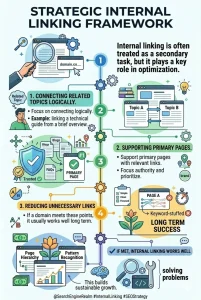
Internal linking is often treated as a secondary task, but it plays a key role in optimization.
Instead of adding links randomly, focus on:
- connecting related topics logically
- supporting primary pages with relevant links
- reducing unnecessary links that dilute focus
Well-structured internal linking helps search engines understand relationships between pages and prioritize important content.
6. Avoid Common Content Optimization Mistakes
From repeated audits, certain patterns appear consistently:
Optimizing pages in isolation
Search engines evaluate how pages relate to each other, not just individual pages.
Publishing more instead of improving existing content
New content can amplify existing problems if structure is weak.
Treating freshness as the main factor
Updating dates without improving substance rarely leads to lasting results.
Ignoring actual search results
Search engine results pages already show what type of content performs well.
Avoiding these mistakes is just as important as applying optimization techniques.
7. Understand That Growth Is Not Always Linear
One important observation is that optimization doesn’t always lead to immediate upward trends.
Sometimes, traffic may dip temporarily. This can happen when:
- weaker pages lose visibility
- search engines reassess site structure
- content consolidation changes ranking signals
This is often part of the process, not a sign of failure.
A well-executed content optimization strategy tends to produce gradual and stable growth rather than sudden spikes.
8. A Practical Content Optimization Checklist
Before optimizing a page, I usually ask:
- Does this page serve a clear purpose?
- Is the intent obvious within the first few seconds?
- Does it compete with another page on the site?
- Is it structured logically?
- Does it offer something useful compared to existing results?
If the answers are unclear, optimization should focus on clarity first.
9. Optimizing for LLMs and AI Search
Modern content also needs to be understandable for AI systems.
To make a content optimization strategy effective in this environment:
- use clear and direct language
- avoid unnecessary complexity
- structure content with headings and logical flow
- keep terminology consistent
- answer questions directly
This improves both human readability and AI interpretation.
FAQs
1. What is a content optimization strategy?
A content optimization strategy focuses on improving existing content so it aligns better with search intent, structure, and user expectations.
2. Is content optimization better than creating new content?
In many cases, yes. Improving existing content can deliver faster and more stable results, especially when pages already have some visibility.
3. How long does content optimization take to show results?
Initial changes may appear within a few weeks, but consistent improvements usually take longer depending on competition and site structure.
4. Does word count matter in content optimization?
Not directly. Content should be as long as needed to fully address the topic without unnecessary filler.
5. Can a content optimization strategy work for small websites?
Yes. Smaller sites often benefit more because they have fewer structural conflicts to resolve.
6. Should all pages be optimized at once?
No. It’s usually better to start with pages that already receive impressions or rank on the second or third page.
7. Does updating content guarantee higher rankings?
No. Updates help when they improve clarity, relevance, and usefulness. Simply changing wording without improving value may not have much impact.
Conclusion
A successful content optimization strategy prioritizes quality over quantity.
From experience, long-term growth results from eliminating confusion—making it simpler for search engines to comprehend what each site represents and why it matters.
Performance improves when material is intent-aligned, well organized, and logically related. Rankings vary less, traffic steadily increases, and the necessity for frequent rework diminishes.
Rather than pursuing short successes, concentrating on clarity, usefulness, and consistency establishes a basis for long-term success.
This is what makes content optimization a dependable strategy—it generates momentum over time rather than depending on short-term results.
.