


If you want to become an SEO expert, you’ve likely seen advice focused on tools, tactics, and quick strategies. While those can help in the beginning, they don’t fully explain how SEO works in practice.
Search engines have evolved. Today, visibility depends less on isolated actions and more on how well a website aligns with user intent, structure, and consistency. That means becoming an SEO expert is not just about learning techniques—it’s about understanding systems and how different elements work together over time.
From experience, many people know what to do at a basic level. They can optimize titles, find keywords, and publish content. But fewer understand why performance changes, why rankings stall, or why some pages never gain traction. These outcomes are often influenced by deeper factors like content clarity, internal linking, and how search engines interpret relevance.
That gap is what separates beginners from those who truly become SEO experts. Experts don’t just follow steps—they analyze patterns, adapt strategies, and make decisions based on how search engines and users actually behave.
What Does It Mean to Become an SEO Expert?
To become an SEO expert means developing the ability to understand, diagnose, and improve how websites perform in search engines based on data, structure, and user intent.
In simple terms:
- beginners follow instructions
- experts interpret situations
- experts make informed decisions
Why SEO Expertise Is About Systems, Not Tactics
Modern SEO is not about isolated actions like adding keywords or building links. It’s about how everything works together.
Search engines evaluate:
- content quality
- internal linking
- crawl behavior
- historical performance
- consistency across pages
If one part is weak, it can affect the entire site.
This is why learning SEO requires more than checklists—it requires understanding patterns.
Core Skills Required to Become an SEO Expert
1. Understanding Search Intent
Search intent is the foundation of SEO.
You need to identify whether users want the following:
- information
- comparison
- action
Matching intent improves rankings and engagement.
2. Technical SEO Awareness
You don’t need to be a developer, but you should understand:
- how search engines crawl pages
- how indexing works
- how site structure affects visibility
This helps prevent hidden issues that block performance.
3. Content Optimization
Content should be:
- clear and focused
- aligned with intent
- easy to navigate
Instead of producing more content, experts improve existing pages.
4. Internal Linking Strategy
Internal links help search engines understand relationships between pages.
A strong structure:
- distributes authority
- improves crawl efficiency
- supports topical relevance
5. Data Interpretation
Tools provide data, but interpretation creates value.
You need to understand:
- why traffic changes
- what affects rankings
- how users interact with content
Step-by-Step Framework to Become an SEO Expert
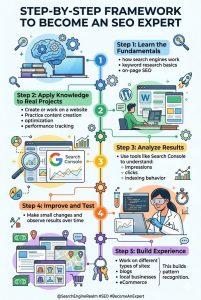
Step 1: Learn the Fundamentals
Start with:
- how search engines work
- keyword research basics
- on-page SEO
Step 2: Apply Knowledge to Real Projects
Create or work on a website.
Practice:
- content creation
- optimization
- performance tracking
Step 3: Analyze Results
Use tools like Search Console to understand:
- impressions
- clicks
- indexing behavior
Step 4: Improve and Test
Make small changes and observe results over time.
Step 5: Build Experience
Work on different types of sites:
- blogs
- local businesses
- eCommerce
This builds pattern recognition.
Common Mistakes When Trying to Become an SEO Expert
1. Focusing Only on Tools
Tools support decisions, but they don’t replace understanding. Relying only on tools can lead to surface-level insights without knowing the real cause of issues.
2. Chasing Quick Results
SEO rewards long-term consistency. Short-term tactics may seem helpful but often don’t lead to stable growth.
3. Ignoring Technical Issues
Hidden technical problems can limit growth. Even strong content won’t perform well if pages aren’t properly crawled or indexed.
4. Overproducing Content
More content doesn’t always mean better performance. Quality, relevance, and structure matter more than volume.
5. Not Analyzing Results
Learning comes from observing outcomes. Without reviewing performance, it’s hard to improve or make informed decisions.
How Long Does It Take to Become an SEO Expert?
Timelines vary, but a realistic range is
- basics: 1–3 months
- practical skills: 6–12 months
- deeper expertise: 1–2+ years
The key factor is consistent practice.
Content Marketing and SEO Expertise
Content marketing plays a major role in SEO.
To become an SEO expert, you need to:
- create helpful content
- answer real questions
- align with search intent
This improves both rankings and user trust.
SEO in the Age of AI and Search Systems
Modern SEO also involves understanding how AI systems interpret content.
To adapt:
- write clearly and directly
- structure content logically
- avoid unnecessary complexity
This helps both search engines and AI tools understand your content.
FAQs
1. What does it mean to become an SEO expert?
It means understanding how to improve search performance through data, structure, and user intent.
2. How long does it take to become an SEO expert?
Most people need 1–2 years of consistent practice to develop strong skills.
3. Do I need coding skills to become an SEO expert?
Basic technical knowledge helps, but advanced coding is not required.
4. Can I become an SEO expert without a website?
You can learn theory, but practical experience is essential.
5. Are SEO tools enough to become an expert?
No. Tools provide data, but expertise comes from interpretation.
6. What is the most important SEO skill?
Understanding search intent and how it connects to content.
7. Is SEO still a good career choice?
Yes. SEO skills remain valuable across many industries.
Conclusion
To become an SEO expert, the focus should not be on shortcuts or quick tactics. It should be on building a deep understanding of how search systems work and how different elements—content, structure, and user behavior—connect over time.
From experience, the most effective approach is simple:
- learn the basics
- apply them consistently
- observe results
- refine your strategy
These steps may seem straightforward, but they require patience and attention. Each stage builds on the previous one, helping you move from theory to practical understanding.
Over time, this process builds confidence and skill. You start recognizing patterns, understanding why certain changes work, and making better decisions without relying on guesswork. Mistakes also become valuable, as they help you see how search engines respond to different actions.
SEO expertise doesn’t come from doing more—it comes from understanding better. When you focus on clarity, consistency, and continuous learning, you create a strong foundation that supports long-term growth. This approach not only improves results but also makes your SEO efforts more stable and predictable over time.