

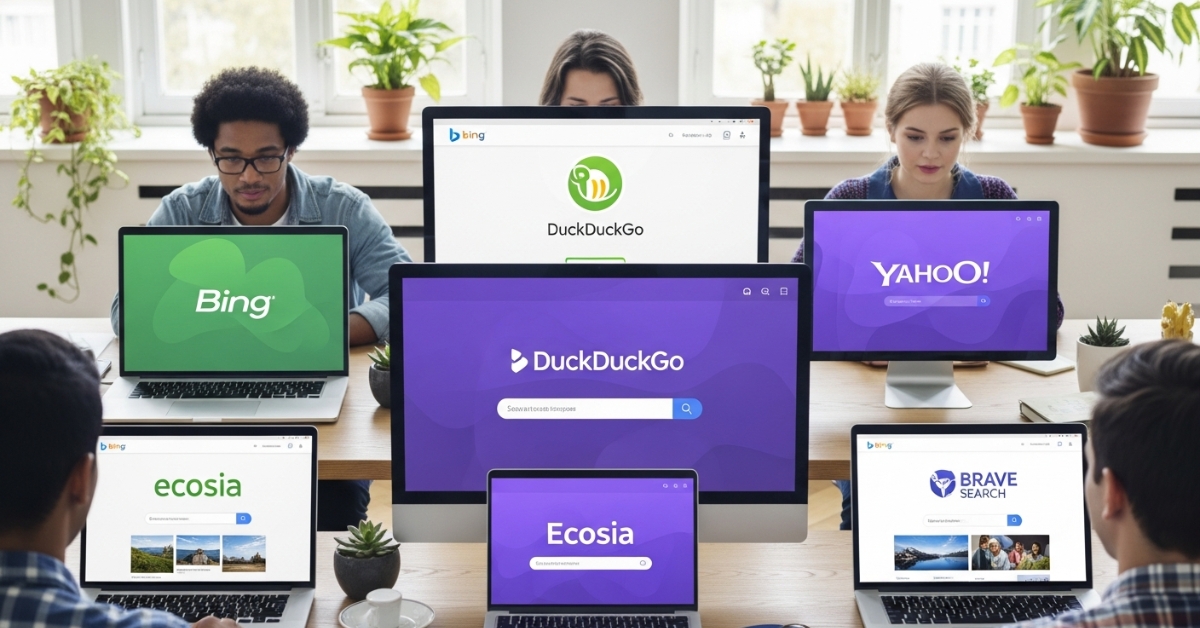
When most people think about searching online, they think Google. And honestly, that makes sense — Google processes over 8.5 billion searches every single day and holds roughly 91% of the global search engine market. But here’s something a lot of website owners and marketers overlook: nearly one in ten searches happens on different search engines other than google.
That might not sound like a lot, but at internet scale, that is hundreds of millions of people every day using different search engines other than Google to find information, shop, watch videos, and discover businesses like yours.
If your SEO strategy only targets Google, you are leaving real traffic on the table. This guide walks you through the most important alternative search engines in 2026, explains how each one works, who uses them, and how you can make your content visible across all of them.
Why You Should Care About Alternative Search Engines
Before we dive into the list, let’s talk about why this matters practically.
Consider this real scenario: A small law firm in Seattle focused their entire digital marketing budget on Google SEO. They ranked well, but their traffic plateaued. When they audited their analytics, they discovered 14% of their website visitors were coming from Bing — a channel they had never once optimized for. After spending just a few hours updating their Microsoft Bing Webmaster Tools profile and adjusting a few meta descriptions, their Bing traffic grew by 40% over the next three months.
That is the opportunity hiding in plain sight. Here are a few reasons to diversify:
- Algorithm risk: Google updates its algorithm hundreds of times each year. Ranking drops on Google can devastate your traffic overnight. If you are also ranking on Bing and DuckDuckGo, you have a safety net.
- Different audiences: Bing’s user base skews older and more affluent. DuckDuckGo users tend to be more tech-savvy and privacy-conscious. Baidu is essentially the only way to reach Chinese internet users. Each platform gives you access to a distinct audience.
- Lower competition: Because most SEOs ignore Bing and other platforms, the competition is far less fierce. It is often much easier to rank #1 on Bing for a competitive keyword than on Google.
- Paid advertising efficiency: Bing Ads (Microsoft Advertising) typically has a lower cost-per-click than Google Ads for the same keywords, sometimes by 30–70%.
The Top 10 Different Search Engines Other Than Google
1. Bing — Microsoft’s Powerhouse
Bing is by far the largest alternative to Google in the English-speaking world. It powers approximately 6% of global searches and significantly more in the United States, where it sits around 8–9% market share. But here is what makes Bing really interesting in 2026: Microsoft has integrated its Copilot AI directly into Bing, making it one of the most capable AI-assisted search experiences available.
Real-world example: Microsoft Surface users, Xbox gamers who look things up on their console, and anyone using a Windows PC that has never changed their default browser settings — they are all using Bing by default. If you sell B2B software or consumer electronics, there is a very good chance your customers are Bing users without even realizing it.
For SEO: Bing Webmaster Tools is free and incredibly useful. Bing places heavier weight on exact-match anchor text and domain age than Google does. If you have been building quality content for a while, Bing will often reward you faster than Google for established websites.
2. DuckDuckGo — The Privacy Champion
DuckDuckGo has exploded in popularity over the past five years, largely because privacy concerns about big tech have gone mainstream. It processes around 100 million searches per day and has built its entire brand around a single promise: we do not track you.
Real-world example: After news broke in 2021 about tech companies tracking user behavior, a wave of users switched to DuckDuckGo. Cybersecurity professionals, journalists, researchers, and everyday users who care about data privacy gravitated to it. If your website serves these audiences — think VPN reviews, financial advice, legal services, healthcare information — DuckDuckGo traffic is highly valuable.
For SEO: DuckDuckGo pulls its results from multiple sources, including Bing, its own crawler, and various specialized APIs. If you rank well on Bing, you will likely rank well on DuckDuckGo too. DuckDuckGo also uses structured data and favors HTTPS sites.
3. Yahoo Search
Yahoo Search may feel like a relic of the early internet, but it still commands a surprisingly large audience — particularly among older demographics and Yahoo Mail users. It actually uses Bing’s index, so optimizing for Bing effectively gets you Yahoo visibility too.
Yahoo’s strength is its integration with Yahoo Finance, Yahoo News, and Yahoo Sports. If your content covers financial topics or news, Yahoo can be a meaningful referral source.
4. Yandex — Russia and Eastern Europe’s Google
Yandex is the dominant search engine in Russia, holding over 60% of market share there, and it is also widely used in Ukraine, Kazakhstan, and Belarus. For businesses with any presence in the CIS region, ignoring Yandex is simply not an option.
Real-world example: A European e-commerce company selling winter outdoor gear discovered through their analytics that 22% of their Russian-speaking customers came through Yandex. They had never optimized for it, yet it was sending them qualified buyers. After registering with Yandex Webmaster and translating key landing pages, their Russian-market revenue grew substantially.
For SEO: Yandex has its own set of ranking factors that differ from Google. It weighs behavioral signals — like time on site and bounce rate — very heavily. It also has its own version of structured data called Yandex Turbo Pages for mobile optimization.
5. Baidu — The Gateway to China
If you want to reach Chinese internet users, Baidu is not optional — it is the only serious option. With over 70% market share in China, Baidu serves billions of searches monthly. Google is effectively blocked in mainland China, which makes Baidu’s dominance even more complete.
For SEO on Baidu, you need a website hosted in China (or with a local CDN), simplified Chinese content, an ICP license (Chinese government internet permit), and ideally a .cn domain. It is a significant investment, but for businesses serious about the Chinese market, there is no substitute.
6. Ecosia — The Search Engine That Plants Trees
Ecosia is a Berlin-based search engine that donates roughly 80% of its profits to tree-planting initiatives around the world. It has planted over 200 million trees since 2009 and has around 20 million active monthly users.
Its user base is environmentally conscious, educated, and predominantly European. If your brand has strong sustainability credentials, Ecosia users are a natural fit. Ecosia also uses Bing’s search index, so your Bing optimization carries over.
7. Brave Search — The Independent Challenger
Brave Search is unique because it is one of the only search engines that does not rely on Google or Bing’s index. It has built its own independent web index from scratch, which makes it the most technically ambitious privacy-first search engine in 2026.
Brave has around 25 million monthly searches, and its user base is almost exclusively made up of people who use the Brave browser—privacy-focused, tech-forward individuals who are skeptical of big tech. While small, this audience is highly engaged and influential.
8. Startpage—Google Results, Without Google Tracking
Startpage’s model is clever: it fetches Google’s search results but acts as a privacy proxy, so Google never sees your personal data. Users get the familiarity of Google rankings with the privacy of a no-track engine. It is particularly popular in the Netherlands and Germany.
9. Naver — South Korea’s Search Giant
In South Korea, Naver beats Google with around 55–60% market share. Naver is not just a search engine — it is a comprehensive content ecosystem with its own blogging platform (Naver Blog), café (online community), knowledge platform (similar to Quora), and shopping search. If your business targets Korean consumers, optimizing for Naver is essential.
10. Swisscows — Family-Safe and AI-Powered
Swisscows is a Swiss search engine that filters adult content by default and uses semantic analysis to understand search intent. It is GDPR-compliant, stores no personal data, and is popular with families and educational institutions across Europe.
Quick Comparison: Different Search Engines Other Than Google
Here is a side-by-side comparison of the top alternative search engines to help you prioritize your efforts:
|
Search Engine |
Country / Focus | Monthly Users | Privacy Level | Best For | Unique Feature |
|
Bing |
USA / Global | ~1.2 Billion | Moderate | Image & Video Search | AI-powered chat (Copilot) |
|
DuckDuckGo |
USA / Privacy | ~100 Million | Very High | Anonymous Browsing | No user tracking ever |
|
Yahoo Search |
USA / General | ~700 Million | Low–Moderate | News & Finance |
Yahoo ecosystem integration |
| Yandex | Russia / CIS | ~3.5 Billion* | Low | Russian-language content |
Best Cyrillic NLP engine |
| Baidu | China / Asia | ~10 Billion* | Low | Chinese content |
Dominant in China (70%+ share) |
|
Ecosia |
Germany / Green | ~20 Million | High | Eco-conscious users | Plants trees with ad revenue |
|
Brave Search |
USA / Privacy | ~25 Million | Very High | Independent index results | No Google/Bing dependency |
| Startpage | Netherlands | ~15 Million | Very High | Google results + privacy |
Proxied Google results |
| Naver | South Korea | ~42 Million | Moderate | Korean content |
Integrated blog & social search |
| Swisscows | Switzerland | ~5 Million | Very High | Family-safe searching |
Semantic AI, no adult content |
* Monthly search queries, not unique users. Data based on 2025–2026 industry estimates.
How to Optimize Your Website for Multiple Search Engines
The good news is that most SEO best practices that work for Google also apply to other search engines. Here is what to focus on:
Universal Fundamentals
- Technical health: Fast loading speeds, mobile responsiveness, clean URL structure, and HTTPS apply everywhere.
- Quality content: Every search engine ultimately wants to surface the most helpful, trustworthy content for its users. Write for humans first.
- Structured data: Schema markup (JSON-LD format) is recognized by Bing, DuckDuckGo, Yandex, and others — not just Google.
- Backlinks: Inbound links from reputable websites are a universal trust signal across all major search engines.
Platform-Specific Steps
- Bing & Yahoo: Submit your sitemap to Bing Webmaster Tools (free). Bing also scans social signals more than Google, so active social media profiles help.
- DuckDuckGo: Focus on Bing optimization since DuckDuckGo relies heavily on Bing’s index. Ensure your site has clear, descriptive meta titles.
- Yandex: Register with Yandex Webmaster. Focus on strong behavioral signals — make your pages engaging and keep bounce rates low.
- Baidu: Consider a China-hosted mirror of your site. Ensure all content is in simplified Chinese and register for ICP licensing.
- Naver: Create a Naver Blog, get listed in Naver’s directory, and build backlinks from Korean websites.
Practical Action Plan: What to Do This Week
You do not need to optimize for every engine simultaneously. Here is a prioritized approach:
- Day 1: Sign up for Bing Webmaster Tools and submit your sitemap. This single step gives you visibility into Bing and DuckDuckGo simultaneously.
- Day 2: Check your Google Analytics to see if any alternative search engines are already sending you traffic. You may be surprised.
- Day 3: Review your site’s structured data implementation. Tools like Schema.org Validator show you if your markup is correct.
- Day 4: If you have international customers, identify which regions they come from and research the dominant search engine in those markets.
- Day 5: If Bing traffic is already coming in, consider a small test campaign on Microsoft Advertising (Bing Ads) to compare CPCs with Google.
FAQs
1. Which search engine is second most used after Google?
2. Is it worth optimizing for Bing if Google already brings me traffic?
Almost always yes. Bing optimization takes minimal extra effort beyond Google—submitting your sitemap to Bing Webmaster Tools takes about 20 minutes. With 8–9% of US searches and less competition, it often delivers high ROI, especially for local and B2B businesses.
3. Does DuckDuckGo have its own index?
DuckDuckGo uses a combination of sources. The bulk of its results come from Bing’s index, but it also integrates its own DuckDuckBot crawler for some results, along with data from Wikipedia, Yelp, Apple Maps (for local results), and various vertical search APIs. So it is mostly Bing-based, but not exclusively.
4. Can I advertise on search engines other than Google?
Yes — and it is often more cost-effective. Microsoft Advertising (Bing, Yahoo, DuckDuckGo) typically shows CPCs 30–70% lower than Google Ads for the same keywords. Yandex Direct is the advertising platform for Yandex. Baidu has its own paid search program. Naver’s Searchad platform serves the Korean market. Each has its own interface and ad policies.
5. What is the best search engine for business research?
Google is best for overall research, Bing excels at quick AI summaries, Yahoo highlights financial data, and Google Scholar remains the top choice for academic research.
Conclusion
Google is not the internet — it is just one entry point to it. The digital landscape in 2026 is more diverse than ever, with different search engines other than Google collectively reaching hundreds of millions of users who have deliberately chosen a different path for browsing, privacy, or language reasons.
The businesses and content creators who thrive in this environment will be those who think beyond Google’s algorithm and build a presence across multiple platforms. Start with Bing — it is the highest-impact, lowest-effort win available to almost any website. Then look at your analytics data with fresh eyes to find which alternative engines are already sending you visitors without any optimization from your side.
Search engine diversification is not just a backup plan. It is a growth strategy. Every search engine on this list represents a community of real people actively looking for answers, products, and services. Make sure they can find you.