


If you’ve done SEO on a large scale for any length of time, you’ve probably learned a painful lesson: workflow problems don’t always show up. They silently lower productivity, make mistakes, and make decisions take longer, all before rankings plummet.
Most teams put their attention onto things that are easy to see, such content strategy, backlinks, or technical issues. But when you have to deal with hundreds or thousands of URLs, the biggest problem is coordinating them. Manual methods don’t work as they become bigger. Tools that work alone quit becoming dependable. This is why working together with more than one agent becomes important.
I have used multi-agent cooperation frameworks in actual SEO work, where several automated systems, or agents, work together to manage duties in big, chaotic content ecosystems. Not just a thought experiment, but a way to deal with actual issues like crawl waste, index bloat, contradicting reports, and teams becoming overwhelmed with data that isn’t related.
The benefit here isn’t only automation. It’s how agents talk to each other, exchange information, and change when things go wrong. When that layer isn’t there, automation usually does more damage than good.
Why Workflow Breakdown Is the Hidden Scaling Problem in SEO
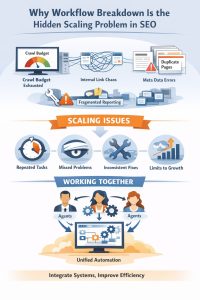
SEO doesn’t fail very often because teams don’t know what to do. It doesn’t work because they can’t execute it consistently, rapidly, and safely on a large scale.
As websites become bigger, a number of problems arise at once:
- Crawl budgets stop working well
- Internal connecting patterns change
- The consistency of metadata goes down.
- There are more and more duplicate and almost duplicate pages.
- Reporting gets split up across tools
People may make up for it on a lesser scale. They can’t do it on a bigger scale. You have to do the same tasks again and over. Problems are overlooked. Fixes don’t always work the same way.
This is where working together with several agents comes in handy—not as a substitute for SEO teams, but as a method to get systems that are already automated but not linked to each other to work together again.
What Multi-Agent Collaboration Actually Means in SEO Operations
In real life, working together with several agents doesn’t mean creating a bunch of tools and letting them go. It has to do with specialization and working together.
Each agent has a specific job to do:
- Crawling and finding
- Checking metadata
- Analysis of internal links
- Validation of indexation
- Monitoring SERP and performance
The system works because no agent works alone. What one agent finds out affects how other agents act.
I have seen the same failure pattern happen over and over again in many business audits: a crawler finds thousands of problems, a content tool reports something else, and engineers get contradicting priorities. Everyone is busy, yet nothing gets done smoothly.
A collaborative agent architecture turns that mess into a shared environment.
Breaking Down a Real Multi-Agent SEO System
Specialized Agents, Clear Boundaries
The first thing to do is to make sure everyone knows what their job is. One of the quickest ways to make noise is to have overlapping jobs.
As an example:
- A crawl agent finds discoveries, status codes, and trends in responses.
- A metadata agent just looks at titles, descriptions, and headers.
- A canonical agent looks at index signals and the reasoning behind consolidation.
- A linking agent looks at internal paths and orphaning.
Each agent creates organized output, not just suggestions on their own.
Coordination Through Shared State
The true change comes when agents work on the same task state.
If a crawl agent sees a lot of 404s on high-traffic URLs, that should mean:
- Start a task to check the reroute
- Give engineering review a higher priority
- Don’t let content agents touch the pages that are impacted.
I’ve seen this cut down on remediation processes on big sites from weeks to days. This wasn’t because there was more work to do, but because there was less rework.
A Real-World Scenario: Duplicate Signals at Scale
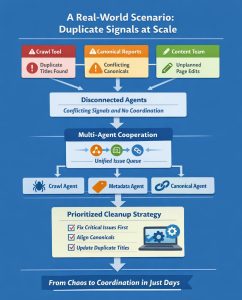
One business site I worked on had more than 50,000 URLs and a lot of trouble with its rankings. Everything seemed “fine” on paper. In fact, agents were saying different things.
- Crawl tools marked titles that were the same as each other
- Canonical reports indicated things that didn’t match up.
- Content teams changed pages without thinking
We connected three agents—crawl, metadata, and canonical—through a common queue by adding multi-agent cooperation. We classified issues by how much they affected things, not how many there were. The team came up with a prioritized cleanup strategy that engineers could really carry out in a matter of days.
This wasn’t magic that made things happen. It was cooperation instead of guessing.
Communication Is the Difference Between Automation and Chaos
The success of multi-agent cooperation depends on how well communication is designed.
This means in practice:
- Shared task lists
- Priority grading based on how SEO affects things
- Feedback loops that stop people from doing the same thing again
- State awareness (what has been fixed and what is still waiting)
A common problem I notice is that teams run numerous crawlers on various schedules without talking to each other. The end result is dashboards that don’t agree, servers that are overloaded for no reason, and signals sent to search engines that aren’t always the same.
When agents work together, they don’t make noise louder; they make it quieter.
What Commonly Goes Wrong in Multi-Agent SEO Systems
Even good intentions might lead to failure. When we look at automated SEO installations, we keep seeing the same problems.
Responsibilities that overlap
Two agents try to solve the same issue in different ways. One changes the metadata, while the other marks the page for pruning. Both acts cause instability when they aren’t coordinated.
Problems with Load and Resources
If throttling and sequencing aren’t handled properly, distributed agents may overload CMSs or hosting infrastructures. During busy times, I’ve seen crawl agents accidentally make things seem like they were under attack.
Data Silos
Agents gather useful information, but if there isn’t a place to store it, it never affects strategy. The system makes data, not choices.
Priorities that aren’t in line
Some SEO problems are more important than others. I’ve seen agents pay attention to sites with little traffic while ignoring important canonical conflicts on URLs that bring in money.
Lack of Human Oversight
Agents are quite good at recognizing patterns. They don’t get subtleties. People still need to look at SERP volatility, changes in purpose, and edge cases in migration. Automation causes harm that isn’t evident by skipping that layer.
A Practical Framework for Multi-Agent SEO Automation
This framework makes multi-agent cooperation safe and productive based on my own experience.
1. Plan Processes Before Tools
Make a list of SEO chores that take a lot of time:
- Crawling
- Analysis of links
- Audits of metadata
- Checks for indexing
Give each duty to one agent. No overlaps.
2. Set rules for communication
Make a choice:
- Where the data is kept
- How agents change the status of a task
- How to settle disagreements
Without this, agents fight each other instead of working together.
3. Give tasks a weight based on how much they matter
Always put pages with a lot of traffic and value first. When scheduling jobs, agents must follow this weighting.
4. Keep an eye on outputs, not just inputs
Dashboards should not only provide raw data dumps; they should show actionable perspectives of what agents have found.
5. Keep going back and forth
Collaboration between several agents isn’t fixed. Patterns of crawling change. The structure of the site changes. Agent rules need to change as well.
Where Multi-Agent Collaboration Delivers the Most SEO Value
Audits of Content on a Large Scale
It is not possible to manually audit tens of thousands of pages. Coordinated agents can look at metadata, internal linkages, and performance signals all at once without doing the same task again.
Improving Internal Links
I’ve used agent systems where one finds orphan pages, another proposes connecting possibilities, and a third checks the index status before changes go live. The upshot is that the crawl flow is better and it takes a lot less work to do it by hand.
Technical SEO When Moving
Collaboration between several agents is very important during site migrations. At the same time, separate agents keep an eye on redirection, status codes, the correctness of sitemaps, and the way crawlers behave. Problems come up early, not after rankings go down.
How Multi-Agent Collaboration Affects Search Performance Long-Term
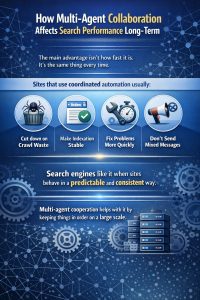
The main advantage isn’t how fast it is. It’s the same thing every time.
Sites that use coordinated automation usually:
- Cut down on crawl waste
- Make indexation stable
- Fix problems more quickly
- Don’t send mixed messages
Search engines like it when sites behave in a predictable and consistent way. Multi-agent cooperation helps with it by keeping things in order on a large scale.
FAQs
1. Will working together with several agents replace SEO teams?
No, agents do the same jobs over and over again with a lot of data. People are still needed to make decisions, come up with strategies, and figure things out, particularly when it comes to SERP dynamics and purpose.
2. What can you do to keep agents from getting in each other’s way?
By setting clear task boundaries, leveraging common queues, and adding a coordinating layer that fixes overlaps before actions are executed.
3. Can working together with several agents make indexing faster?
Yes. More efficient indexing comes from coordinated crawl scheduling, quicker problem resolution, and better internal linking, but only if they are watched closely.
4. What are the dangers of automating SEO on a broad scale?
If agents are set up wrong, they might produce duplicate content, crawl loops, or wrong redirection. Automation without supervision makes errors just as easy to make as it makes success.
5. What is the greatest place to start with implementation?
Start by making a list of jobs that you do again and over again and figuring out which ones may be securely automated. Set up coordination before adding new agents.
Conclusion
One thing that keeps coming up in audits and redesigns of workflows is that working with a lot of agents isn’t a quick way to get things done; it’s a way to get more done.
When agents are explicit in their communication, respect each other’s goals, and stay within certain limits, they cut down on work that has to be done again and over again, provide useful ideas, and let SEO teams concentrate on strategy instead of cleaning up. When there isn’t any coordination, automation makes things a lot more confusing.
The best solutions find a middle ground between automated procedures and human judgment. They are always trying new approaches, seeing how they work, and seeing agents as partners rather than substitutes.
When it comes to SEO on a broad scale, multi-agent cooperation isn’t about tidy systems. Smart coordination is what makes big websites healthy, easy to find, and competitive in search.