


For much of SEO’s history, it was easy to see. You received clicks when you ranked. The higher the ranking, the more traffic it gets. There were hardly any SERP features, and search results worked as expected. When we looked at audits, we frequently found that performance problems were caused by things we already knew about, including technical blockages, weak content, bad internal linking, or holes in authority.
That connection isn’t as clear-cut now.
I constantly check sites nowadays where ranks stay the same, impressions go up, and traffic keeps going. There is no punishment. No problem with crawling. No trouble with indexing. Pages are technically fine and still “winning” in old SEO terms, but consumers never get to them.
The missing element is how SERP features change how people receive what they want before they ever click.
Your ranking isn’t the only thing that determines how visible you are in search results nowadays. It’s based on how Google shows responses. SERP characteristics change how intent is met before visitors ever get to a page. They sit between rankings and clicks.
You can’t fairly tell how well SEO is doing in 2026 if you don’t know what SERP elements are.
SERP Features are extra things on the Google search results page, such as highlighted snippets, People Also Ask boxes, local packs, and knowledge panels. They provide consumers answers right on the SERP, often before they click on organic results.
They move visibility away from conventional blue links and toward placements based on intent. This is why rankings alone don’t explain traffic results anymore.
What Are SERP Features?
SERP Features are extra result items that show up next to or above organic listings on the search engine results page.
SERP characteristics are different from regular organic results since they are designed to:
- Fix purpose more quickly
- Less friction
- Lead users to actions or answers right away
They don’t take the place of biological outcomes, but they do frequently compete with them.
When it comes to SEO, SERP features affect the standards for how visible something is. If a feature takes the click, a site might still lose traffic even if it ranks high.
Core SERP Features Explained (Entity-Level Definitions)
These definitions are short and easy to copy since that’s how search engines and AI systems utilize them again.
Snippet that stands out
An answer box that stands out and takes a short answer from a website and puts it above organic results.
People Also Ask (PAA)
Expandable inquiries that show related user intentions, letting Google look into the depth and ambiguity of a subject.
Panel of Knowledge
An information box that is based on an entity and is driven by Google’s Knowledge Graph. It commonly shows up for businesses, persons, or ideas.
Map Pack / Local Pack
A location-based result that shows companies, reviews, and map listings for local searches.
Pack of Images
A visual SERP feature that shows pictures related to the search, frequently causing people to discover things visually instead of via clicking.
Video Carousel
A row of video results, usually from YouTube, that are meant to teach or show something.
The Most Important News
A news-driven service that shows relevant or trending material from trusted providers.
Links to Sites
Extra links that show up underneath a main result, indicating brand trust or navigation.
Why SERP Features Matter More Than Rankings
In genuine audits, SERP characteristics show why certain ranks are better than others.
I have seen:
- Pages that are ranked #2 lose 40% of their traffic when a highlighted snippet shows up.
- Pages that are ranked #6 do better than those that are ranked #3 because they are better at PAA.
- Knowledge panels and reviews help brands get seen without clicks.
SERP elements have an effect on more than simply traffic. They give it a new meaning.
How SERP Features Affect SEO (Direct Answer)
SERP features affect SEO by redistributing visibility away from traditional organic listings and toward intent-driven placements that satisfy queries directly on the SERP.
As a result, rankings alone are no longer reliable indicators of performance. Visibility must be measured through impressions, CTR, and feature ownership.
The Rise of Zero-Click Searches
One thing that SEOs have to realize is that
A lot of searches don’t want clicks anymore.
When a question has:
- A single response that is true
- A goal for defining
- A fast way to make a choice
Google typically fixes it right on the SERP.
SEO is not “dying,” however. It signifies that SEO is breaking apart. There is visibility without traffic, and traffic needs more and more value after the response.
Intent Is the Real SERP Feature Trigger
SERP characteristics don’t show up at random. They fit the aim of the inquiry quite well.
Questions for Information
Trigger included excerpts, PAA, and information panels
Questions about navigation
Start brand panels and links.
Queries for transactions
Start shopping results, reviews, and local packs
Business Investigation
PAA, video carousels, and trigger comparison snippets
Most of the time, SERP feature failures are due to purpose mismatches, not technical SEO.
What Commonly Goes Wrong (What I See in Audits)
1. Ranking for the Wrong Reason
Pages are ranked, but the SERP is meant to answer questions, not convey traffic.
2. Hiding Answers
Important answers are veiled by intros, stories, or fluff.
3. Using a schema as a shortcut
Structured data is helpful, but it doesn’t fix poor intent alignment.
4. Going after every feature
Trying to make the most of all SERP features typically means you don’t possess any.
How to Optimize for SERP Features (Practically)
1. Plan for Extraction
Write replies that make sense even when you don’t have the background. Google could cite you without your consent.
2. Figure out what you want to do early on
The first 10–20% of a page is more important than the remainder when it comes to feature eligibility.
3. Limited Scope
Pages that explicitly address one question do far better than lengthy “ultimate guides” when it comes to features.
4. Use structure to make things less clear.
Extraction is easier with clear headers, definitions, and layout.
SERP Feature Optimization Checklist
Before you post or update anything, ask:
- Can one paragraph completely explain the main question?
- Is the main SERP feature for this search query clear?
- Does the site contribute anything useful after the answer?
- Are the definitions explicit and the same every time?
- If this response were quoted alone, would it still make sense?
If not, SERP feature exposure will be restricted.
Measuring SERP Feature Impact (What to Track)
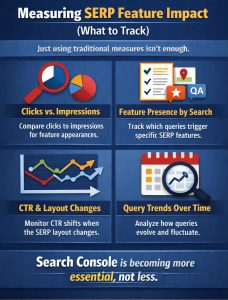
Just using traditional measures isn’t enough.
Track:
- Clicks vs. impressions
- Feature presence by search
- CTR varies when the SERP layout changes
- Changes in query throughout time
Search Console is becoming more essential, not less.
Real-World SEO Observation
One audit showed that a site was in the top three for many “what is” searches, but traffic was steadily dropping. It wasn’t competition that caused it. Google added “featured snippets” and “PAA blocks” that completely answered the question.
The fix wasn’t about getting higher ranks. It was changing the content such that the site became the place to get those answers.
Traffic didn’t come back right away, but visibility was steady, and searches for the brand went up.
That’s how to optimize SERP features in real life.
FAQs
1. What do SERP features mean in SEO?
SERP features are extra things on Google’s search results page that provide information immediately, frequently before consumers click on organic results.
2. Do SERP features make people click less?
Yes, particularly for questions that are easy to answer. But they may help your business get more attention and awareness.
3. How do you make the most of highlighted snippets?
By giving clear, short replies at the beginning of the material and making sure they match the query’s aim.
4. Are SERP features taking the place of organic results?
No. They don’t affect whether organic results exist; they change how search gives them prominence.
5. Which SERP features bring in the most visitors?
PAA, sitelinks, and video carousels are examples of features that stimulate exploration. These features tend to get more clicks than ones that don’t need any clicks.
Conclusion
SERP features don’t hinder SEO.
They increase misinterpretation costs.
Ranking well no longer earns pages SEO points. Pages that clearly, confidently, and rapidly resolve user intent—often before a click—are rewarded. Featured snippets, People Also Ask boxes, and knowledge panels often answer inquiries immediately on the results page, telling Google the site has satisfied the user’s purpose.
This shift affects practitioners’ success metrics. Rankings are now the gateway to a tiered visibility system where presentation, formatting, and extractability matter.
Long-term winners don’t decry SERP features or lost clicks. Content is tailored for them. They determine where clicks count and where exposure alone fosters confidence, memory, and demand.
Modern SEO has fewer assumptions, a clearer goal, and a strategy based on current search behavior.