
Table of Contents
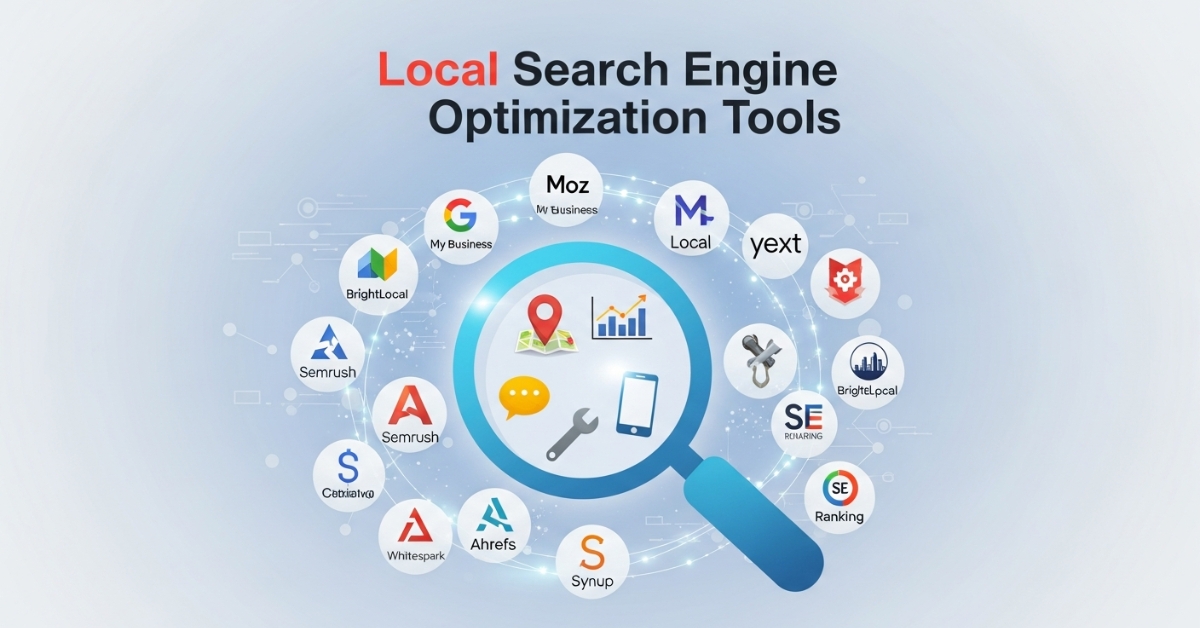
ToggleLocal SEO tools have become essential if you run a local business—whether it’s a restaurant, dental clinic, law firm, or any shop with a physical location. Showing up on Google Maps can directly impact your monthly revenue. But here’s the reality: simply having a Google Business Profile is no longer enough. The local search landscape in 2026 is more competitive, influenced by AI, and driven by data in ways that didn’t exist a few years ago.
The good news is that the right local SEO tools can help you stay competitive—whether you’re managing your own business or running campaigns for multiple clients.
In this guide, you’ll discover the best local SEO tools available in 2026, what they actually do in simple terms, real-world use cases, and how to choose the ones that deliver real value.
Why Local SEO Tools Matter More Than Ever in 2026
Let us start with a quick reality check. A 2025 BrightLocal study found that 78% of local mobile searches result in an offline purchase within 24 hours. That is enormous. If someone in your city searches for a plumber, a bakery, or a tax consultant and your business does not show up, that customer is walking into a competitor’s door.
But here is what most business owners miss: local SEO in 2026 is no longer just about keywords on your website. It involves:
- Your Google Business Profile completeness and activity level
- Your citation consistency across 50+ online directories
- Review velocity, star ratings, and how quickly you respond
- Local backlinks from community websites and local press
- On-page signals like your NAP (Name, Address, Phone) and schema markup
- Google Maps geo-grid rankings — which vary street by street
Managing all of this manually is nearly impossible. That is precisely where local SEO tools come in. They automate the tedious parts, surface hidden problems, and give you data that actually helps you make decisions.
The Best Local SEO Tools for 2026 — Comparison Table
Below is a comprehensive comparison of the top tools used by SEO professionals and business owners in 2026. We have included pricing, what each tool is best at, the skill level required, and the standout feature.
Tool Name |
Pricing |
Best For |
Skill Level |
Key Feature |
|
Google Business Profile |
Free | GBP Optimization | Beginner | Essential for listing management, review responses, Q&A, and local post publishing |
|
BrightLocal |
$29–$79/mo | Full Local SEO Suite | Intermediate |
Citation audit, rank tracking across multiple locations, reputation management, and white-label reports |
| Whitespark | $20–$100/mo | Citation Building | Intermediate |
Best citation finder in the market; local rank tracker with map pack data |
| Semrush Local | $50+/mo add-on | All-in-One SEO | Advanced |
GBP audit, listing management, competitor gap analysis, and AI-driven recommendations |
|
Moz Local |
$14–$33/mo | Listing Distribution | Beginner | Automatic listing sync across 15+ major directories; duplicate suppression |
|
Ahrefs |
$99–$399/mo | Backlink & Content | Advanced | Local link gap analysis, keyword research with local intent filters, content explorer |
|
LocalFalcon |
$24+/mo | Geo-Grid Rank Tracking | Intermediate |
Visual geo-grid maps showing where you rank on Google Maps across a city area |
| GeoRanker | $99+/mo | Hyperlocal Rank Check | Advanced |
Track rankings at pin-point GPS level; bulk location rank checks |
| Surfer SEO | $89+/mo | On-Page Optimization | Intermediate |
Local landing page content scoring and NLP keyword optimization |
|
ReviewTrackers |
$45+/mo | Review Management | Beginner |
Aggregate reviews from 100+ platforms; alerts, analytics, and response templates |
Note: Pricing is approximate and subject to change. Always check the tool’s official website for current plans.
Deep Dive: The Essential Tools Every Local Business Needs
1. Google Business Profile — The Non-Negotiable Foundation
Before you spend a single rupee or dollar on any paid tool, your Google Business Profile (GBP) needs to be fully optimized. This is the free profile that appears in the Google Maps pack — that box of three businesses that shows up at the top of local search results.
Real-world example: Raza’s Karachi-based air conditioning repair service had a basic GBP listing with no photos, no service categories, and an outdated phone number. After spending just one afternoon completing the profile — adding 15 photos, listing all services, setting correct business hours, and responding to 8 old reviews — his impressions in Google Maps jumped 340% within 30 days. No money spent. Just optimization.
What to do with GBP in 2026:
- Post updates at least once a week — Google treats active profiles as more relevant
- Answer every Q&A, even the ones you wrote yourself to pre-empt common questions
- Add your full service menu or product catalogue
- Enable messaging so customers can reach you directly from Maps
- Use the new AI-assisted response feature for reviews
2. BrightLocal — Best All-in-One Tool for Agencies and Multi-Location Businesses
BrightLocal has been the go-to local SEO platform for agencies for years, and in 2026 it remains the most comprehensive option for anyone managing multiple locations or multiple clients.
What makes it stand out is the citation auditing feature. You can run a report and immediately see which directories have your business information listed incorrectly — wrong phone number, old address, misspelled business name. These inconsistencies hurt your local rankings more than most people realize.
Real-world example: A dental clinic chain in Lahore with four branches used BrightLocal to discover that one of their locations had 23 directories listing an old phone number from when they moved offices two years prior. Fixing those citations brought that location from position 7 to position 3 in the local pack within six weeks.
3. Whitespark — The Citation Specialist
If you need to build citations fast for a new business or after a move, Whitespark is the most trusted tool for this specific job. Its Citation Finder lets you see exactly which directories your competitors are listed in but you are not — and then helps you get listed there.
Whitespark also offers a Local Rank Tracker that specifically tracks your position in the Google Maps 3-pack, not just organic rankings. This distinction matters a lot because a business can rank on page 1 organically but not appear in the Maps pack at all.
Real-world example: A new real estate agency in Islamabad used Whitespark’s competitor citation gap report to identify 47 directories where the top-ranking competitor was listed but they were not. After submitting to those directories over a two-month period, their Maps pack appearance went from zero to showing up for 12 different local keywords.
4. LocalFalcon — See Exactly Where You Rank on the Map
This tool solves a problem that most business owners do not even know they have. Your Google Maps ranking is not the same for everyone — it changes based on where the searcher is physically standing. Someone searching for a restaurant from one end of a city might see completely different results than someone searching from five kilometres away.
LocalFalcon creates a geo-grid — a visual map that shows you a dot at each grid point, with a number showing your Maps rank at that specific location. Green dots mean you are ranking well. Red dots mean you are invisible.
Real-world example: A bakery in Karachi’s Defence area used LocalFalcon and discovered they ranked #1 on Google Maps within 1 km of their shop but fell to #12 just 4 km away. They then ran a hyper-local content and citation campaign targeting those weak zones and brought their average rank down from 8.3 to 4.1 across the full grid in 90 days.
5. Semrush Local — Best for Data-Driven Team
Semrush added a dedicated Local module in recent years and it has become increasingly powerful. If your team already uses Semrush for organic SEO, adding the local add-on gives you a unified dashboard for both. It pulls GBP data, compares you against local competitors, and gives AI-driven recommendations.
The listing management feature automatically pushes your business information to 40+ directories from a single dashboard — saving hours of manual work every time your address or phone number changes.
6. Moz Local — Simplest Tool for Small Business Owners
If you are not an SEO expert and just want something simple that handles the basics, Moz Local is excellent. You enter your business information once, and it distributes it to major directories automatically. It also flags duplicates and inconsistencies.
It is not the most powerful tool on this list, but for a solo business owner who does not have time to become an SEO specialist, it does the foundational work reliably at an affordable price.
How to Choose the Right Local SEO Tool for Your Situation
With so many options, it is easy to get overwhelmed. Here is a simple decision framework:
- Single location, DIY: Start with Google Business Profile (free) + Moz Local ($14/mo). Total: under $15/month.
- Single location, serious growth: Add BrightLocal ($29/mo) for citation auditing and rank tracking. Total: ~$45/month.
- Multi-location or agency: BrightLocal or Semrush Local + Whitespark for citations + LocalFalcon for geo-grid tracking. Budget $150–$250/month.
- Advanced data teams: Layer in Ahrefs for backlink analysis and Surfer SEO for local landing page optimization.
The biggest mistake businesses make is paying for expensive tools before they have done the free fundamentals. Optimize your GBP completely before spending money on anything else. You will be amazed at what happens.
Real-World Local SEO Tool Stack: A Case Study
Let us look at how a mid-sized business — say, a plumbing company with two locations in a major Pakistani city — might build their local SEO tool stack step by step.
Month 1 — Foundation:
- Fully optimize both GBP listings with photos, services, and hours
- Use BrightLocal to audit existing citations and fix inconsistencies
- Set up weekly GBP posts using a simple content calendar
2–3 — Citation Building:
- Use Whitespark to identify citation gaps versus top competitors
- Submit to the top 30 missing directories
- Monitor review responses with ReviewTrackers
4–6 — Ranking Expansion:
- Run LocalFalcon geo-grid to identify weak geographic zones
- Create location-specific landing pages optimized with Surfer SEO
- Build local backlinks from city directories, chamber of commerce, and local news sites
Result: This type of structured approach, using the right tools at each stage, consistently produces a 200–400% increase in Google Maps visibility over a 6-month period for local service businesses.
Common Mistakes to Avoid With Local SEO Tools
Even with the best tools, businesses often make mistakes that cancel out their progress:
- Inconsistent NAP: Your business Name, Address, and Phone number must be identical — character for character — across every directory. Even ‘St.’ versus ‘Street’ can confuse Google.
- Ignoring reviews: Tools can track reviews, but you still need to respond to them. Google rewards businesses that engage with customers.
- Keyword stuffing in GBP: Adding keywords to your business name in GBP (like ‘Ahmed Plumbing Best Plumber Karachi’) violates Google’s guidelines and can get your listing suspended.
- Over-relying on tools and ignoring content: Tools optimize what you have. If your website has no local landing pages, no service area content, and no blog — tools can only do so much.
- Ignoring mobile experience: 61% of local searches happen on mobile. If your website loads slowly on phones, your rankings will suffer regardless of your off-page optimization.
FAQs
1. What is the single most important local SEO tool for a new business?
Google Business Profile, without question. It is completely free, and a fully optimized GBP listing is the single highest-impact thing a new local business can do. Most businesses see meaningful results just from completing their profile properly before investing in any paid tools.
2. Do I need to pay for local SEO tools if I only have one location?
Not necessarily. You can achieve solid local rankings with just Google Business Profile (free) and careful manual work on the main directories (Google, Yelp, Apple Maps, Facebook, Bing Places). Paid tools become worth it when you want to scale faster, track competitors, or manage multiple locations efficiently.
3. How long does it take to see results from local SEO efforts?
Most businesses start seeing movement in Google Maps rankings within 4–8 weeks of consistent optimization. Full results from a complete local SEO campaign — including citation building and content — typically take 3–6 months. The local search algorithm updates more frequently than organic search, so changes can happen faster.
4. Is BrightLocal better than Semrush for local SEO?
It depends on your needs. BrightLocal is purpose-built for local SEO and is generally better for citation auditing, local rank tracking, and agency reporting. Semrush is a broader SEO platform with a local add-on that works well if you already use Semrush for your overall SEO strategy and want everything in one place. For pure local SEO, BrightLocal has the edge.
5. What is a geo-grid and why does it matter?
A geo-grid is a visual map showing your Google Maps ranking at different physical locations within a city. Since your Maps position changes based on where the searcher is located, a geo-grid reveals exactly which areas you are strong in and which areas you are losing business to competitors. Tools like LocalFalcon create these maps. They are essential for businesses targeting customers across a large city or multiple neighborhoods.
6. Can local SEO tools help with voice search optimization?
Yes, indirectly. Voice searches like ‘plumber near me’ or ‘best biryani open now’ are largely answered by Google’s local pack, which is powered by GBP data and local ranking signals. Optimizing with local SEO tools — completing your GBP, maintaining citations, earning reviews — directly improves your visibility in voice search results. Some tools like Semrush also offer keyword research that helps you target conversational, voice-style search phrases.
7. Are these tools useful for businesses in Pakistan or only Western markets?
Absolutely useful in Pakistan. Google is the dominant search engine in Pakistan, and its local algorithm works the same way globally. BrightLocal, Whitespark, and LocalFalcon all support Pakistani cities. The citation directories that matter most for Pakistani businesses include Google, Facebook, Yelp (where applicable), Apple Maps, Bing Places, and local Pakistani directories like Rozee, PakWheels (for automotive), and Zameen (for real estate). The core principles and tools apply universally.
Conclusion
Local search in 2026 is genuinely a level playing field — if you know how to use the tools. A small family-run business using BrightLocal, Whitespark, and LocalFalcon consistently can absolutely outrank a large chain that is neglecting their local presence.
The key is not to use every tool on this list. The key is to use the right tools for your stage and budget, implement them consistently, and combine that data with real effort: responding to reviews, posting updates, creating local content, and building genuine relationships in your community.
Start with the free foundation — your Google Business Profile. Make it perfect. Then layer in paid tools as your needs grow. Track your geo-grid. Fix your citations. Watch your phone ring more.
That is not theory. That is exactly what thousands of local businesses are doing right now to win in their markets. The tools are there. The question is whether you use them.