


It seems like content gap analytics is a way to plan. In genuine SEO work, it’s typically a technique for getting things back on track.
Lack of content is not the main reason most sites fail. They fail because they put out material without knowing what search engines want the site to cover as a whole. In audits, I often see websites with hundreds of pages that still have trouble ranking consistently because they don’t have enough information on important themes, stages of intent, or supporting content. Google doesn’t think these sites are incomplete because they are lacking one term. It thinks they are incomplete because the thematic picture doesn’t entirely connect.
Content gap analytics is significant because it helps answer a more important question than “What should we write next?” It explains why certain sites don’t rank, why impressions stop, or why traffic levels off even if new content is being published. When there are gaps in material, crawling becomes less effective, indexing takes longer, and topical authority doesn’t build.
This post shows you how to get content gap analytics from a practical SEO point of view, utilizing actual data, trends, and limits instead of theory or tool images.
What Content Gap Analytics Actually Means
In reality, content gap analytics means finding out where a site’s content doesn’t meet search demand based on purpose, competition, and the topics it covers.
It’s not just
- Missing important words
- Pages that are missing
- Blog entries that are missing
Content gaps typically show up in audits as the following:
- Questions with impressions but no good landing page
- Pages that rank on page two without apparent purpose support
- Competitors who write on subtopics that your site doesn’t
- Indexing problems induced by weak topical signals
I’ve seen sites post a lot and yet lose ground because they filled the incorrect gaps or didn’t fill any at all.
Content Gaps vs Keyword Gaps: A Practical Distinction
A keyword gap study looks at how rankings compare. Content gap analytics is a way to compare comprehension.
Keyword gaps answer:
- “What keywords do our competitors rank for that we don’t?”
Answer to content gaps:
- “What questions, situations, or stages of intent are not covered by our content?”
Keyword gap analysis alone caused pages to be thin and repetitive in some audits and never be indexed correctly. When done well, content gap analytics leads to fewer pages that are more relevant, which is what current search algorithms reward.
Where Content Gaps Usually Show Up in SEO Audits
It helps to see patterns before describing procedures.
In audits, content gaps often show up as:
- Pages that get a lot of impressions but not many clicks and have rankings that change a lot
- Queries that go to landing pages that don’t make sense
- Topic clusters that don’t have basic or supporting content
- Blog posts that don’t link to business or service pages
- Indexing takes longer since the subject isn’t obvious.
Publishing extra material doesn’t usually address the problem when similar patterns happen again. Finding the correct spacing does.
Step 1: Start With Search Performance, Not Competitors
Most individuals start their content gap investigation by looking at the outside world. In practice, your own search data is the most dependable source of information.
When I look at search performance statistics, I look for:
- Queries with impressions but no page just for them
- Pages that rank for searches that aren’t relevant
- Pages that score well for broad phrases but not for long-tail terms
These signals usually mean that there are gaps in the content purpose, not that there aren’t enough keywords.
A common finding in audits is that sites frequently score well for a subject but not completely for it since they don’t have adequate contextual coverage.
Step 2: Analyze Query Clusters, Not Individual Keywords
There are no content gaps at the keyword level; they are at the cluster level.
That implies putting inquiries into groups based on the following:
- Intent to get information vs. intent to do business
- Framing the problem vs the solution
- Understanding for beginners vs. advanced
- Comparison versus explanation
I’ve seen sites fail because they attempted to address too many questions at once. When content gap analytics groups coverage by intent clusters, indexing and rankings generally stay the same without adding new links or making technological modifications.
Step 3: Identify Missing Content Types, Not Just Topics
It’s a typical fallacy in content gap analysis to think that every gap needs a new article.
There are typically content gaps in audits because
- The content format is incorrect.
- There is a theme, but it isn’t very deep.
- There is no supporting material.
- Internal linking doesn’t make things more relevant.
For instance, a site could contain a guide yet not have the following:
- FAQs that make things clear
- Giving reasons for subtopics
- Links to other pages that are relevant to this one
Information gap analytics should show not just what subject is lacking but also what kind of information is missing.
Step 4: Use Competitors to Validate, Not Copy
Competitor analysis is helpful after internal holes are found.
Competitor content helps address these questions in practical SEO work:
- What subtopics does Google expect to see?
- How deep does coverage usually go?
- What levels of intent do competitors support?
I’ve seen organizations imitate the outlines of their competitors and yet fail because their site didn’t have the authority or internal structure to support that content. Data about competitors should confirm gaps, not set strategy.
Step 5: Map Content Gaps to Topical Authority
Modern search engines look at the whole issue, not just individual pages.
In audits, content gaps typically make the following less strong:
- Indexing that is always the same
- Value of internal links
- Prioritizing crawls
- AI-based eligibility for summarizing
When content gap analytics connects missing material to a bigger subject structure, search engines may more readily understand the following:
- What the site is for
- What pages are most important
- How pages help each other
That’s when it becomes easier to guess the ranks.
What I Commonly See Go Wrong in Content Gap Analysis
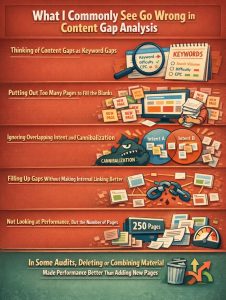
This pattern keeps coming up:
- Thinking of content gaps as keyword gaps
- Putting out too many pages to fill in the blanks
- Ignoring overlapping intent and cannibalization
- Filling up gaps without making internal linking better
- Not looking at performance, but the number of pages
In some audits, deleting or combining material made performance better than adding new pages.
A Practical Content Gap Analytics Framework
When I look for content gaps, I usually do it in this order:
- Which inquiries indicate interest but don’t have distinct landing pages?
- Which pages rank yet don’t entirely meet the need?
- What subjects don’t have any supporting or contextual information?
- Where do competitors have a better understanding of the subject?
- Which gaps fit with the goals of the company or the traffic?
This maintains content gap analysis based on facts, not guesses.
Content Gap Analytics and Indexing Behavior
Indexing is directly affected by content gaps.
Pages that don’t have any context support:
- Slowly index
- Results that come and go
- Struggle to get good rankings all the time
Filling in content gaps during audits frequently makes indexing better before rankings change. That’s an indication that people are getting the site better.
Content Gap Analytics in the Age of AI Search
AI-powered search engines don’t summarize pages; they summarize concepts.
That implies that content deficiencies now have an impact on:
- AI overviews that are easy to see
- Coverage breadth of queries
- Links between entities
Even if individual pages rank, sites that don’t cover all of a subject are less likely to show up in summary results.
FAQs
1. What is the analysis of content gaps?
Content gap analytics is the process of finding missing subjects, intent layers, or contextual coverage that prevent a site from completely meeting search demand.
2. Is content gap analysis the same as keyword research?
Yes. Keyword research finds words. Content gap analysis reveals things that aren’t clear.
3. Do content gaps have an effect on indexing?
Yes. Pages that don’t have supporting context sometimes take a long time to index or don’t index at all.
4. Do tools by themselves discover content gaps?
No. Tools provide you data, but you have to understand how people search to make sense of it.
5. How frequently should you undertake a content gap analysis?
Often, particularly when traffic levels are down or rankings start to change.
Conclusion
Content gap analytics isn’t about adding pages or material. Identifying purpose, context, and subject coverage gaps. Lack of volume seldom hinders SEO progress. It stalls because search engines can’t tell how material fits together or whether it meets search demand.
In my experience, sites that expand sustainably employ content gap analysis to organize their material. They clarify search intent throughout, enhance topical linkages between sites, and define what each page should rank for. Search engines are more confident in sites with material that fills real voids. Indexing improves, rankings stay steady, and traffic rises predictably.
Overall site interpretation improves using content gap analytics. Internal page competition stops, crawl resources are better allocated, and topical authority is simpler to develop. In audits, indexing behavior improvements generally precede ranking improvements, indicating that the site is being understood better.
Incomplete content doesn’t hinder development. They hinder development because people and search engines are confused. Content strategy that prioritizes clarity and relevance over volume typically performs well.