

You don’t look at the SEO KPIs dashboard to feel better. Before traffic does, SEO KPIs let you know whether trust, clarity, and structure are becoming worse.
I’ve looked at sites that get a steady stream of organic visitors for months or even years. A single core update showed problems that had been building up over time: sites that were moving in and out of the index, crawl budget wasted on low-value URLs, and several pages trying to do the same thing. It was clear that the warnings were there when we looked back. People paid close attention to rankings and sessions, but they never looked at search engine trust signals.
This is why SEO KPIs are more important in 2026 than they were in the past. Search engines no longer look at pages one at a time. A single keyword, backlink, or well-optimized content does not decide how visible a site is. It’s linked to site patterns, such as how often important sites are indexed, how well purpose is communicated across related URLs, and how well Googlebot can find important places.
Wrong SEO KPIs give you false confidence. Traffic may seem strong, but trust in the index is dropping. As competition inside the company rises, rankings may remain the same. Once surface metrics go down, it takes longer and costs more to fix them.
The right SEO KPIs find friction early on. They show you where search engines stop, what your priorities are, and how structure gets in your way.
This course is about SEO KPI audits and performance, not reporting. To fix problems before growth ceases, search engines utilize measurements that show how they rate a site’s quality, relevancy, and stability over time.
The Shift in SEO KPIs: From Output Metrics to Confidence Metrics
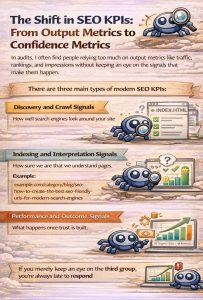
In audits, I often find people relying too much on output metrics like traffic, rankings, and impressions without keeping an eye on the signals that make them happen.
There are three main types of modern SEO KPIs:
- Discovery and Crawl Signals: How well search engines look around your site
- Indexing and Interpretation Signals—How sure we are that we understand pages
- Performance and Outcome Signals: What happens once trust is built
If you merely keep an eye on the third group, you’re always late to respond.
Core SEO KPIs That Actually Matter in 2026
1. Indexed Pages vs. Indexable Pages (Indexing Confidence KPI)
This is one of the SEO KPIs that people don’t pay enough attention to.
In a number of audits, I’ve noticed that 30–50% of “indexable” URLs never really stabilize in the index. That gap tells you a lot more than traffic does.
What to look at:
- Pages that can be indexed but aren’t yet
- Changes in status happen often (indexed → not indexed → indexed)
- “Crawled – currently not indexed” trends over time
An increasing gap means that the objective is not obvious, there is not enough internal support, or the quality is not clear.
2. Crawl Allocation Efficiency (Crawl Budget Quality)
It’s not simply about the magnitude of a crawl budget. It’s about where crawling work is squandered.
When I looked at corporate and mid-size sites, Googlebot spent most of its time on filtered URLs, old pagination, or low-value templates, while key pages were crawled just a few times.
Follow:
- How often do priority URLs get crawled?
- Percentage of crawls that reach non-SEO URLs
- How deep the crawl goes vs. how important the page is
Healthy sites tell crawlers where to go on purpose.
3. URL Role Clarity (Primary vs. Supporting Pages)
You specify this KPI; it’s not visible in tools.
When more than one URL tries to rank for the same thing, performance drops. This is the main reason why many people blame “algorithm updates” for ranking plateaus.
Signs of an audit:
- For the same set of queries, many URLs are ranking differently.
- Links from one site to another that don’t always work
- Search Console searches are spread out among comparable URLs.
Clear page responsibilities help rankings stay stable quicker than link building ever would.
4. Query-to-Page Alignment (Intent Satisfaction KPI)
Rankings that aren’t in line don’t last.
I keep notes of whether searches always go to the same URL over time. When Google repeatedly changes URLs, it means that there is some confusion about how to read them.
Keep an eye out for:
- Changing URLs often for the same search
- The structure of the page doesn’t match the aim of the query
- Pages that rank but don’t get enough engagement
Growth frequently comes after stability here.
5. Internal Link Distribution to Priority Pages
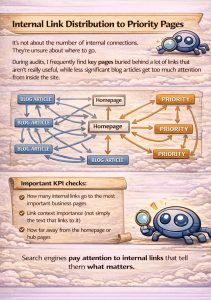
It’s not about the number of internal connections. They’re unsure about where to go.
During audits, I frequently find key pages buried behind a lot of links that aren’t really useful, while less significant blog articles get too much attention from inside the site.
Important KPI checks:
- How many internal links go to the most important business pages
- Link context importance (not simply the text that links to it)
- How far away from the homepage or hub pages
Search engines pay attention to internal links that tell them what matters.
6. Content Coverage vs. Topical Gaps
This KPI does away with the old-fashioned way of thinking about “content volume.”
It’s not about how much you post. It’s if your material covers the subject entirely without any gaps or overlaps.
Follow:
- Questions that show up without specific landing sites
- Several pages that partly address the same question
- Not enough supporting information on main themes
Completeness of topics lowers volatility.
7. Organic Traffic Distribution (Not Total Traffic)
Total organic traffic conceals danger.
I keep notes of how traffic is spread out throughout pages and sections. Sites that rely on a limited number of URLs are weak.
Good habits:
- Traffic slowly spread over clusters
- Supporting pages help with traffic.
- No one URL is driving growth.
Traffic that builds up is different from traffic that stays the same.
8. Ranking Stability (Volatility KPI)
Rankings are important, but stability is perhaps more so.
I regularly notice sites that are in the top five yet change every day. That’s not a success. It’s not clear.
Track:
- Average change in position
- URL consistency for each query
- The impact radius after updates
Stable rankings mean future improvements.
9. Conversion-Assisted SEO Metrics (SEO ROI Reality Check)
SEO doesn’t work on its own.
I keep watch of the following in SaaS and content-led sites:
- Helped conversions from organic sessions
- Paths of content before conversion
- SEO touchpoints at every stage of the funnel
This stops you from eliminating sites that don’t convert but help growth in the background.
What Commonly Goes Wrong With SEO KPIs (Audit Patterns)
The greatest error I find with KPIs is keeping track of what is simple instead of what is important.
Common mistakes:
- Worrying more about keyword numbers than intent coverage
- Reporting traffic without putting it in context
- Instead of seeing rankings as signals, see them as success.
When KPIs don’t have anything to do with how search engines rank sites, teams chase noise.
A Practical SEO KPI Diagnostic Framework
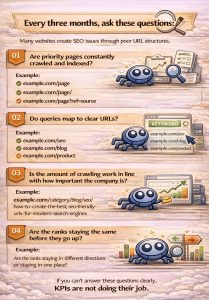
Every three months, ask these questions:
- Are priority pages constantly crawled and indexed?
- Do queries map to clear URLs?
- Is the amount of crawling work in line with how important the company is?
- Are the ranks staying the same before they go up?
- Is traffic moving in different directions or staying in one place?
If you can’t answer these questions clearly, KPIs are not doing their job.
FAQs
1. What are SEO KPIs?
SEO KPIs are ways to measure how well search engines find, index, understand, and reward a site.
2. What SEO KPIs would be most important in 2026?
Stability of indexing, efficiency of crawling, alignment of purpose, and consistency of ranking are more important than raw traffic or keyword counts.
3. Are rankings still a key performance indicator (KPI) for SEO?
Yes, but only when looking at stability and purpose alignment, not just one position.
4. Can SEO KPIs tell you when traffic may drop?
Yes, indexing problems, crawl misallocation, and query-URL instability typically show up months before traffic drops.
5. How frequently should you check your SEO KPIs?
You should look at your core KPIs every month and do a more in-depth assessment every three months.
Conclusion
SEO KPIs don’t have to show that you’re successful. They’re about finding ambiguity.
From my perspective, the sites that expand in a way that lasts aren’t collecting more metrics; they’re measuring the proper ones. They know how search engines look at structure, purpose, and precedence over time.
Search engines cease being unsure when SEO KPIs concentrate on clarity, such as clear page responsibilities, clear internal signals, and unambiguous indexing behavior. Crawl patterns become stable. Before they go up, rankings settle. Instead of starting again, growth multiplies.
SEO performance doesn’t just drop out of nowhere. It slowly goes away when the erroneous cues are ignored.
SEO becomes predictable again when you track confidence, not just results.