

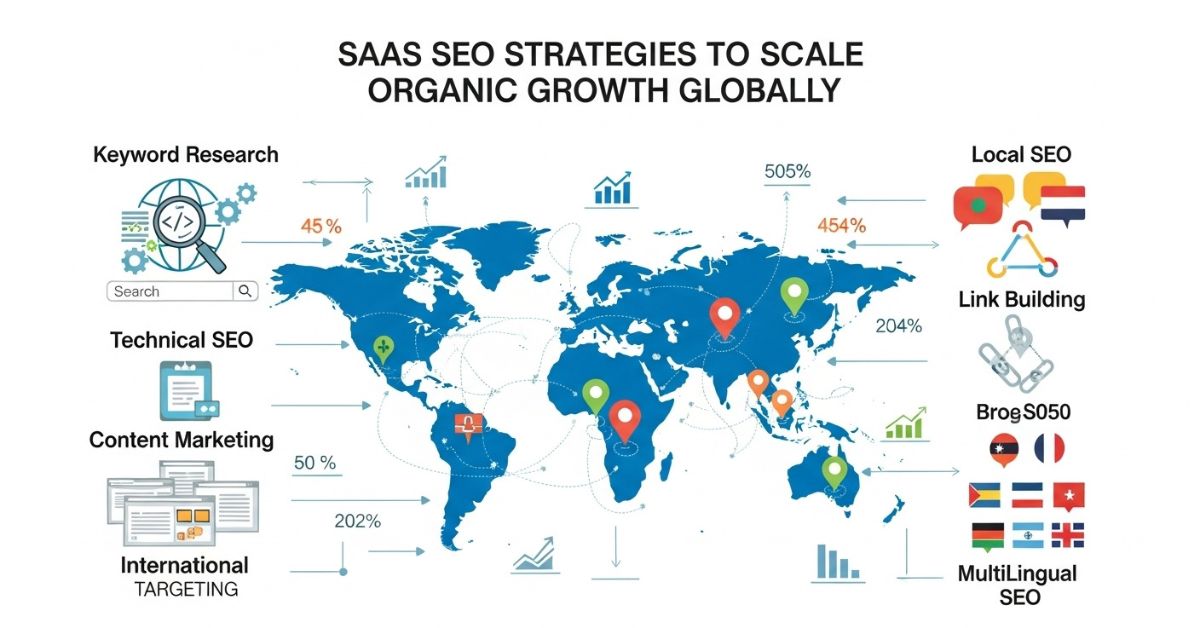
Many SaaS organizations think that SEO will “just scale” at this stage; therefore, SaaS SEO strategies become quite important. At first, growth seems easy: write articles, get backlinks, and watch signups come in. After that, the site becomes bigger. More features, uses, areas, and material. SEO typically stops working or begins acting strangely at that point.
I’ve looked at SaaS companies with great goods and a lot of demand where organic traffic stopped growing even if they kept posting. The rankings changed. Pages with features didn’t do well. The number of visitors to the blog went up, but the number of sales didn’t. The issue wasn’t a lack of SEO work. There was a problem with how the product was set up, how the material was meant to be used, and how search engines look at SaaS sites on a large scale.
SaaS SEO is not the same as B2B SEO with lengthier sales cycles. It includes documentation, feature pages, comparative information, onboarding tools, and occasionally even more than one market and language. Search engines have a hard time figuring out what the product does and who it is for when those parts aren’t clearly laid out.
This tutorial talks about SaaS SEO strategies from the point of view of a real-world audit. It talks about what works consistently to develop organic traffic throughout the world, what goes wrong over and over again as SaaS businesses grow, and how to set up an SEO strategy that helps growth without causing internal rivalry or crawl waste.
How SaaS SEO Is Different From Traditional Content SEO
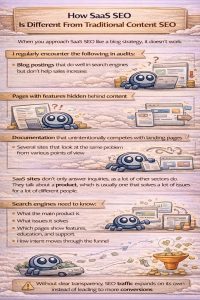
When you approach SaaS SEO like a blog strategy, it doesn’t work.
I regularly encounter the following in audits:
- Blog postings that do well in search engines but don’t help sales increase
- Pages with features hidden behind content
- Documentation that unintentionally competes with landing pages
- Several sites that look at the same problem from various points of view
SaaS sites don’t only answer inquiries, as a lot of other sectors do. They talk about a product, which is usually one that solves a lot of issues for a lot of different people.
Search engines need to know:
- What the main product is
- What issues it solves
- Which pages show features, education, and support
- How intent moves through the funnel
Without clear transparency, SEO traffic expands on its own instead of leading to more conversions.
What Commonly Goes Wrong in SaaS SEO Audits
1. Blog Content That Never Connects to the Product
This is the problem that happens the most. I’ve seen SaaS blogs that get tens of thousands of hits a month but don’t help people join up at all.
The information is ranked, but it doesn’t have any context. Links inside the site are poor. Intent is too high up in the funnel. At best, product relevance is indirect.
SEO traffic that doesn’t match the product doesn’t increase sales.
2. Feature Pages Competing With Blog Posts
Another motif that keeps coming up:
- Blog postings that ask, “What is X?”
- Pages with features that also target “what is X”
- Pages that compare “X vs. Y”
All optimized independently and all in competition.
This causes intent overlap, which makes rankings unstable and weakens authority.
3. Documentation and Help Centers Leaking SEO Signals
Users need documentation, but if it’s not maintained well, it might hurt SEO.
I typically discover the following in audits:
- Docs that rank for business questions
- Help articles are more popular than feature pages.
- A lot of low-value URLs using up crawl budget
Without explicit standards for indexing, documentation subtly hurts product SEO.
4. Global Expansion Without SEO Guardrails
When SaaS firms grow over the world, SEO problems become worse:
- Same information in different areas
- Bad use of hreflang
- There is a mixed purpose between global and local pages.
- Market’s unclear ownership of keywords
Before translation, global SEO needs structure, not after.
SaaS Keyword Strategy: Intent Before Volume
Keyword research that works for SaaS at scale doesn’t work well.
The hard part isn’t finding keywords. It’s about giving the right intent.
A good SaaS keyword strategy links keywords to the following:
- Pages for core products
- Pages with features
- Pages for use cases
- Pages for comparing
- Content that teaches
The best thing to do in audits is to figure out which keywords a site shouldn’t be targeting.
Clarity is more important than volume.
Product-Led SEO: Aligning Content With the SaaS Funnel
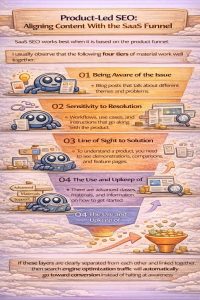
SaaS SEO works best when it is based on the product funnel.
I usually observe that the following four tiers of material work well together:
1. Being aware of the issue
Blog posts that talk about different themes and problems.
2. Sensitivity to resolution
Workflows, use cases, and instructions that go along with the product.
To understand a product, you need to see demonstrations, comparisons, and feature pages.
3. The use and upkeep of
There are advanced classes, materials, and information on how to get started.
If these layers are clearly separated from each other and linked together, then search engine optimization traffic will automatically go toward conversion instead of halting at awareness.
SaaS Content Strategy That Scales Without Cannibalization
SaaS is at danger when it comes to scaling content.
Things that people often do wrong:
- Putting out more than one post for each feature
- Rewriting the same use case again and again
- Making pages for different regions without a clear purpose
What works instead:
- One official page for each usage case
- Supporting text that clearly refers to primaries
- Regularly combining items that are similar to each other
I’ve seen SaaS sites get their rankings back by combining and focusing old material, not by adding new content.
SaaS Technical SEO: The Hidden Growth Constraint
Technical SEO sets the speed limit for SaaS SEO growth at scale.
Important things that come up again and over again in audits:
- How well does crawling work on products, blogs, and docs?
- Control over indexing for low-value URLs
- JavaScript rendering clarity
- Consistency in the construction of URLs
- Performance in different areas
Problems with technology don’t necessarily create dropouts. They slow things down, like indexes, rankings, and growth that isn’t steady.
Global SaaS SEO: Structure Before Localization
For multinational SaaS organizations, SEO works best when there is a clear division of responsibilities.
Before you grow:
- Explain the difference between a global and a local aim.
- Choose which sites should show up in search results throughout the world
- Keep track of duplication across markets
When I look at audits, I notice that international SEO fails not because of language problems, but because search engines can’t figure out which market a site is in.
SaaS Link Building: Authority With Context
Links are important for SaaS SEO, but context is much more important.
The following things make for strong SaaS link profiles:
- Leading with ideas
- Integrations of products
- Partnerships for use cases
- Data and studies that are original
Weak profiles depend on:
- Generic posts from guests
- Publications that aren’t linked
- More volume than significance
In SaaS audits, contextual links related to product comprehension are more effective than simple link counts.
Automation in SaaS SEO: Where It Helps and Where It Breaks
SaaS makes automation seem good.
Automation that is useful:
- Keeping an eye on index coverage
- Keeping an eye on how well feature pages do
- Finding crawl problems
That is risky:
- Content that is programmed without an evaluation of purpose
- Automatic connecting between pages without a hierarchy
- Targeting a lot of keywords across templates
Automation should help things be clear, not take their place.
A Practical SaaS SEO Diagnostic Framework
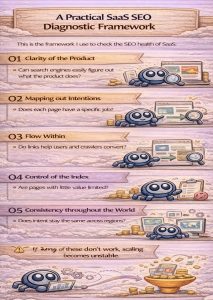
This is the framework I use to check the SEO health of SaaS:
1. Clarity of the product
Can search engines easily figure out what the product does?
2. Mapping out intentions
Does each page have a specific job?
3. Flow within
Do links help users and crawlers convert?
4. Control of the index
Are pages with little value limited?
5. Consistency throughout the world
Does intent stay the same across regions?
If any of these don’t work, scaling becomes unstable.
FAQs
1. What are the best ways to do SEO for SaaS?
SaaS SEO strategies are planned ways to get more organic traffic to software goods by making sure that content, product pages, and technical SEO all work together with what users want and the SaaS funnel.
2. What makes SaaS SEO different from regular SEO?
SaaS SEO is more than simply rankings or blog traffic; it also looks at how well a product is understood, how well it controls purpose, and how well it fits into a funnel.
3. Can SaaS SEO help businesses thrive throughout the world?
Yes, but only if you prepare the site’s structure, localization, and indexing before you grow.
4. Is content marketing adequate for SEO for SaaS?
No, content should not stand on its own; it should complement product pages and conversions.
5. Do you need an agency for SaaS SEO?
Not always. What counts is governance, clarity, and getting everyone on the same page.
Conclusion
SaaS SEO strategies don’t include more content, keyword hunting, or competitive response. Building clarity into a developing system.
SaaS firms that expand organically internationally don’t perform much SEO, in my experience. Clearness is key for top performance. Each page has a purpose, content matches the product funnel, and crawl behavior and indexing are planned.
Search engines cease hesitating with good SaaS SEO. Stabilize rankings. Feature pages acquire credibility. Blog traffic boosts sales. Global growth becomes stable.
SaaS SEO strategies succeed despite low demand. Due to unclear product search representation, it fails.
Fix that clarity, and organic development becomes a system, not a chance.