


Table of Contents
ToggleInternal links SEO is one of the most underrated yet powerful SEO strategies. While many website owners focus heavily on backlinks and keyword optimization, internal links SEO quietly influences how search engines crawl, understand, and rank content across your entire website.
When you do a true SEO audit, problems with internal linking come up a lot more than technical mistakes. A lot of websites post dozens or even hundreds of articles, but they don’t always make sense together. Because of this, search engines have a hard time figuring out which pages are essential and how themes are connected.
Bad internal linking causes a number of SEO issues:
- Important pages stay hidden
- The crawl speed goes down.
- Topical authority breaks out
- Link equity doesn’t move across groups of material.
This post tells you how internal links SEO works, how to set up your site the right way, and which tools may help you make internal linking function better.
Internal links SEO is the process of connecting pages on the same website to assist search engines in finding, crawling, and comprehending how material is related. Proper internal linking makes the structure of a site better, spreads link authority across pages, makes sites more relevant to the topic, and helps crucial pages rank higher in search results.
Internal connections SEO is the act of linking pages on the same website to make it easier for search engines to index them, share link authority, and make it clearer how topics are related. Search engines use internal links to find fresh material, figure out how a site is set up, and figure out which pages are most essential for ranking.
What Is Internal Links SEO?
Internal links are links that go from one page on a website to another page on the same domain.
Backlinks come from other websites, but internal links let you decide how authority and relevance move around on your own site.
From the point of view of a search engine, internal links assist in answering three key questions:
- What pages are on the website?
- What do those pages have in common?
- What are the most significant pages?
Based on how current search engines work, internal links are contextual signals that assist algorithms in figuring out how topics are related.
Why Internal Links Matter for SEO
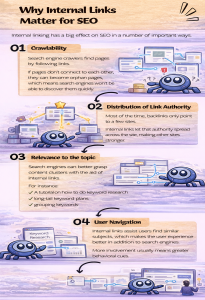
Internal linking has a big effect on SEO in a number of important ways.
Crawlability
Search engine crawlers find pages by following links.
If pages don’t connect to each other, they can become orphan pages, which means search engines won’t be able to discover them quickly.
Distribution of Link Authority
Most of the time, backlinks only point to a few sites.
Internal links let that authority spread across the site, making other sites stronger.
Relevance to the topic
Search engines can better grasp content clusters with the aid of internal links.
For instance:
A tutorial on how to do keyword research could connect to the following:
- researching keywords with meaning
- long-tail keyword plans
- grouping keywords
This structure shows that you know a lot about the subject.
User Navigation
Internal links assist users find similar subjects, which makes the user experience better in addition to search engines.
More involvement usually means greater behavioral cues.
How Search Engines Use Internal Links
Search engines look at internal connections for a number of indications.
How important is the page
People tend to think that pages with more internal connections are more significant.
This idea is similar to how PageRank works.
Relationships in context
Anchor text and the information around it assist algorithms figure out how pages are related to each other.
The Structure of the Site
Internal links show how material is organized on a website.
For instance:
Homepage ← Category Page → Topic Cluster → Individual Articles
Search engines can better recognize the importance of material and the range of topics when architecture is well-structured.
Types of Internal Links
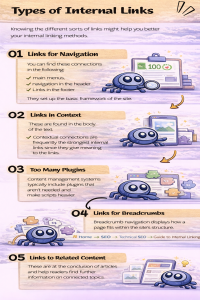
Knowing the different sorts of links might help you better your internal linking methods.
Links for navigation
You can find these connections in the following:
- main menus
- navigation in the header
- Links in the footer
They set up the basic framework of the site.
Links in Context
These are found in the body of the text.
Contextual connections are frequently the strongest internal links since they give meaning to the links.
Links for breadcrumbs
Breadcrumb navigation displays how a page fits within the site’s structure.
For example:
Home → SEO > Technical SEO → Guide to Internal Linking
Links to Related Content
These are at the conclusion of articles and help readers find further information on connected topics.
Internal Link Structure Strategies
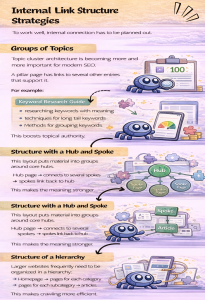
To work well, internal connection has to be planned out.
Groups of Topics
Topic cluster architecture is becoming more and more important for modern SEO.
A pillar page has links to several other entries that support it.
For example:
Keyword Research Guide Pillar: Cluster Pages:
- researching keywords with meaning
- techniques for long-tail keywords
- Methods for grouping keywords
This boosts topical authority.
Structure with a Hub and Spoke
This layout puts material into groups around core hubs.
Hub page → connects to several spokes → spokes link back to hub
This makes the meaning stronger.
Structure of a hierarchy
Larger websites frequently need to be organized in a hierarchy:
Homepage → pages for each category → pages for each subcategory → articles
This makes crawling more efficient.
Internal Linking Tools for SEO
There are a number of tools that may assist you look at and optimize your internal links.
Screaming Frog
Great for audits of technology.
It finds:
- pages that are not linked to
- connections that don’t work inside
- Problems with crawl depth
Site Audit with Ahrefs
Gives an examination of how internal links are spread out.
It shows which pages require additional connections to other pages on the same site.
Audit of the SEMrush site
Helps find:
- links between pages are weak
- Problems with crawlability
- problems with structure
Plugins for Internal Linking
For CMSs like WordPress:
- Link Whisper
- Suggestions for internal linking from Yoast
- Tools for internal linking in RankMath
These technologies assist link to many pages on big websites.
Real SEO Audit Insights
Internal linking errors come up surprisingly regularly in genuine SEO audits.
Some common problems are:
- Pillar pages that don’t get many internal connections
- orphaned information that search engines don’t often explore
- connecting too much to pages that aren’t worth much
- weak anchor text that doesn’t give much information
In one audit of a site with 300 pages of content, just changing the way the internal links worked brought in 28% more organic traffic in four months.
The modification didn’t add any new information or backlinks; it only made the links work better.
Internal Linking Optimization Framework
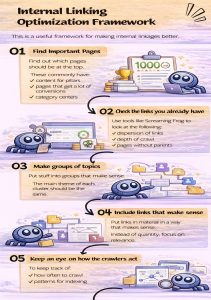
This is a useful framework for making internal linkages better.
Step 1: Find Important Pages
Find out which pages should be at the top.
These commonly have:
- content for pillars
- pages that get a lot of conversions
- category centers
Step 2: Check the links you already have
Use tools like Screaming Frog to look at the following:
- dispersion of links
- depth of crawl
- pages without parents
Step 3: Make groups of topics
Put stuff into groups that make sense.
The main theme of each cluster should be the same.
Step 4: Include links that make sense
Put links in material in a way that makes sense.
Instead of quantity, focus on relevance.
Step 5: Keep an eye on how the crawlers act
To keep track of:
- how often to crawl
- patterns for indexing
Common Internal Linking Mistakes
There are a lot of common blunders that people make while connecting to other pages on their own site.
Linking Without a Plan
Random links do not make the content more relevant.
Internal links should help the content hierarchy.
Using too many Exact Match Anchors
The wording of the anchor should change organically.
People may think that over-optimization is dishonest.
Not Paying Attention to Orphan Pages
Other pages can’t provide authority to orphan pages.
They typically have trouble getting a good rank.
Too Many Links
Too many connections weaken authority signals.
Put quality ahead of quantity.
Future of Internal Linking in AI Search
Search engines powered by AI are becoming better.
Some systems are:
- Google AI Summaries
- search engines that can talk to you
- models for generative search
evaluate linkages between content and entities more and more.
Internal linking helps build these connections.
Internal links now assist establish knowledge hierarchies across websites, not only give out authority.
This suggests that in the future of SEO, well-organized content clusters will probably be even more crucial.
FAQs
1. What does SEO mean when it says “internal linking”?
Internal linking is the technique of linking pages on the same website to make it easier for search engines to index, share authority, and make it clear how topics are related.
2. How many connections to other pages should a page have?
There isn’t a set quantity, however most pages do better with 3 to 10 contextual internal links, depending on how long the content is.
3. Do links within a site assist rankings?
Yes. Internal links assist search engines figure out how important a page is and how relevant it is to a topic.
4. What does “orphan page” mean in SEO?
An orphan page is a page with no internal links going to it, making it harder for search engines to detect.
5. Should keywords be used as anchor text in internal links?
Yes, but of course. The anchor text should be relevant to the subject without looking too optimized.
6. Are internal connections as significant as links from other sites?
Backlinks are still the best way to tell search engines how important your site is, but internal links help spread that authority throughout your site.
Conclusion
Website owners can regulate internal links better than almost any other part of search engine optimization. Backlinks need validation from an outside source, but internal links let you modify how search engines see the structure of your website and the authority of your subject matter.
By employing internal linking wisely, you can make crawling more efficient, make it easier to understand how different subjects are related, and spread ranking power among important pages. In today’s search engine optimization strategies, internal links are becoming more and more important parts of content architecture instead of being an afterthought.