


Technical SEO for developers is what makes it possible for search engines to crawl, interpret, and index your website correctly. If a site’s technological architecture stops search engine bots from crawling it or slows down page rendering, even the finest content will have a hard time ranking.
When you conduct a real SEO audit, you often discover technical problems in unexpected areas, such as JavaScript rendering issues, crawl budget inefficiencies, incorrect canonical tags, or poorly configured robots directives. These issues don’t usually lead to immediate penalties, but they do make a site less visible over time and make it harder for it to grow in search.
This tutorial has a full technical SEO checklist only for developers. It covers the architecture, infrastructure, and performance factors that help a site show up well in search results.
Technical SEO for developers refers to the process of optimizing a website’s infrastructure so search engines can efficiently crawl, render, and index content. It involves improving site architecture, page performance, structured data, crawl directives, and server behavior to ensure search engines correctly interpret and rank website pages.
Technical SEO for developers is all about making a website’s infrastructure better so that it can be crawled, indexed, and run faster. It includes controlling the site’s structure, server replies, structured data, page speed, and crawl directives to make sure search engines can easily find and comprehend the material on the site..
What Is Technical SEO for Developers?
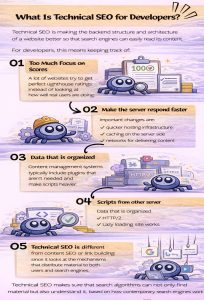
Technical SEO is making the backend structure and architecture of a website better so that search engines can easily read its content.
For developers, this means keeping track of:
- How URLs are set up
- instructions for crawling
- page rendering
- data that is organized
- answers from the server
- How well the site works
Technical SEO is different from content SEO or link building since it looks at the mechanisms that distribute material to both users and search engines.
Technical SEO makes sure that search algorithms can not only find material but also understand it, based on how contemporary search engines work.
Why Does Technical SEO Matter for Search Visibility?
Automated crawlers check out webpages for search engines. These crawlers use a lot of technical signals to figure out how to index material.
A lot of difficulties happen when there aren’t strong technological foundations:
- search engines can’t find pages
- delays in rendering keep material from being seen by crawlers
- Duplicate pages make indexing signals less clear.
- Slow performance makes users less interested.
In genuine SEO audits, a lot of ranking difficulties are caused by technical flaws, not by the quality of the content.
For instance, a site with great content might not rank if:
- There is a problem with the canonical tags.
- Pages take a long time to load.
- Weak internal connecting
- JavaScript stops rendering
Technical SEO fixes these problems before they hurt rankings.
How Do Search Engines Crawl and Render Websites?
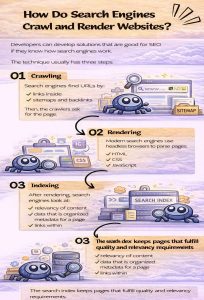
Developers can develop solutions that are good for SEO if they know how search engines work.
The technique usually has three steps:
Crawling
- Search engines find URLs by:
- links inside
- sitemaps and backlinks
Then, the crawlers ask for the page.
Rendering
Modern search engines use headless browsers to parse pages:
- HTML
- CSS
- JavaScript
Rendering lets the crawler see the page the same way people do.
Indexing
- After rendering, search engines look at:
- relevancy of content
- data that is organized metadata for a page
- links within
The search index keeps pages that fulfill quality and relevancy requirements.
Core Technical SEO Areas Developers Must Understand
Developers should focus on several key technical areas.
Site Architecture
A well-structured architecture helps both users and crawlers navigate a site.
Example structure:
Homepage
→ Category Pages
→ Topic Clusters
→ Individual Articles
Clear hierarchy improves crawl efficiency.
URL Structure
SEO-friendly URLs should be:
-
readable
-
short
-
descriptive
-
consistent
Example:
example.com/seo/technical-seo-checklist
Avoid:
example.com/page?id=5829
Robots Directives
Robots directives control crawler access.
Important directives include:
robots.txt
meta robots tags
X-Robots headers
Incorrect configuration can accidentally block important pages.
XML Sitemaps
Sitemaps help search engines find URLs.
They should have:
- pages that are canonical
- new content
- valid links
Don’t include:
- sites that were redirected
- sites that don’t show up in search results
- URLs that are the same
Technical SEO Checklist for Developers
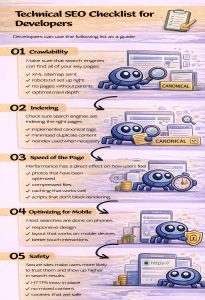
Developers can use the following list as a guide.
Crawlability
Make sure that search engines can find all of your key pages.
List:
- XML sitemap sent
- robots.txt set up right
- no pages without parents
- optimal crawl depth
Indexing
Check sure search engines are indexing the right pages.
List of things to do:
- implemented canonical tags
- minimized duplicate content
- noindex used when necessary
Speed of the Page
Performance has a direct effect on how users feel.
List of things to do:
- photos that have been optimized
- compressed files
- caching that works well
- scripts that don’t block rendering
Optimizing for mobile
Most searches are done on phones.
Check list:
- design that responds
- layout that works on mobile devices
- better touch interactions
Safety
Secure sites make users more likely to trust them and show up higher in search results.
List of things to do:
- HTTPS is now in place
- no mixed content
- cookies that are safe
JavaScript SEO Considerations
Modern frameworks use JavaScript a lot, but if it’s not done well, it might hide material from crawlers.
Developers should think about:
Rendering on the server side (SSR)
Strategies for hydration in static site generation (SSG)
In genuine SEO audits, sites that utilize a lot of JavaScript generally have trouble being indexed since content only shows up after scripts run.
Rendering methods like SSR make sure that material is shown right away.
Structured Data and Schema Implementation
Structured data helps search engines interpret page content more precisely.
Developers can implement schema for:
-
articles
-
products
-
FAQs
-
breadcrumbs
-
organizations
Proper structured data improves eligibility for rich results in search engines.
Real SEO Audit Insights
In true technical SEO audits, several patterns keep coming up.
Some common difficulties are:
- sites that are not related to each other
- big JavaScript packages that slow down rendering
- redundant canonical tags
- too many redirect chains
In one audit of a 500-page e-commerce site, correcting problems with redirect chains and crawl depth led to a 37% increase in indexed pages in just two months.
There were no new pieces of material; only technical fixes were made.
Common Technical SEO Mistakes
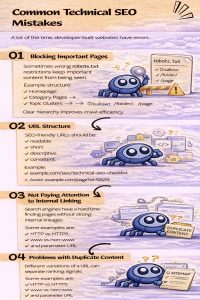
A lot of the time, developer-built websites have errors.
Blocking Important Pages
Sometimes, wrong robots.txt restrictions keep important content from being seen.
Too much use of JavaScript Rendering
Heavy rendering on the client side slows down crawler access.
Not paying attention to internal linking
Search engines have a hard time finding pages without strong internal linkages.
Problems with Duplicate Content
Different variations of a URL can separate ranking signals.
Some examples are:
- HTTP vs. HTTPS
- www vs. non-www
- and parameter URL
Future of Technical SEO in AI Search
Search engines are moving toward indexing algorithms that use AI.
In the future, technical SEO may focus more on:
- organized way of showing knowledge
- connections between entities
- links between semantic content
- review of rendering in real time
As AI systems start to understand websites more as people do, developers need to make sure that the layout of a site makes it easy to read and quick to load.
FAQs
What is technical SEO for developers?
Technical SEO for developers is all about making the architecture of a website better so that search engines can crawl, render, and index information quickly and easily.
Why is technical SEO crucial for programmers?
Developers are in charge of the architecture, rendering process, and server settings that have a direct effect on how easy it is to find anything on the web.
What tools do developers use to check technical SEO?
Some common tools are:
- Console for Google Search
- Screaming Frog
- Light House
- Insights on PageSpeed
Does technical SEO have an effect on rankings?
Yes. Technical problems can stop pages from being indexed or crawled correctly, even though content and backlinks are still very important.
Is JavaScript not good for SEO?
JavaScript itself isn’t harmful for SEO, but client-side rendering that isn’t done well might slow down indexing.
How often should you do technical SEO audits?
At least once every three months, large websites should do technical audits, especially after big deployments.
Conclusion
Technical SEO for developers combines engineering decisions with search visibility. SEO teams focus on keywords, content, and links. Developers create the tools search engines need to read and analyze the information. Without a strong technological foundation, even the finest content won’t rank well in search results.
Web crawling, rendering, indexing, and ranking are intricate processes used by current search engines. Each phase relies on server response codes, structured data, page speed, and site architecture. Search engines can swiftly evaluate a website and understand how pages and topics relate when these things are done appropriately.
In real-world SEO audits, a lot of visibility problems stem from technical defects that aren’t too hard to repair. Examples are robot resources banned.txt, too many redirect chains, poorly designed canonical tags, or large JavaScript frameworks that impede information presentation. Search engines struggle to comprehend and rank sites with these problems, although they seldom result in penalties.
Developers are crucial for long-term search success. Development teams assist search engines crawl and interpret material by prioritizing clean design, optimal performance, and organized data. Technical SEO should be part of the development process when adding new features or redesigning the site’s architecture.
The requirement for well-structured technology will expand as search technology evolves toward AI-driven indexing and semantic comprehension. Strong technological infrastructure, high-quality content, and logical internal linkage will continue to give websites persistent, scalable search visibility.