

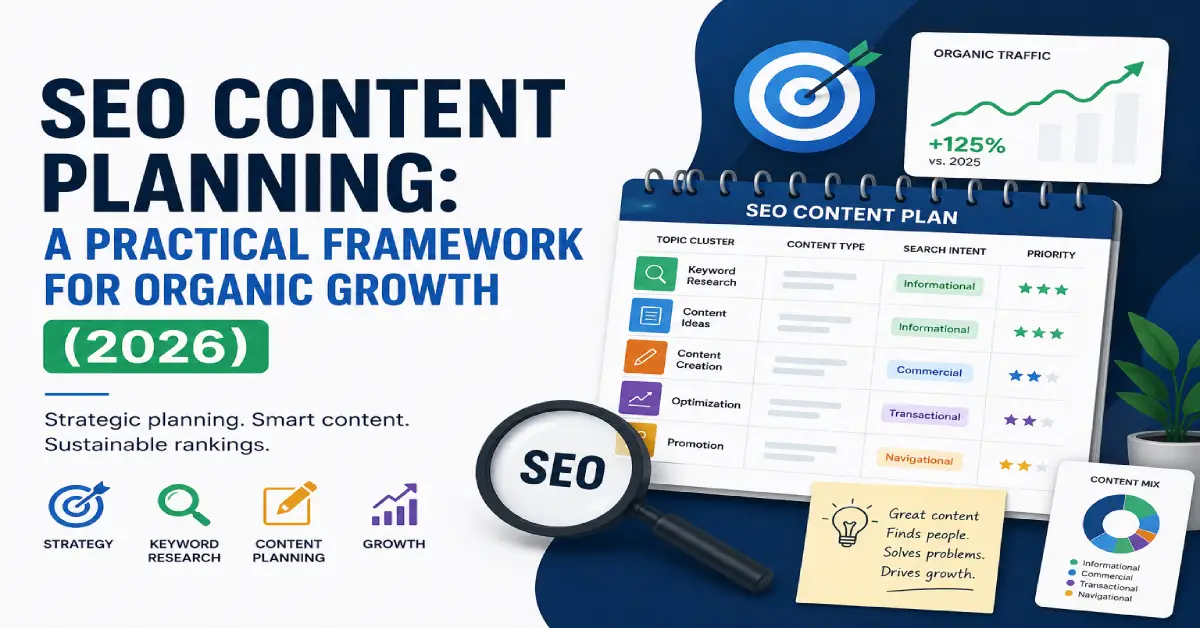
SEO content planning is the practice of deciding what content to create, how it connects to existing pages, and how it fits your site’s overall structure—so that every page strengthens your authority instead of competing with it.
At first, SEO content planning looks simple — a list of keywords or a calendar showing what gets published months ahead. In real life, it’s rarely that clean.
I’m Zohanuddin Shaikh, an SEO consultant based in Karachi, Pakistan, with 8 years of experience. I’ve seen websites publish hundreds of articles a year with no organic growth, while lean teams consistently outperform much larger competitors. The difference isn’t content volume — it’s how well everything is organized.
Search engines don’t evaluate content in isolation. They assess your entire site: how well it crawls, how it satisfies user intent, whether pages compete with each other, and how consistent the overall structure is. When your content plan accounts for these factors, performance improves. When it doesn’t, even “good” content underperforms.
That’s why SEO content planning isn’t just a creative activity — it’s an operational discipline. Done well, it compounds over time. Done poorly, it quietly creates content dilution, crawl inefficiencies, and unstable rankings. This guide covers what SEO content planning actually is, how it differs from a content calendar, and the framework that makes content scale instead of fragment.
What Is SEO Content Planning?
SEO content planning is the strategic process of determining what content to create, how each page relates to existing content, and how it fits within the site’s architecture—with the goal of building topical authority rather than producing isolated pages.
It answers questions that go far beyond “what should we publish next”:
- Where does this page fit in the site’s overall structure?
- Which URLs does it support or compete with?
- How will search engines interpret intent overlap in six months?
- What happens when this page is no longer “new”?
Even well-written content can hurt a site over time if it doesn’t answer these questions. SEO content planning is the layer that ensures content adds value cumulatively, rather than fragmenting your site’s signals.
SEO Content Planning vs Content Calendars
One of the most common mistakes I find in audits is treating content planning as the same thing as a publishing calendar. They serve completely different purposes.
Aspect |
Content Calendar |
SEO Content Planning |
|
Core focus |
When content gets published | How content fits and performs |
|
Primary concern |
Timing and frequency | Intent, structure, authority |
|
Question it answers: |
What’s next on the schedule? |
Where does this fit strategically? |
| Risk if ignored | Missed deadlines |
Fragmentation, cannibalization |
| Success measure | Consistent publishing |
Stable rankings, clear structure |
| Timeframe | Short-term (weeks/months) |
Long-term (page lifecycle) |
A calendar tells you when content goes live. SEO content planning tells you where it fits, what it supports, and how it will perform over time. A calendar is useful — but without planning behind it, consistent publishing can actually accelerate fragmentation.
SEO Content Planning Starts before Keywords
Keyword research matters, but it isn’t the first step in SEO content planning. Planning starts with defining your boundaries and goals.
Before choosing keywords, you need clarity on:
- What problems this content is meant to solve
- Which intents your site already “owns”
- Where your authority is strong versus borrowed
- How deep each topic genuinely needs to go
When planning content for organic growth, fewer well-placed pages frequently outperform dozens of weakly connected ones.
I’ve seen sites resume growth simply by not adding new pages—instead strengthening existing URLs by cleaning up intent signals, improving internal linking, and aligning content updates with how search engines already interpret the site. This counterintuitive approach works consistently across site types, even though it surprises many content teams.
Keyword-Driven vs Intent-Driven Content Planning
Keyword-driven content planning only works when it’s organized around separating intent—not just phrases.
In audits, keyword-driven planning usually fails because of:
Problem |
What It Creates |
|
Multiple pages saying the same thing differently |
Internal competition |
|
Long-tail keywords treated as new topics |
Fragmentation instead of depth |
| Mixing informational and commercial intent in one cluster |
Confused intent signals |
| Prioritizing “coverage” over keyword difficulty |
Scale that behaves like dilution |
This produces something that looks like scale but behaves like fragmentation.
The better approach is grouping keywords by intent rather than by phrase: one strong page for each core goal, supported by content that reinforces it rather than competing articles. This is where SEO content architecture becomes critical.
What Is SEO Content Architecture?
SEO content architecture is the structural layer that defines how pages relate to each other — which page is the primary authority on a topic, which pages support it, and how internal links signal those relationships to search engines.
It’s more than just categories. Architecture answers:
- Which page is the definitive source for this topic?
- What pages support and reinforce it?
- Which pages should never stand alone?
I’ve seen sites with apparent topical authority lose ground in audits because their content architecture allowed too many pages to stand alone when they should have been combined. Strong SEO content planning includes not just topics but hierarchy—a clear sense of which pages lead and which support.

How to Plan Content Clusters for SEO
Topic cluster planning is widely discussed, but it often fails in practice. A content cluster is a group of related pages—one pillar page covering a core topic, supported by articles addressing specific subtopics, all connected through internal links.
Clusters fail when:
- The pillar page keeps changing what it’s about
- Supporting pages are too similar to each other
- Internal links aren’t consistent or deep
- Updates reset intent instead of reinforcing it
I’ve seen clusters where every article was “optimized,” yet rankings fluctuated randomly because the cluster never stabilized.
Building stable clusters requires discipline:
Principle |
Why It Matters |
|
Not every keyword needs its own URL |
Some deserve a paragraph, not a page |
|
Some keywords belong in existing content |
As updates, not new posts |
| The pillar must stay stable |
Changing focus resets authority |
| Internal links must be intentional |
They signal cluster relationships |
When search engines can consistently map intent to stable URLs over time, organic growth accelerates. Stability — not constant optimization — is what makes clusters work.
Editorial Planning for SEO: Timing, Not Frequency
Editorial planning usually focuses on how often to publish. SEO content planning focuses on order — the sequence in which content is published and reinforced.
In practice, this means:
- Publishing foundational pages before long-tail pages
- Strengthening authority before expanding to related topics
- Updating existing URLs before adding new ones
- Letting crawl patterns — not calendars — guide publishing timing
I’ve audited sites where ambitious publishing schedules actually slowed indexing because crawl budget was being spent on low-impact URLs instead of important pages. In SEO content planning, the goal isn’t momentum — it’s efficiency. The right order compounds; the wrong order fragments.
What Usually Goes Wrong in Real SEO Audits
Across content-heavy audits, the same planning mistakes repeat.
Mistake 1: Planning Content Without Crawl Awareness
Large sites forget that crawl budget is finite. Adding hundreds of low-quality pages makes it less likely that important pages get indexed. Rankings decline with no obvious cause — because the cause is buried in crawl inefficiency.
Mistake 2: Detecting Intent Overlap Too Late
Teams usually notice cannibalization only after traffic drops. By then, the fix is consolidation, not optimization—a much bigger intervention than catching the overlap during planning.
Mistake 3: Calendars That Ignore Maintenance
Publishing continues while older content decays. Authority quietly fades because the calendar only accounts for new content, never maintenance of existing pages.
Mistake 4: Reactive Internal Linking
Internal links get added after performance declines, rather than being built into the plan from the start. Proactive internal linking is part of planning; reactive linking is damage control.
These problems rarely look alarming on dashboards, but they show up clearly in long-term trend lines.
A Practical SEO Content Planning Diagnostic
Before approving any new content, run it through these questions:
Diagnostic Question |
If the Answer Is Unclear… |
|
Is this intent already covered elsewhere? |
Strengthen the existing page instead |
|
Does this clarify or confuse topical authority? |
If it fragments, reconsider the URL |
| What lifecycle stage is this page in? |
Plan for when it’s no longer “new” |
| Can this page realistically be maintained? |
If not, it’s a long-term risk |
If any answer isn’t clear, the content usually underperforms. This diagnostic prevents the slow accumulation of fragmenting, hard-to-maintain pages.
Does Publishing Less Content Help SEO?
Counterintuitively, yes—publishing less content often helps SEO when it improves clarity, reduces internal competition, and concentrates authority.
This happens because search engines reward sites that are easy to understand. When you publish fewer, better-connected pages:
- Crawl budget focuses on important URLs
- Intent signals stay clear instead of fragmenting
- Internal authority concentrates rather than spreading thin
- Topical authority strengthens around stable pages
I’ve repeatedly seen sites grow after reducing their publishing pace to reinforce existing content. This doesn’t mean stop creating content — it means every new page should earn its place by strengthening the overall structure, not just adding to the count.
For a deeper look at how content ages and when to retire it, see my content lifecycle management guide.
SEO Content Planning as Part of Content Marketing
SEO content planning is the discipline that ties the rest of content marketing together. It connects:
- Planning and execution
- Structure and creativity
- Publishing and maintenance
It ensures content doesn’t just exist—it gains value over time. Without planning, content marketing becomes noise: lots of activity, little compounding. With careful SEO content planning, it becomes predictable, scalable, and durable.
This connects directly to broader strategy. For the full picture, see my SEO growth strategy guide and topical authority guide.
FAQs
1. What is the difference between SEO content planning and content calendars?
A content calendar focuses on timing — when content gets published. SEO content planning focuses on intent, structure, and long-term performance — where each page fits, what it supports, and how it will perform over time. A calendar schedules publishing; planning ensures that publishing actually builds authority instead of fragmenting it.
2. What is SEO content architecture?
SEO content architecture is the structural layer that defines how pages relate to each other — which page is the primary authority on a topic, which pages support it, and how internal links signal those relationships. It goes beyond categories to determine which pages lead, which support, and which should never stand alone.
3. Can small teams use SEO content planning?
Yes — and small teams often benefit the most. Planning reduces wasted effort by ensuring every page strengthens the site rather than competing with it. With limited resources, the focus and efficiency that come from good planning matter even more than they do for large teams with bigger budgets.
4. How often should you review your SEO content plan?
Review your SEO content plan at least once every three months and additionally whenever rankings shift noticeably or crawl behavior changes. Regular reviews catch intent overlap and content decay early—before they require expensive consolidation. The cadence should match your publishing speed; faster publishing needs more frequent review.
5. Is it really better for SEO to publish less content?
Often, yes — when publishing less improves clarity, reduces internal competition, and concentrates authority. Search engines reward sites that are easy to understand. Fewer, better-connected pages frequently outperform high-volume publishing because crawl budget and internal authority focus on what matters instead of spreading thin.
6. How do you know if your SEO content planning is working?
The clearest signs are stability: rankings that don’t fluctuate wildly, predictable crawl patterns, faster indexing of new content, and fewer internal competition issues. If your content plan is working, growth feels steady and compounding rather than volatile — and new pages in established topics rank faster.
7. What are the most common SEO content planning mistakes?
The most common mistakes are planning without crawl awareness (adding pages that waste crawl budget), detecting intent overlap too late (after traffic drops), calendars that ignore content maintenance, and reactive rather than proactive internal linking. All four quietly fragment a site’s signals before showing up in traffic data.
8. Should every keyword get its own page?
No. Some keywords deserve their own page, some belong as a section within existing content, and some are simply variations that should be folded into a page you already have. Treating every keyword as a new URL is a leading cause of fragmentation and internal competition. Group by intent, not by phrase.
Final Thoughts
SEO content planning isn’t about ranking faster or publishing more. It’s about building a website that search engines can consistently understand, trust, and reward.
I’ve seen content succeed not because it was clever but because it was placed with awareness of intent, crawl behavior, and timing. The sites that grow steadily aren’t the noisiest — they’re the clearest.
In content marketing, SEO content planning is where ambition and discipline meet. It’s the difference between content that exists and content that compounds. When you plan around intent, architecture, and lifecycle — rather than just keywords and calendars — every page contributes to a structure that strengthens over time.
The teams that win don’t publish the most. They plan the best.
For questions about building a content plan for your own site, feel free to reach out through my Contact page.
For more SEO guides, browse Search Engine Realm.
Last Updated: June 2026