

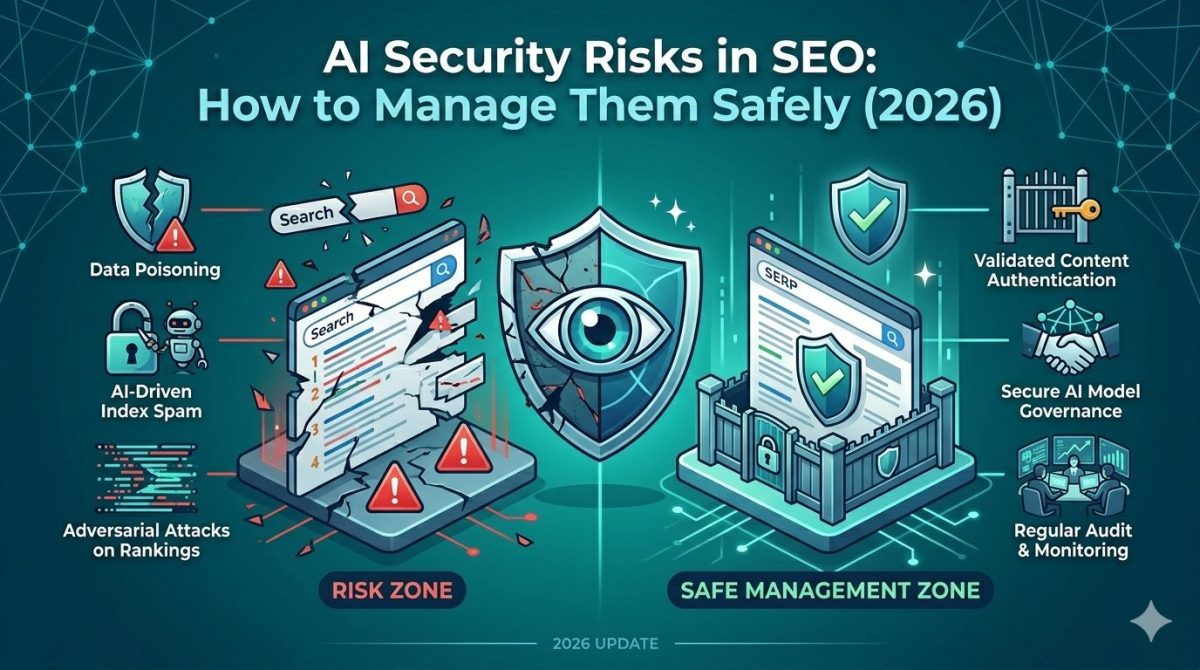
AI security risks in SEO are rarely dramatic—they’re subtle, gradual, and easy to miss. Artificial intelligence now plays a central role in modern SEO, even when teams don’t fully recognize its impact.
Artificial intelligence no longer just supports content creation. It actively shapes keyword clustering, suggests internal linking strategies, analyzes logs, prioritizes crawling, and even applies automated fixes inside CMS platforms and plugins. These systems often run in the background, making decisions at scale—and teams frequently rely on AI-driven outputs without understanding how those decisions are made or how they change over time.
I’m Zohanuddin Shaikh, an SEO consultant based in Karachi, Pakistan, with 8 years of experience. This is why AI security risks matter in SEO. You don’t need advanced systems to feel the impact—even basic AI tools can introduce risk if you don’t monitor them. When AI influences your site structure, content relationships, and how search engines interpret your pages, even small errors can scale quickly. This guide explains where those risks come from, how they affect rankings, and how to use AI safely with proper oversight.
What Are AI Security Risks in SEO?
AI security risks in SEO are the risks that arise when AI-driven systems shape SEO decisions—content, structure, internal linking, and crawling—without proper human oversight, gradually distorting the signals search engines rely on to judge quality and trust.
Unlike traditional security threats, these risks rarely look like a breach. They don’t trigger penalties or sudden crashes. Instead, they appear as the following:
- Slow performance decline
- Stagnating rankings
- Traffic that never fully recovers
In many cases, what gets blamed on algorithm updates is actually AI quietly misclassifying content, reinforcing weak signals, or scaling small errors across hundreds of pages. AI itself isn’t the problem — the real issue is AI operating without oversight.
Why AI Security Impacts SEO
Search engines don’t just evaluate individual pages — they assess entire systems: how content is created, how structure evolves, and how signals stay consistent over time. When AI becomes part of that system, any flaw in how it operates can affect your site’s reliability, clarity, and trustworthiness.
Unlike traditional threats, AI-related SEO issues typically
Effect |
What It Does |
|
Distort internal signals |
Confuses how pages relate to each other |
|
Create inconsistencies |
Pages send mixed signals across the site |
| Reduce topical clarity |
Blurs what the site is actually about |
| Introduce structural noise |
Adds low-value pages and patterns |
These don’t trigger penalties—they reduce search engine confidence over time. And lost confidence is much harder to diagnose than a penalty, because nothing looks technically broken.
Where AI Enters SEO Workflows
Many teams underestimate how deeply AI is embedded in their processes. AI typically enters SEO workflows in these areas:
AI Entry Point |
Common Risk |
|
AI-assisted content creation |
Thin or templated content at scale |
|
Keyword clustering models |
Wrong groupings that confuse intent |
|
Automated internal linking tools |
Links that don’t follow logic |
| SEO plugins and SaaS platforms |
Automated changes without review |
| Dynamic metadata/template updates |
Inconsistent signals across pages |
| Automated content cleanup systems |
Removing or altering valuable pages |
The risk usually isn’t an external attack — it’s unchecked automation making decisions no one reviews.
Common AI-Driven SEO Failures
Across real-world audits, several failure patterns repeat:
Failure Pattern |
What Happens |
|
Over-reliance on AI outputs |
Teams trust recommendations without questioning them |
|
Lack of safeguards |
AI suggestions go live with no review or rollback |
| Feedback loops |
Weak signals reinforce themselves over time |
| Disconnected teams |
SEO and security operate separately, leaving gaps |
In most of these cases, nothing is technically “broken.” Performance simply fades. This is what makes AI-driven failures so dangerous — they don’t announce themselves the way a crawl error or a manual penalty would.
How AI Affects Crawling and Indexing
Search engines rely on stability and predictability. AI systems that dynamically change a site can disrupt that stability in ways that directly affect crawl efficiency.
When AI dynamically adjusts internal links, rewrites templates, changes navigation structures, or modifies canonical signals, common outcomes include:
- Important pages getting crawled less often
- Low-value URLs receiving more crawl attention
- Unstable, unpredictable indexation patterns
Over time, this leads to reduced trust and inconsistent visibility. The pages that matter most may be crawled less, while AI-generated low-value URLs consume crawl budget. For a deeper process on diagnosing these issues, see my technical SEO audit guide.
A Smarter Approach to AI in SEO
The solution isn’t to remove AI — it’s to control how you use it. AI delivers real speed and scale advantages; the goal is keeping those benefits while maintaining oversight.
Follow these principles to build safe, effective AI-assisted systems:
Principle |
What It Means |
|
Insights, not decisions |
Let AI generate insights, but humans decide |
|
Clear automation boundaries |
Define exactly what AI can and can’t do |
| Validate before deploying |
Review AI outputs before they go live |
| Keep rollback options |
Always be able to reverse changes |
| Monitor continuously |
Track performance on an ongoing basis |
The core principle: use AI as a support system, not an independent decision-maker. This keeps the speed of automation while preserving the judgment that protects long-term performance.
A Practical AI-SEO Oversight Checklist
Use this checklist to keep AI-driven SEO under control:
- Map where AI influences SEO decisions across your stack
- Limit what AI can execute automatically (vs. suggest)
- Review AI-driven changes regularly
- Track crawl and indexing shifts after AI updates
- Keep human oversight in place for critical decisions
- Maintain rollback options for every automated change
This approach doesn’t slow growth — it makes growth sustainable. The teams that govern AI well capture its speed without inheriting its risks.
How to Detect AI-Driven SEO Problems Early
Because AI-driven problems appear as gradual decline rather than sudden drops, early detection requires linking performance changes to automation activity.
To catch issues before they compound:
- Correlate ranking or traffic changes with recent AI/automation updates
- Review crawl patterns in Search Console after any automated change
- Check for new low-value URLs appearing in the index
- Monitor whether internal linking still follows logical structure
- Watch for pages that rank briefly then slide (a weak-signal indicator)
The key diagnostic question is simple: did anything change in our automation around the time performance shifted? Most AI-driven SEO problems trace back to an automated change that no one reviewed. Connecting the timeline is often the fastest path to the root cause.
FAQs
1. How do AI security risks affect SEO?
AI security risks affect SEO by gradually distorting the signals search engines rely on—internal links, content relationships, and structural consistency. This leads to slow visibility loss rather than sudden drops. The site keeps functioning and pages stay indexed, but performance weakens because underlying signals lose clarity and consistency over time.
2. Are AI SEO tools unsafe?
No, AI SEO tools aren’t inherently unsafe. The risk comes from poor implementation and lack of oversight, not from the tools themselves. AI tools become risky when their outputs go live without review, when automation runs unchecked, or when teams trust recommendations without validating them against real user intent and site goals.
3. Can AI cause ranking declines?
Yes, especially when AI reinforces weak decisions at scale. If an AI system misclassifies content, creates illogical internal links, or generates low-value pages, those errors multiply across the site. Because search engines evaluate sites as systems, scaled errors gradually reduce confidence and cause rankings to decline or stall.
4. How can teams detect AI-driven SEO issues?
Teams detect AI-driven issues by linking performance changes to automation activity. When rankings or traffic shifts, check whether any AI or automated change happened around the same time. Review crawl patterns, indexing behavior, and internal linking in Google Search Console to spot inconsistencies introduced by automated systems.
5. Should AI be removed from SEO entirely?
No. AI shouldn’t be removed — it should be guided, monitored, and controlled rather than left to operate independently. AI provides genuine speed and scale benefits. The goal is to keep humans involved in critical decisions, review automated outputs, and maintain rollback options, capturing AI’s advantages without its risks.
6. What’s the difference between AI security risks and traditional SEO threats?
Traditional SEO threats—hacking, negative SEO, and malware—are usually obvious and trigger clear warnings. AI security risks are subtle: they distort internal signals gradually without any technical breach. Nothing looks broken, but performance slowly fades as search engines lose confidence in the site’s clarity and consistency.
7. How do I use AI safely for content creation in SEO?
Use AI to assist research, drafting, and ideation — but keep human judgment for strategy, brand voice, original insight, and final editorial decisions. Always review AI-generated content for accuracy and genuine value before publishing. Avoid mass-producing thin AI content, which scales low-value pages and weakens topical clarity across your site.
8. Does using AI hurt SEO rankings automatically?
No, using AI doesn’t automatically hurt rankings. Google doesn’t penalize content simply for being AI-assisted. The risk is in how AI is used — unchecked automation, thin content at scale, and distorted signals hurt rankings. Well-governed AI with human oversight can support rankings rather than harm them.
Final Thoughts
AI doesn’t usually break websites in obvious ways, but it can quietly lead them in the wrong direction.
From an SEO standpoint, the real danger isn’t hacking or malicious activity. It’s the slow, subtle distortion of the signals search engines rely on to judge quality, relevance, and trust. Over time, these small inconsistencies add up, making a site appear less reliable even when nothing seems technically wrong on the surface.
This is why many AI-linked SEO issues don’t show up as sudden drops. They appear as gradual declines, stalled growth, or rankings that never fully recover. The site still functions and pages still get indexed, but performance slowly weakens because the underlying signals lose clarity.
The takeaway is straightforward but important: use AI to support your decisions, not replace your judgment. Maintain control over what gets implemented and how. Treat AI as part of your infrastructure—not as the authority making final calls.
In practice, this means keeping humans involved in critical decisions, reviewing automated outputs, and ensuring changes align with real user intent—not just patterns AI has learned. Teams that approach AI this way build stronger, more stable SEO systems. They benefit from speed and scale without sacrificing control, leading to more consistent performance and a more resilient foundation for long-term growth.
For questions about managing AI in your own SEO workflow, feel free to reach out through my contact page.
For more SEO guides, browse Search Engine Realm.
Last Updated: June 2026