

Local SEO is complicated, and creating local citations is often the first step. Many organizations assume generating citations is as simple as checking off a list: Submit the company to a few directories, wait a few weeks, and hope the rankings rise. Citations seldom work that way in SEO, especially local audits. They seldom change ranks quickly. They are the trust basis that powers local search.
Due to inconsistent citation profiles, local firms with decent websites, content, and reviews struggled to appear on maps. Since their firm information was clear, consistent, and supported by numerous trusted sources, average-looking websites fared well in local search. Google’s trust in not having to “guess” which data was correct led to more consistent exposure.
Local citations help search engines identify companies. They strengthen web-wide name, address, phone number, and category signals. Google hesitates when signals don’t match, such as phone numbers, name changes, or outdated addresses. Hesitancy shows up as unreliable rankings, hard-to-see map packs, or inconsistent performance across neighboring regions. Citation data matching usually fixes such issues.
This article explains how to establish SEO-friendly local citations for a firm. It emphasizes real-world successes, time waste, and audit mishaps. Citations improve long-term local awareness without causing new issues to solve later.
What Do Local Citations Really Do?
A local citation is each time a company’s name, address, and phone number (NAP) are mentioned on a website that isn’t owned by the firm. That section is widely known. People don’t talk about why citations are important as much.
In real life, citations:
- Make the business more legitimate
- Support the recognition of local entities
- Make business data less unclear
- Make Google more likely to believe location and category cues.
They don’t take the place of links, reviews, or content. They help other local SEO signals work better by making them more dependable.
When there are problems with citations, they frequently show up in audits when
- Rankings change for no obvious reason
- Map visibility isn’t the same in all places
- Businesses are ranked in one area but not in the area next to it.
- Unexpectedly, the data on your Google Business Profile keeps altering.
Citation inconsistency is typically the blame for such troubles.
NAP Consistency: The Foundation of Citation Building
Consistency in NAP isn’t about being flawless; it’s about being able to count on it.
Based on what I’ve seen, the most typical difficulties with citations are the following:
- Some names are a little different (LLC vs. no LLC)
- Old phone numbers are still in the index.
- Different address forms in different listings
- Tracking numbers not utilised regularly
These don’t seem like big concerns on their own. They cause problems when there are a lot of them.
Fixing NAP consistency alone made local stability better in some audits, even without adding additional citations. If Google can’t safely match up old listings, it doesn’t need a lot of new ones.
Manual Citation Building vs Automated Submissions
This is one of the most important trade-offs in citation building.
Manual Citation Building
Manual submissions involve the following:
- Making listings by hand
- Checking who owns it
- Making sure info is correct
- Picking the right platforms
In real SEO work, manual citation building is slower but safer. It reduces duplication and ensures category accuracy.
Automated Citation Tools
Automation can help with:
-
Data distribution
-
Monitoring changes
-
Speed at scale
However, I’ve seen automation cause issues when:
-
Incorrect data is pushed everywhere
-
Duplicate listings are created
-
Old business information is reintroduced
For small and local businesses, manual-first usually produces better long-term results.
Choosing the Right Citation Sources (Quality Over Quantity)
Not all sites that provide citations are the same.
When I do audits, I put the following first:
- Big data collectors
- Famous business directories
- Platforms for specialised industries
- Directories that are relevant to your location
What I stay away from:
- Directories that are full with spam and just exist for SEO
- Unmoderated sites
- Platforms that aren’t tied to the business category
It’s a typical error to look for “best local citation sites” lists without checking to see whether they are relevant. Ten good citations are sometimes better than fifty bad ones.
Google Local Citations and the Role of Google Business Profile
Google Business Profile isn’t a citation in the usual sense, yet it is the main source of information.
Citation problems in audits often come from:
- Third-party sources altered GBP data
- Directories pushed conflicting addresses
- Categories don’t match up between platforms
When you build citations, you should always follow the below:
- Main business name in GBP
- Formatting of the exact address
- Main phone number
- Main groups
When citations don’t agree with GBP, rankings become shaky.
Local Citations for Small Businesses: What Actually Works
Small firms don’t require big citation profiles. They need ones that are clean.
Based on what I’ve seen, small firms should use these citation strategies:
- First, accuracy
- Second, core platforms
- Third, relevance to the industry
- Only grow when you need to
I have witnessed local service firms become more visible without adding a single new citation, just by correcting problems.
How Local Citations Affect Local Rankings (Realistically)
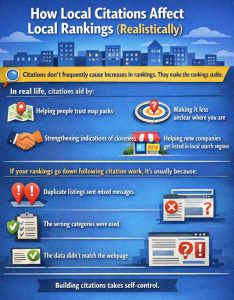
Citations don’t frequently cause increases in rankings. They make the rankings stable.
In real life, citations aid by
- Helping people trust map packs
- Making it less unclear where you are
- Strengthening indications of closeness
- Helping new companies get listed in local search engines
If your rankings go down following citation work, it’s usually because:
- Duplicate listings sent mixed messages.
- The wrong categories were used.
- The data didn’t match the webpage
Building citations takes self-control.
What I Commonly See Go Wrong in Citation Audits
This motif keeps coming back:
- Making new citations before clearing up old ones
- Using different phone numbers in an inconsistent way
- Making listings in directories that don’t matter
- Not paying attention to duplicate suppression
- Treating building citations as a one-time job
In some audits, addressing these errors was more important than adding new listings.
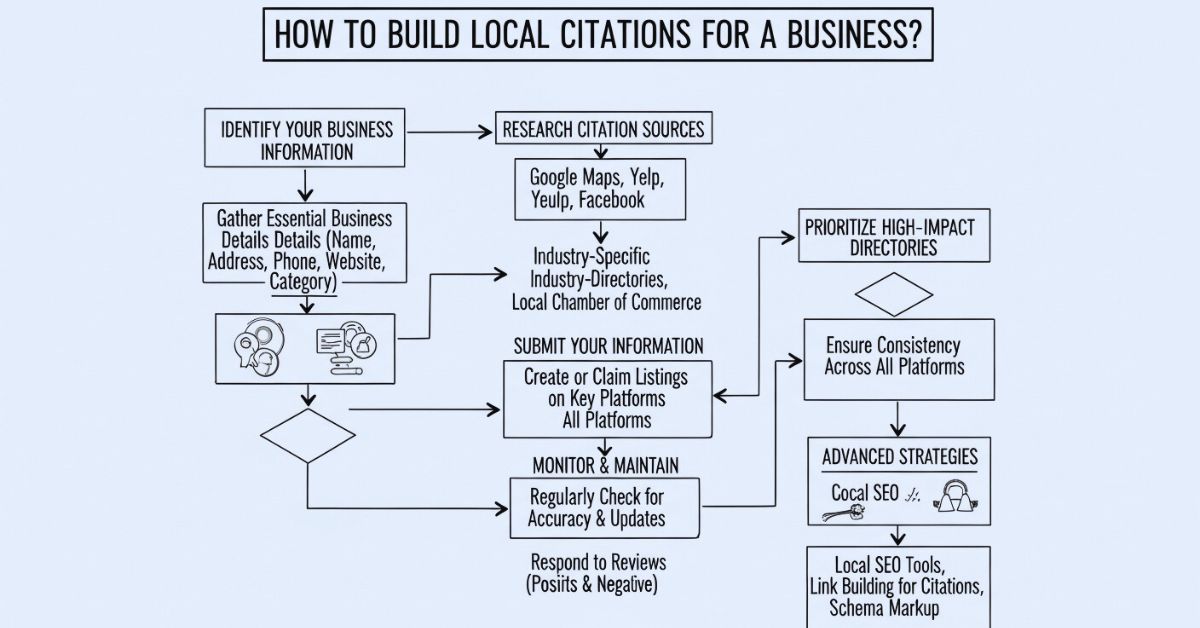
A Practical Local Citation Building Framework
This is the order I normally use when making local citations:
- Check for duplicates and existing citations
- Make NAP and business information the same
- Fix or hide wrong listings
- Make citations on important platforms
- Add to directories for your industry and your area
- Keep an eye on changes throughout time
Skipping stages wastes time and effort.
Local Citation Management Over Time
Citations go around. Companies relocate, phone numbers change, and platforms update their data sources.
In real life:
- You should check citations every so often.
- Changes should be made with caution.
- We need to keep a tight eye on automation.
You don’t set up citation management; you keep it up.
Local Citations, Reviews, and On-Site Signals
Citations function best when they are in line with:
- NAP on site
- Pages for getting in touch
- Schema markup
- Platforms for reviews
In audits, a mismatch between citations and website data is generally the reason why excellent review profiles don’t lead to high ranks.
Local Citations and Crawl Behavior
Citations also affect how search engines find and check business information again.
Consistent references:
- Lower delays in reprocessing
- Make people trust you more
- Help local indices get updates quicker
This is very significant for firms that are new or have moved.
FAQs
1. How many local citations does a firm need?
There is no set number. More than number, accuracy and relevancy are important.
2. Do citations still matter for local SEO?
Yes, particularly for building trust, being consistent, and validating small businesses.
3. Can poor citations damage your local rankings?
Yes. Local signals might be weaker if citations are not consistent or are the same.
4. Do I need to employ services that help me build citations?
Only if they let you manage, audit, and clean up—not blindly automate.
5. How frequently should you check your citations?
At least once or twice a year, and after each big change in the company.
Conclusion
Local citations aren’t about putting your firm in every directory. Local SEO requires credible, consistent, and verified company information everywhere. Search engines regard citations as facts, not endorsements. Data agreement boosts trust. Visibility diminishes when they fight.
Local companies with the most citations seldom perform well in search, in my experience. Their clear citation profiles support their website and Google Business Profile. These companies don’t push volume or automate submissions. They opt for correctness, category relevance, and upkeep. This consistency lowers search engine and user confusion over time.
Although they don’t guarantee success, local citations help. They clarify the company’s name, location, and services. Reviews, on-site material, and proximity perform better when search engines no longer need to resolve contradictory information.
Correct citation building encourages long-term local visibility rather than short-term profits. With a firm base, local rankings may rise consistently and adapt to changing algorithms and competitive environments.