

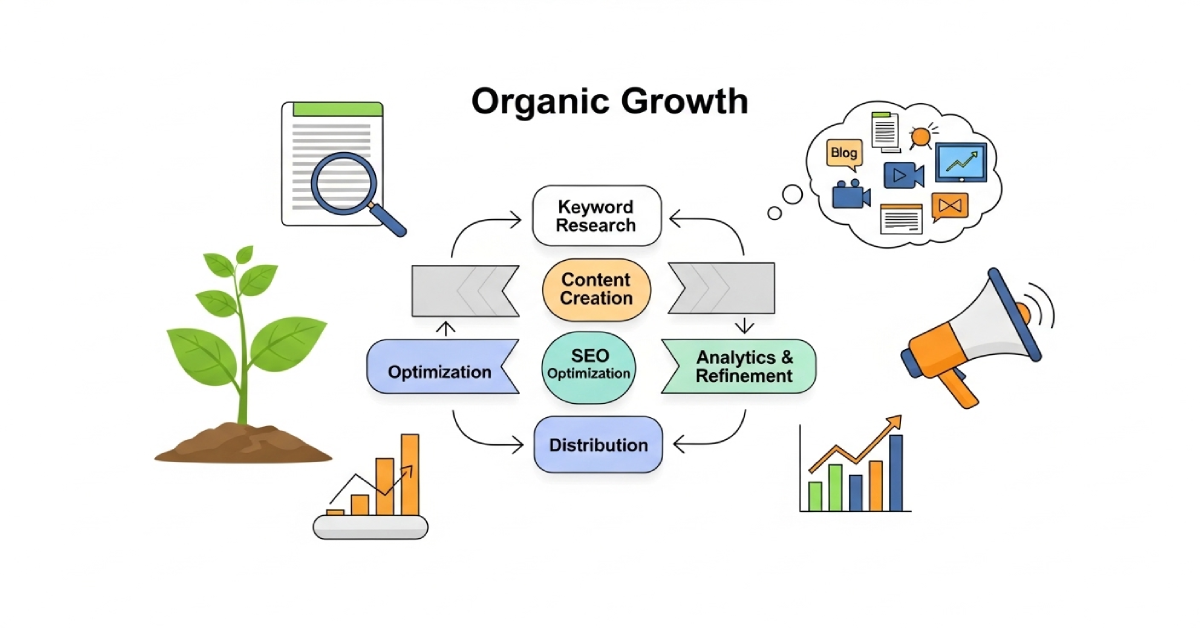
Content strategy is the practice of planning, creating, governing, and measuring content as a business asset—defining what you produce, why, for whom, where, and how you measure success.
Online blogs publish roughly 7.5 million posts every minute. YouTube receives over 500 hours of video per minute, and Instagram users upload around 95 million photos and videos daily. Yet most content is never read, watched, or remembered. Why? Because creating content is easy. Creating strategy-driven content is hard.
I’m Zohanuddin Shaikh, an SEO consultant based in Karachi, Pakistan, with 8 years of experience. A content strategy is what separates a brand that consistently attracts, engages, and converts its audience from one that produces content aimlessly, wasting budget and energy. The strategy connects every blog post, video, email, and social update to a business objective.
This is a complete content strategy guide. Each section provides concrete frameworks, real examples, and practical insights you can apply right away—whether you’re building a strategy from scratch or revising an existing one.
What Is Content Strategy?
Content strategy is the planning, development, and governance of text, video, audio, and visual content as a business asset. It determines what you produce, why you produce it, who it’s for, where it’s published, and how you measure success.
The term was popularized by Kristina Halvorson’s 2009 book Content Strategy for the Web, but it has expanded far beyond web text. Content strategy now spans search, social media, email, video, podcasts, sponsored media, and more.
Think of content strategy as the architecture of your content operation. Building content without it is like constructing rooms without a blueprint — it might be livable, but it won’t be the home you intended.
Content Strategy vs Content Marketing
These terms are often used interchangeably, but they’re not the same thing.
Aspect |
Content Strategy |
Content Marketing |
|
Focus |
Planning, governance, systems | Execution, promotion, distribution |
|
Timeframe |
Long-term (6–24 months) | Short-to-medium (campaigns) |
| Question it answers: | Why and how to create content |
What content to create and push |
| Output | Frameworks, guidelines, workflows |
Blogs, videos, social posts, emails |
| Who owns it | Strategy lead, CMO |
Content team, campaign managers |
The takeaway: content marketing is what you do; content strategy is why and how you do it. You need both, but strategy must come first.
The 6 Pillars of a Complete Content Strategy
Every complete content strategy rests on six foundational pillars:
Pillar |
Core Question |
|
Purpose |
What business outcomes does this content serve? |
|
Audience |
Who exactly are you creating content for? |
|
Content |
What topics, formats, and channels will you use? |
| Process |
How will content be created, reviewed, and published? |
| Governance |
Who owns what, and what are the editorial standards? |
| Measurement |
How will you define and track success? |
According to Content Marketing Institute research, brands with a documented content strategy are significantly more likely to report content marketing success than those without one. Documentation turns scattered effort into a repeatable system.
Why Content Strategy Matters in 2026
The digital landscape has shifted dramatically. Organic social reach has declined, paid advertising costs have risen, and consumers trust sponsored content less than ever. In this environment, a consistent content strategy is most organizations’ main competitive advantage.
What a content strategy does for a business:
- Increases organic traffic without paid advertising
- Builds niche domain authority and thought leadership
- Provides tailored information throughout the buyer journey
- Reduces customer acquisition costs through quality inbound leads
- Maintains brand consistency across channels
- Enables scalable content creation that grows with your team
Content production without a plan is reactive and expensive. Teams create gut-based content, waste resources on low-ROI formats, and struggle to prove marketing’s value to leadership. A documented strategy fixes all three problems.
How to Set SMART Content Goals
Goal clarity makes or breaks a content strategy. Vague objectives like “create more content” lead to scattered effort and unmeasurable outcomes. Content goals must be specific, business-driven, and trackable.
The SMART framework—Specific, Measurable, Achievable, Relevant, and Time-bound—is applied to content:
SMART Element |
Weak Goal |
Strong Goal |
|
Specific |
Grow blog traffic | Increase organic blog traffic from Google |
|
Measurable |
Get more leads | Generate 300 MQLs/month via content |
| Achievable | Rank #1 for everything |
Rank in the top 3 for 10 target keywords |
| Relevant | Post daily on TikTok |
Build LinkedIn presence for B2B pipeline |
| Time-bound | Improve content ROI |
Achieve 5x content ROI by Q4 |
Map goals to the marketing funnel:
- Top of funnel (Awareness): organic impressions, social reach, pillar posts
- Middle of funnel (Consideration): email subscribers, session duration, case studies
- Bottom of funnel (Decision): landing page conversion rate, tools, sales enablement assets
Map every piece of content to a funnel stage. If 80% of your content targets awareness but you need conversions, rebalance the mix.
Understanding Your Audience and Buyer Personas
A buyer persona is a semi-fictional, research-backed profile of your ideal customer. Even the best content fails if it doesn’t speak to the right audience. Most businesses need 2–4 personas to cover their core segments.
How to build a buyer persona:
Step |
What to Gather |
Sources |
|
1. Quantitative data |
Demographics, deal size, queries | GA4, CRM, Search Console |
| 2. Qualitative insights | Pain points, language, objections |
Interviews, support tickets, forums |
| 3. Profile build | Goals, challenges, content preferences |
Synthesized from steps 1-2 |
Every piece of content must answer three questions:
- Who is this for? (a specific persona, not “everyone”)
- What problem does it solve? (a specific pain point)
- What action should they take next? (a clear next step)
The biggest mistake brands make is writing for “everyone.” Content that speaks to everyone speaks to no one. Define your audience so specifically that readers feel you wrote it just for them.
How to Conduct a Content Audit
A content audit is a systematic review of all your content assets to determine what’s working, what’s wasting resources, and where your biggest opportunities are. Most companies have a backlog of underperforming content that can be improved or repurposed for quick gains.
The 4-step content audit process:
Step |
Action |
Tools |
|
1. Inventory |
List every URL with title, type, word count, dates | Screaming Frog, CMS export |
|
2. Pull performance data |
Sessions, position, CTR, bounce, conversions |
GA4, Search Console |
| 3. Categorize | Keep, Merge, Rewrite, Delete, or Repurpose |
Spreadsheet |
| 4. Prioritize | Start with “quick wins” (positions 4–15) |
Manual review |
Pages ranking in positions 4–15 are your fastest wins — they can reach page one within weeks with a smart upgrade to depth, search intent, and UX. Updating and republishing old posts with fresh data and expanded depth is one of the highest-ROI activities in content marketing.
For a deeper process on managing content over time, see my content lifecycle management guide.
Building Content Pillars and Topic Clusters
The pillar-cluster model is the most effective content structure for both SEO and audience experience. It creates a hub-and-spoke design: authoritative pillar pages supported by cluster content on specific subtopics.
Content pillars are the 3–5 core topics your brand consistently covers to build authority. Topic clusters are the 8–15 supporting pages that detail subtopics around each pillar. The pillar links to clusters, and clusters link back to the pillar—signaling topical authority to search engines.
Example: Content strategy pillar architecture:
Pillar Page |
Example Cluster Topics |
|
Content Strategy (this page) |
Content audit guide, editorial calendar, content goals |
|
SEO Content Strategy |
Keyword research, on-page SEO, search intent |
| Social Media Strategy |
LinkedIn strategy, Instagram calendar, short-form video |
| Content Analytics |
Content KPIs, GA4 for marketers, ROI calculation |
Build your pillar page first, then create cluster content that links back to it. This gives your cornerstone content maximum internal link equity from day one. For more on this, see my topical authority guide.
Creating an Editorial Calendar
An editorial calendar turns your strategic vision into a publishing plan. Even the best strategy stays theoretical without one.
What your editorial calendar should include:
Field |
Purpose |
|
Content Title |
Working title for the piece |
|
Primary Keyword |
Main SEO target |
|
Content Type |
Format (e.g., long-form blog) |
|
Target Persona |
Who it’s written for |
| Funnel Stage |
Where in the buyer journey |
| Author/Owner |
Who creates it |
| Publish Date |
When it goes live |
| Distribution |
Where it will be promoted |
| Status |
Current production stage |
Best practices:
- Plan 30–90 days ahead, leaving room for reactive content
- Balance content types: ~60% evergreen, 30% timely, 10% experimental
- Assign clear ownership—every piece needs one accountable creator
- Use content batching to improve production efficiency
- Review and adjust monthly based on performance
For the planning discipline behind the calendar, see my SEO content planning guide.
SEO Content Strategy: Rank, Traffic, and Authority
SEO supercharges content strategy. While social reach is rented and email lists need maintaining, organic search delivers compounding returns — content that ranks today keeps bringing visitors for years.
Keyword types to target:
Type |
Example |
Characteristics |
|
Head |
“content strategy” | High volume, high competition |
|
Body |
“content strategy framework” |
Moderate volume, specific |
| Long-tail | “content strategy for B2B SaaS” |
Low volume, high intent |
| Question | “What is content strategy?” |
Great for featured snippets |
Search intent is the most underrated SEO factor. Google’s main job is to match content to intent. Even technically brilliant content won’t rank if it doesn’t match the keyword’s intent — informational, navigational, commercial, or transactional.
On-page SEO essentials: primary keyword in the title tag (first 60 characters), a compelling meta description, one keyword-focused H1, LSI keywords in subheadings, content depth that exceeds top-ranking pages, internal links to pillar pages, descriptive image alt text, fast Core Web Vitals, and schema markup.
Target keywords ranking in positions 4–15 with content updates first—these pages are already indexed and trusted, and a strategic refresh can deliver significant traffic increases within weeks.
Social Media Content Strategy by Platform
Each platform has its own culture, algorithm, and audience expectations. What succeeds on LinkedIn often fails on TikTok, and vice versa.
|
Platform |
Best For | Top Formats | Posting Frequency |
|
|
B2B thought leadership | Text posts, carousels, articles | 3–5x/week |
|
|
Visual storytelling | Reels, carousels, Stories |
4–7 Reels/week |
| YouTube | Long-term SEO | Tutorials, how-tos, reviews |
Consistent weekly |
| X (Twitter) | Real-time commentary | Threads, short insights |
3–5x daily |
The universal content mix balances four types: Educational (40%), Entertainment (25%), Inspirational (20%), and Promotional (15%)—but is always value-first.
Post frequency matters less than engagement. Respond to comments, ask questions, and spotlight community members. Brands with real communities grow faster than those that only broadcast. For platform-specific tactics, see my social search SEO guide.
Content Distribution: The 80/20 Rule (H2)
The most common content strategy mistake is spending 80% of effort on creation and 20% on distribution. Flip the formula. Creating great content no one sees is as useless as not creating it at all.
The three tiers of distribution:
Tier |
Channels |
Cost |
|
Owned |
Email, social profiles, blog, push notifications | Free, full control |
| Earned | SEO traffic, social shares, backlinks, mentions |
Free, no guarantee |
| Paid | Social ads, display network, sponsored placements |
Budget required |
The COPE framework—Create Once, Publish Everywhere—turns one long-form blog post into 10 LinkedIn posts, 5 X threads, 3 Instagram carousels, 1 YouTube video, 2 newsletters, and multiple Pinterest pins.
For every hour spent creating content, spend at least 30 minutes actively distributing it across owned, earned, and paid channels. Don’t publish and pray.
Email Marketing and Newsletter Strategy
Email is the oldest digital channel yet one of the most profitable, returning roughly $36 for every $1 invested for many businesses.
Building a high-value email list:
- Create lead magnets aligned with your pillar content
- Use content upgrades embedded in your best posts
- Offer a compelling newsletter value proposition
- Use exit-intent popups with content-specific offers
Email sequences that work:
Sequence |
Purpose |
|
Welcome (5–7 emails) |
Introduce the brand and deliver value |
|
Nurture drip |
Educate over 30–90 days toward conversion |
| Re-engagement |
Win back inactive subscribers |
| Post-purchase |
Onboard customers, drive referrals |
Segmented emails — by industry, job title, funnel stage, or engagement — consistently outperform batch-and-blast campaigns. Industry-average open rates range from 20 to 40%, depending on the niche.
Video and Short-Form Content Strategy
Video dominates content strategy across platforms. Short-form video on TikTok, Reels, and Shorts delivers unmatched organic reach in 2026.
The short-form video structure:
- Hook (0–3 sec): counterintuitive statement, surprising fact, or direct question
- Problem (3–15 sec): name the pain point
- Solution (15–50 sec): deliver genuine value
- CTA (last 5 sec): clear next step
For long-form YouTube, follow the flywheel: research demand, script before filming, optimize titles and thumbnails, engage in the first 24 hours, then repurpose into Shorts and blog content.
Captions are not optional — most social videos are watched without sound. Always add accurate subtitles; they also improve SEO and accessibility.
B2B Content Strategy (H2)
B2B content strategy differs significantly from B2C. Your audience makes committee purchases with long sales cycles, multiple stakeholders, and tight budgets. Content must build trust, reduce risk, and speak to business results.
The B2B buyer journey and content mapping:
Stage |
Buyer Mindset |
Best Content |
|
Awareness |
“I have a problem.” | Blogs, reports, podcasts |
|
Consideration |
“I’m evaluating options.” |
Case studies, whitepapers, webinars |
| Decision | “I need to justify this.” |
ROI calculators, demos, testimonials |
| Post-purchase | “I need to get value.” |
Onboarding guides, training |
The most effective B2B format is the case study, using a Problem → Approach → Results framework with specific metrics. A typical B2B buying group involves 6–10 stakeholders, so create content addressing each role’s concerns: CFO (ROI), CTO (security), CMO (strategy), and end users (usability).
Content Repurposing: Work Smarter
Content repurposing adapts existing content into new formats, platforms, or angles to maximize reach and longevity.
|
Original Format |
Repurpose Into |
|
Long-form blog |
LinkedIn carousel, X thread, video script, newsletter |
|
Podcast episode |
Blog transcript, audiograms, quote cards |
| YouTube video |
Blog post, Reels clips, audio podcast |
| Research report |
Blog series, infographic, webinar |
A single pillar blog post, fully repurposed, can generate 30–50 pieces of content across platforms—letting you maintain a high publishing frequency without proportionally increasing your budget.
Measuring Content Performance and ROI
Content without measurement is just storytelling. You need a framework that ties content activity to business outcomes.
The content metrics hierarchy:
Level |
Metrics |
Use For: |
|
Vanity metrics |
Likes, followers, raw views | Track, don’t optimize. |
| Engagement metrics | Session duration, bounce, CTR, return rate |
Optimization signals |
| Business impact | Leads, pipeline, revenue, CAC, ROI |
What leadership cares about |
Content ROI formula:
(Revenue from content − Cost of content) / Cost of content × 100
Your dashboard should answer five questions: How much traffic is content driving? Where does it come from? What converts best? How does content contribute to revenue? What should you create more of?
Content ROI is a long game — most content takes 6–12 months to reach full performance. Track leading indicators (rankings, traffic) monthly and lagging indicators (revenue) quarterly. For the technical foundation, see my technical SEO audit guide.
Building Your Content Team and Workflow
Content strategy requires the right people, processes, and systems to execute consistently.
Core content team roles: content strategist (strategy, planning), content writer (drafts), SEO specialist (optimization), social media manager (platform content), video producer, graphic designer, and content editor (quality control—critical).
The content production workflow:
- Brief — strategist creates a detailed brief
- Research — writer researches topic and competitors
- Draft — writer produces the first draft
- Edit — editor reviews accuracy, voice, SEO
- Design — designer creates visuals
- Review — stakeholder approval if needed
- Publish — CMS upload, SEO settings, internal links
- Distribute — email, social, paid promotion
- Measure and track performance at 30, 60, 90 days
Common Content Strategy Mistakes to Avoid
Mistake |
Why It Hurts |
|
Creating content without a goal |
No way to measure success |
|
Ignoring search intent |
Content can’t rank if intent mismatches |
|
Quantity over quality |
One great piece beats ten thin ones |
| Never updating old content |
Content decay drops rankings |
| Skipping distribution |
Great content goes unseen |
| Measuring vanity metrics |
Doesn’t prove business value |
Google’s Helpful Content guidance makes it clear: one genuinely useful, comprehensive piece outperforms ten thin, formulaic posts. Always tie content metrics to business outcomes—reporting leads and revenue builds budget; reporting likes doesn’t.
Your 90-Day Content Strategy Action Plan
Month 1: Strategy and Foundation (Days 1–30)
Audit existing content (Keep/Update/Merge/Delete), define 2–3 buyer personas, set 3 SMART goals, identify 3–5 content pillars with 10 cluster topics each, build your editorial calendar, set up GA4 and Search Console, and define your workflow.
Month 2: Creation and Optimization (Days 31–60)
Publish your first pillar page (2,500–5,000 words), publish 4–6 cluster posts linking to it, optimize your top 10 existing pages for intent, refresh your newsletter, establish a social cadence, produce your first video, and implement a repurposing workflow.
Month 3: Distribution and Measurement (Days 61–90)
Double down on channels showing traction, build an analytics dashboard for leadership, launch a lead-generation campaign, pursue 10 backlink opportunities, conduct your first 30-day review, and plan the next quarter based on data.
By day 90, you should have a documented content strategy, your first pillar cluster live, a growing email list, and early data showing what resonates.
Content Strategy Tools and Tech Stack
Category |
Recommended Tools |
|
Planning |
Notion, Airtable, Monday.com |
|
Keyword Research |
Ahrefs, SEMrush, Google Keyword Planner |
|
Writing & Editing |
Google Docs, Grammarly, Hemingway |
| SEO Optimization |
Surfer SEO, Clearscope, Yoast |
| Visual Design |
Canva, Adobe Express, Figma |
| Distribution |
Buffer, Hootsuite, Mailchimp |
| Analytics |
GA4, Search Console, Looker Studio |
For a detailed tool comparison, see my Ahrefs vs SEMrush vs Moz guide. AI tools can accelerate research, drafts, and repurposing—but human expertise remains essential for strategy, brand voice, and editorial judgment.
FAQs
1. What is content strategy?
Content strategy is the planning, creation, governance, and measurement of content as a business asset. It defines what content you produce, why, for whom, where it’s published, and how you measure success. It’s the “why and how” behind content, while content marketing is the “what.”
2. What’s the difference between content strategy and content marketing?
Content strategy is the long-term planning and governance layer—frameworks, systems, and standards. Content marketing is the execution layer — the blogs, videos, and social posts you create and promote. Strategy answers why and how; marketing answers what. You need both, but strategy comes first.
3. How do I create a content strategy?
Start by setting SMART goals tied to business outcomes, then research your audience and build buyer personas. Audit existing content, define 3–5 content pillars with supporting topic clusters, build an editorial calendar, create and optimize content, distribute it across channels, and measure performance against your goals.
4. What are content pillars and topic clusters?
Content pillars are the 3–5 core topics your brand consistently covers to build authority. Topic clusters are the supporting pages (8–15 per pillar) that detail subtopics. The pillar links to clusters, and clusters link back, creating an internal linking structure that signals topical authority to search engines.
5. How do I measure content ROI?
Content ROI is calculated as (Revenue from content − Cost of content) / Cost of content × 100. Track three levels of metrics: vanity (likes and views), engagement (session duration and CTR), and business impact (leads, pipeline, and revenue). Most content takes 6–12 months to reach full ROI, so track leading indicators monthly and revenue quarterly.
6. How often should I update my content strategy?
Review your editorial calendar monthly based on performance data, and revisit your overall strategy quarterly. Content strategy is an ongoing process, not a one-time document—it should evolve based on what each piece of content, metric, and audience signal reveals.
7. Does publishing more content improve SEO?
Not necessarily. Google’s Helpful Content guidance makes clear that one genuinely useful, comprehensive piece outperforms ten thin posts. Quality, search intent alignment, and topical authority matter far more than raw volume. Often, updating and consolidating existing content delivers better results than publishing more.
8. What’s the most important part of a content strategy?
Audience understanding and goal clarity are the foundation. Content that doesn’t serve a specific business goal or speak to a specific audience fails regardless of quality. Define who you’re creating for and what outcome each piece serves before creating anything.
Final Thoughts
A content strategy isn’t a one-time document—it’s a living system that learns from every piece of content, metric, and audience signal you produce. The brands that succeed treat strategy as an ongoing process, not a one-time task.
Know your audience deeply, create content that meets their needs, optimize for discoverability, distribute more aggressively than your competitors, and measure everything that matters.
Ten non-negotiable principles to take with you: plan before publishing; write for humans and optimize for algorithms; one great piece beats ten mediocre ones; match content to search intent; distribution is half the battle; measure business results, not just likes; repurpose everything; structure content as pillars and clusters; update content as it decays; and stay consistent—content strategy rewards patience.
Your content strategy is only as good as its execution. Start with the simplest workable version, create consistently, let data guide your progress, and trust the compounding power of content.
For questions about building a content strategy for your own business, feel free to reach out through my Contact page.
For more SEO and content guides, browse Search Engine Realm.
Last Updated: June 2026