


Advanced link building strategies start where basic SEO ends. You could already have optimized content, the right meta tags, and even a few guest posts, but if your rankings aren’t moving, the true problem is authority.
And backlinks help you build authority.
The problem is that most old-fashioned ways of creating links don’t work anymore. In competitive niches, submitting to directories and getting low-quality backlinks just don’t work.
Modern SEO needs improved link building methods that concentrate on getting high-quality, relevant backlinks that can really change ranks.
This article will help you go from basic SEO techniques to a systems-driven, white hat SEO strategy that will help you establish authority over time.
The main idea behind advanced link building tactics is to get backlinks by creating content, doing digital PR, and reaching out to people in a planned way. Instead of developing links by hand, these approaches get natural citations, which help ranks, create authority, and keep SEO performance going strong on both conventional and AI-driven search engines.
Advanced link building techniques involve acquiring high-authority backlinks through content-driven strategies, digital PR, and relationship-based outreach. These approaches prioritize relevance, trust, and value, aligning with modern search engine algorithms and helping websites achieve stable, long-term rankings.
Why Advanced Link Building Matters in Modern SEO
Link building is still very important for SEO, but it has evolved.
Today, search engines look at the following:
- Quality over number of links
- More important than raw authority
- Context is more important than anchor text.
When you do a genuine SEO audit, you often see:
- Those with fewer high-quality backlinks do better than those with more connections.
- Websites are ranked not simply because of backlinks, but also because of their authority on a certain issue.
This change means:
- Link building isn’t about how many links you have anymore; it’s about creating trust.
What Are Advanced Link Building Techniques
Advanced link building approaches are ways to get links organically by providing value and authority.
They are different from fundamental techniques because they:
- Need to prepare strategically
- Concentrate on sources that are of high quality
- Follow the rules of white hat SEO
You develop content and systems that naturally attract links instead of going for them.
Key Advanced Link Building Techniques
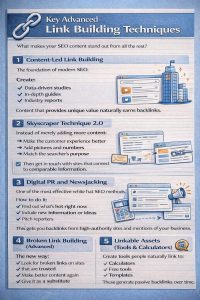
Content-Led Link Building
The foundation of modern SEO.
Create:
- Data-driven studies
- In-depth guides
- Industry reports
Content that provides unique value naturally earns backlinks.
Skyscraper Technique 2.0
A better variation of a traditional plan.
Instead of merely adding more content:
- Make the customer experience better
- Add pictures and numbers
- Match the searcher’s purpose
Then get in touch with sites that connect to comparable information.
Digital PR and Newsjacking
One of the most effective white hat SEO methods.
How to do it:
- Find out what’s hot right now
- Include new information or ideas
- Pitch reporters
This gets you backlinks from high-authority sites and mentions of your business.
Broken Link Building (Advanced)
The new way:
- Look for broken links on sites that are trusted
- Make better content again
- Give it as a substitute
This works because you’re aiding the owner of the site.
Linkable Assets (Tools & Calculators)
Create tools people naturally link to:
- Calculators
- Free tools
- Templates
These generate passive backlinks over time.
HARO and Expert Contributions
Respond to journalist queries to earn the following:
- High DA backlinks
- Authority mentions
Speed and expertise are key here.
Unlinked Brand Mentions
Find places where your brand is mentioned but not linked.
Then:
- Reach out politely
- Request a link
This is one of the easiest wins in link building.
Link-Building Strategies for E-commerce
Ecommerce websites face a unique challenge—product pages don’t attract links.
How to solve this
Create:
- Buying guides
- Product comparisons
- Educational blog content
Example:
👉 “Best Smartphones Under $500 (2025 Guide)”
This approach builds links to content that supports product pages.
Web 2.0 Backlinks Strategy (Modern Approach)
Web 2.0 backlinks still work—but only when used correctly.
Best practices
- Publish high-quality content
- Use platforms like Medium
- Focus on value, not link placement
Avoid:
- Spam content
- Keyword stuffing
- Low-effort posts
Systems-First Link Building Framework
Most people fail because they treat link building as a task, not a system.
The system includes
- Content creation
- Distribution
- Outreach
- Internal linking
Execution model
Create → Promote → Repurpose → Scale
This is how you rank for hundreds or thousands of keywords.
Practical Link Building Checklist
Before building links, ask:
- Is this content worth linking to?
- Does it solve a real problem?
- Is it better than competitors?
- Is it structured for readability?
If the answer is no, fix the content first.
Common Mistakes in Link Building
Focusing on Quantity Over Quality
More links do not guarantee better rankings.
Ignoring Relevance
Irrelevant backlinks have minimal impact.
Over-Optimizing Anchor Text
This can trigger penalties.
Using Spammy Links
Short-term gains often lead to long-term losses.
No Content Strategy
Without strong content, links won’t sustain rankings.
Future of Link Building in AI Search
AI search engines are changing how authority is measured.
Key trends
- Citations matter more than backlinks
- Authority comes from trust and relevance
- Structured content gets prioritized
What this means
To succeed:
- Create high-quality content
- Build authority signals
- Focus on clarity and usefulness
FAQs
1. How long does it take to use sophisticated link-building methods?
It usually takes 3 to 6 months to see benefits that can be measured, but this depends on how consistent you are and how much competition there is.
2. Is it preferable to have one high DA link than several low DA links?
Yes. One high-authority link is typically more powerful than many low-quality connections.
3. Can I develop links without spending any money?
Yes. HARO, outreach, and content marketing are examples of strategies that need more time than money.
4. Are links from Web 2.0 sites safe?
Yes, but only if you utilize it correctly and with good content.
5. What is the best way to create links for an online store?
Content-driven methods include guidelines, comparisons, and blog posts.
6. Are backlinks still important for SEO?
Yes, but it’s more vital to have quality and relevance than to have a lot of them.
Conclusion
Advanced link building isn’t about looking for fast victories or easy ways to get links. It’s about creating true authority over time. In today’s world of SEO, when both search engines and AI systems look at trust, relevance, and depth, long-lasting results come from persistent, value-driven work instead of tricks that don’t work.
You put high-quality content first, creating things that are truly worth linking to. You then add strategic outreach, ensuring your material reaches the right audience and gains attention from trusted sources. Everything is grounded in relevance—both in terms of niche alignment and user intent—which strengthens your website’s overall credibility.
These parts work together to create a system that can grow, not simply a plan. Over time, this mechanism builds on itself, which means that your website will organically get backlinks, boost its domain authority, and keep its ranks consistent even when algorithms change. You don’t have to deal with short-term spikes and declines; instead, you develop a solid, long-lasting SEO foundation that keeps growing and working over time.