

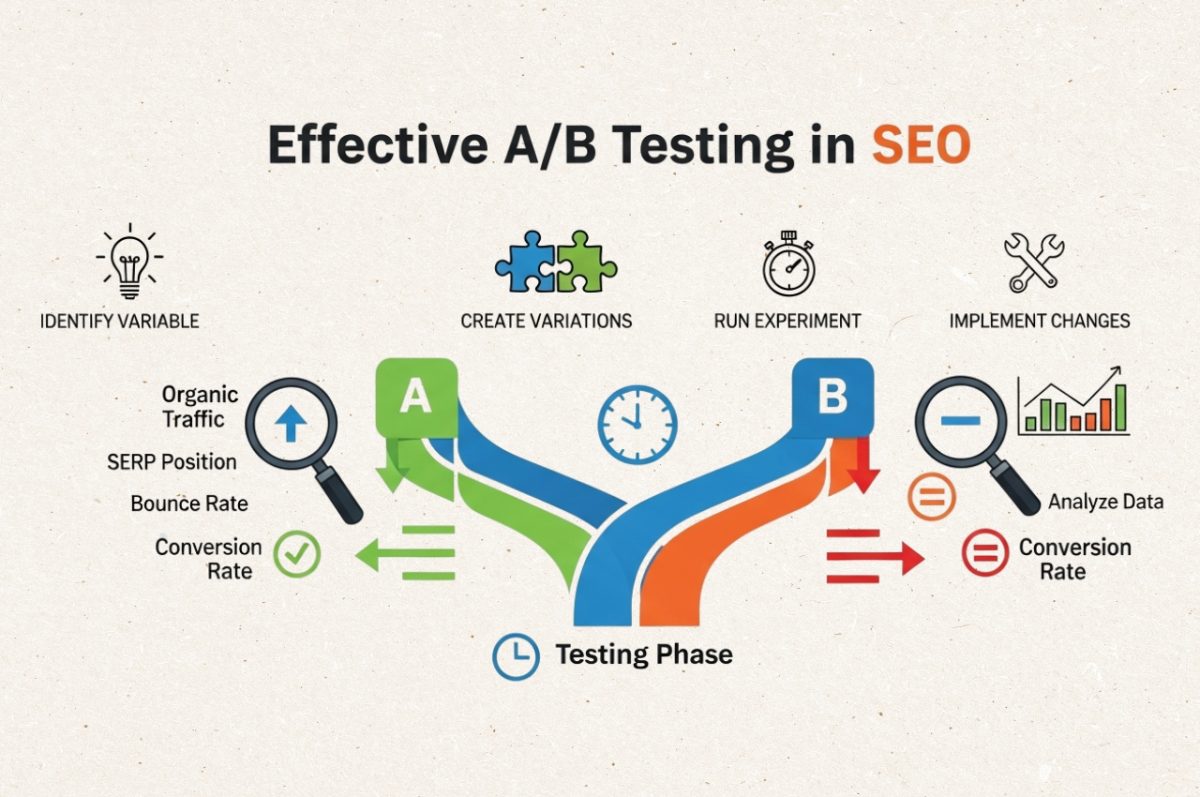
Effective A/B testing in search engine optimization can sometimes feel uncertain at first. You make updates, wait for results, and then try to understand what actually changed. This is where effective A/B testing becomes especially valuable, because it brings structure and clarity to what would otherwise feel like guesswork.
Instead of relying on assumptions or general “best practices,” effective A/B testing allows you to measure real outcomes. You can test specific changes, compare performance over time, and make decisions based on actual data rather than intuition. This approach helps you understand what works for your site, your audience, and your content.
In practice, effective A/B testing gives you a controlled way to improve elements like page titles, content structure, and user experience. Even small adjustments can reveal useful insights when tested properly. Over time, these insights build into a more reliable and scalable strategy.
This method is widely used across SEO, content marketing, and conversion optimization because it reduces uncertainty and supports consistent improvement. Instead of making random changes, you follow a process that helps you learn from each test. That makes your overall strategy more stable, more predictable, and easier to refine as search behavior continues to evolve.
What Is Effective A/B Testing? (Simple Definition)
Effective A/B testing is a method of comparing two versions of content or page elements to determine which one performs better based on measurable results.
In SEO, this usually means testing:
- page titles
- meta descriptions
- headings
- content structure
- internal linking
The goal is to understand how these changes affect search performance, user behavior, and engagement.
Why Effective A/B Testing Matters for SEO
Search engines evaluate multiple signals, including relevance, user interaction, and clarity.
Effective A/B Testing helps you:
- improve click-through rates (CTR)
- align content with search intent
- refine on-page SEO elements
- understand user behavior
- make decisions based on data instead of assumptions
Over time, this leads to more stable and predictable SEO performance.
SEO vs CRO A/B Testing (Quick Comparison)
Understanding the difference is important:
SEO A/B Testing
- compares groups of pages
- focuses on organic traffic
- measures rankings, impressions, and CTR
- runs over time
CRO A/B Testing
- compares versions of the same page
- focuses on user actions (sales, signups)
- splits traffic in real time
Both are useful, but they serve different purposes.
How Effective A/B Testing Works (Step-by-Step)
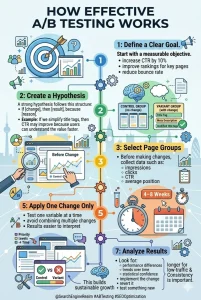
Step 1: Define a Clear Goal
Start with a measurable objective.
Examples:
- increase CTR by 10%
- improve rankings for key pages
- reduce bounce rate
Step 2: Create a Hypothesis
A strong hypothesis follows this structure:
If [change], then [result], because [reason].
Example:
If we simplify title tags, then CTR may improve because users can understand the value faster.
Step 3: Select Page Groups
Instead of testing one page, group similar pages into the following:
- control group (no change)
- variant group (with change)
This helps isolate results more accurately.
Step 4: Measure Baseline Performance
Before making changes, collect data such as:
- impressions
- clicks
- CTR
- average position
This creates a reference point.
Step 5: Apply One Change Only
To ensure accuracy:
- test one variable at a time
- avoid combining multiple changes
This makes results easier to interpret.
Step 6: Run the Test
Allow enough time for meaningful data:
- typically 4–8 weeks
- longer for low-traffic sites
Consistency is important.
Step 7: Analyze Results
Look for:
- performance differences
- trends over time
- statistical confidence
Then decide whether to:
- implement the change
- revert it
- test something new
What You Can Test in SEO
Effective A/B Testing works well for:
1. Title Tags
Test clarity, length, and keyword placement.
2. Meta Descriptions
Improve relevance and user appeal.
3. Headings (H1, H2)
Align with search intent and structure.
4. Content Layout
Adjust readability and flow.
5. Internal Linking
Strengthen topic connections and navigation.
6. Structured Data
Test schema for better visibility.
Content Optimization and Search Intent
Effective A/B Testing is closely tied to search intent.
Every page should clearly answer:
- What is the user looking for?
- How quickly can they find it?
When content matches intent:
- engagement improves
- bounce rates decrease
- rankings become more stable
This is especially important in content marketing strategies.
Tools for Effective A/B Testing
1. Google Search Console
Track impressions, clicks, and CTR.
2. Google Analytics
Measure user behavior and engagement.
3. SEO Testing Tools
Platforms can help automate:
- page grouping
- data analysis
- reporting
Manual testing is possible but requires more effort and accuracy.
Common Mistakes to Avoid
Testing Too Many Changes
This makes results unclear.
Ending Tests Too Early
Short tests often produce unreliable data.
Ignoring Search Intent
Even optimized pages fail if intent is unclear.
Using Poor Page Groups
Pages must be similar for valid comparisons.
Expecting Immediate Results
SEO changes take time to show impact.
FAQs
1. What is Effective A/B Testing in SEO?
It is a method of testing changes across groups of pages to measure their impact on organic performance.
2. How long should an SEO A/B test run?
Typically 4–8 weeks, depending on traffic levels and data volume.
3. Can small websites use effective A/B testing?
Yes, but tests may take longer due to lower traffic.
4. What is the biggest benefit of A/B testing?
It helps make decisions based on data rather than assumptions.
5. Is A/B testing safe for SEO?
Yes, when done correctly using page grouping instead of duplicate content.
6. What should I test first?
Start with high-impact elements like titles, headings, and content structure.
7. Do I need advanced tools for A/B testing?
Not always. Basic tools can work, but advanced tools make analysis easier.
Conclusion
Effective A/B testing is one of the most practical ways to improve SEO performance over time. It helps shift your strategy from assumptions to evidence, allowing you to make decisions based on what actually works rather than what is expected to work.
Instead of relying on guesswork, it provides a structured approach to testing, learning, and refining your strategy. Each test—whether it leads to improvement or not—adds valuable insight. Over time, these insights help you understand your audience better, align content more closely with search intent, and prioritize changes that have a real impact.
From experience, the most successful SEO strategies are not built on quick wins but on consistent improvements. Small, data-driven changes—like refining titles, improving structure, or adjusting content flow—can compound over time and lead to steady growth.
Another advantage of effective A/B testing is that it reduces risk. Instead of making large changes across your entire site, you can test ideas on a smaller scale first. This allows you to validate what works before applying it more broadly.
In the long run, this approach builds a more stable and predictable SEO strategy—one that adapts based on real performance rather than assumptions.