

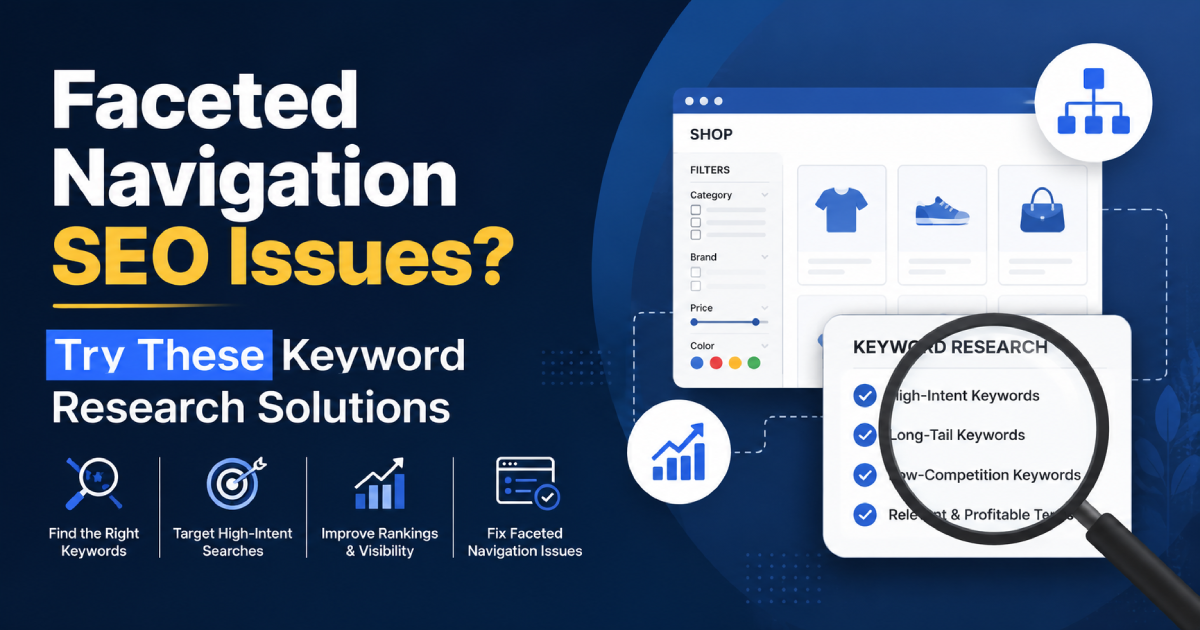
Faceted navigation SEO issues often begin exactly where user experience improvements meet search engine limitations. The very feature that makes large sites easy to browse can quietly create thousands of low-value pages that drag down rankings.
Faceted navigation helps users filter products or content by attributes like price, brand, size, features, or location. This is especially useful for e-commerce and large websites with hundreds or thousands of pages, where users need quick ways to narrow down options. From a user’s perspective, the experience feels smooth and efficient.
I’m Zohanuddin Shaikh, an SEO consultant based in Karachi, Pakistan, with 8 years of experience. In my audits, faceted navigation is one of the most common causes of hidden crawl and indexing problems on large sites — precisely because it looks perfect to users while creating chaos for search engines behind the scenes. This guide explains what faceted navigation SEO issues are, why they happen, and how to control them so filtering stays a user benefit instead of an SEO liability.
What Is Faceted Navigation?
Faceted navigation is a filtering system that lets users narrow down content or products by multiple attributes—such as price, brand, size, color, features, or location—usually on e-commerce and large catalog websites.
Someone searching for “affordable laptops in Karachi” or “men’s running shoes size 10” expects fast, accurate results without scrolling through endless listings. Faceted navigation delivers exactly that speed and precision.
But search engines interpret this system very differently from users. Each filter applied can generate a new URL. Over time, this creates many URLs with very similar or nearly identical content. For example, filtering by “brand + price” or “price + brand” may produce separate URLs that show the exact same products—and search engines treat each as a distinct page to crawl and evaluate.
Why Faceted Navigation Creates SEO Issues
The core problem is scale. A handful of filters can multiply into thousands of URL combinations, most of which offer little unique value.
This leads to a large number of low-value pages that search engines spend time crawling instead of focusing on important content. The common issues that develop include:
Issue |
What It Causes |
|
Reduced crawl efficiency |
Crawlers waste budget on filter URLs |
|
Indexation delays |
Important pages get indexed slower |
| Diluted page authority |
Link equity spreads across duplicates |
| Declining rankings |
Weak pages compete instead of one strong page |
These problems develop gradually, which makes them harder to detect early. By the time rankings visibly decline, the underlying crawl and indexing inefficiency has usually been building for months. This is why faceted navigation issues are so often missed until they become serious.
Common SEO Problems Caused by Faceted Navigation
Let’s break down the three biggest problems in detail.
Duplicate and Thin Content
Faceted navigation often generates multiple URLs with nearly identical content. For example:
- /shoes?color=black&size=10
- /shoes?size=10&color=black
Both pages show the same products but appear as different URLs to search engines. This creates duplicate content, weak content signals, and reduced ranking potential. Search engines prefer clear, unique pages — and too many similar pages reduce overall site quality. This connects to broader duplicate-URL problems; see my canonicalization SEO guide for more.
Crawl Budget Waste
Search engines allocate a limited crawl budget for each website. When thousands of filter combinations exist, crawlers may spend their time on low-value filter pages instead of your category pages, product pages, and blog content. This delays indexing and reduces visibility for the pages that actually matter. For a complete process, see my crawl budget guide.
Dilution of Ranking Signals
Links and authority get spread across multiple URLs. Instead of one strong page ranking well, many weak pages compete with each other. This reduces ranking strength, weakens keyword focus, and lowers overall SEO performance. Consolidating that authority onto fewer, stronger pages is one of the core goals of fixing faceted navigation.
Turning Faceted Navigation into an SEO Advantage
Faceted navigation doesn’t have to be a problem. With the right strategy, it can actually generate targeted landing pages for long-tail keywords—turning a liability into an asset.
The goal is threefold:
- Identify valuable filter combinations that match real search demand
- Optimize those combinations as proper landing pages
- Block or control low-value variations that only waste crawl budget
This balanced approach keeps the user experience intact while ensuring search engines receive clear, consistent signals. Done well, faceted navigation becomes a source of highly relevant, intent-matched landing pages rather than a source of duplicate-content problems.
Step 1: Identify High-Value Filter Combinations
Start with keyword research. Look for queries that match filtered results — these represent the filter combinations worth optimizing and indexing.
Sources for this data:
- Google Search Console (queries you already appear for)
- Keyword tools like Ahrefs or Semrush
- Internal site search (what users search for on your site)
- Customer queries and support questions
For example, if users search for “Nike running shoes for men,” “gaming laptops under 1000 USD,” or “organic skincare products in Lahore,” these represent valuable combinations with genuine search demand. These pages should be optimized and indexed. The key insight: let real search demand—not every possible filter combination—decide what deserves indexing.
Step 2: Create an Indexation Strategy
Not all filtered pages should be indexed. You need clear rules defining which combinations are valuable enough to appear in search.
Allow Indexing |
Block or Limit Indexing |
|
Category + Brand (/shoes/nike) |
Multiple filters combined |
| Category + Feature (/laptops/gaming) |
Low search volume combinations |
| Category + Location (/restaurants/karachi) |
Sorting parameters |
Allow indexing for single, high-demand combinations like category + brand, category + feature, or category + location — these match real search queries and deserve to rank.
Block or limit indexing for multiple filters combined (like /shoes?color=black&size=10&brand=nike), low-search-volume combinations, and sorting parameters. These provide little SEO value and mostly waste crawl budget.
The principle is simple: index what people search for, control what they don’t.
Step 3: Use Technical SEO Controls
Once you know what to index, you need the technical tools to enforce those decisions. Three controls do most of the work.
Canonical Tags
Use canonical tags to point duplicate filter pages to the main version. For example, a filtered page can canonicalize to its category page, consolidating ranking signals onto the version you want to rank. This is the primary tool for handling duplicate filter variations.
Robots.txt
Block unnecessary URL patterns to save crawl budget — for example, disallowing URLs with multiple parameters. Robots.txt prevents crawlers from wasting time on combinations that will never provide value. Use it carefully, though: blocked pages can’t pass signals, so reserve it for genuinely worthless URL patterns.
Noindex Tag
Use noindex for pages that shouldn’t appear in search results but still need to exist for users. Unlike robots.txt blocking, noindex lets crawlers access the page (so links are still followed) while keeping it out of the index. This is ideal for filter pages that serve users but have no search value.
Step 4: Optimize Indexable Pages as Real Landing Pages
Pages you allow to be indexed should be treated as genuine landing pages, not just filtered views. This is what turns faceted navigation into an SEO advantage.
Use Clean URLs
Avoid long parameter-based URLs in favor of clean, readable ones:
- Good: /laptops/gaming
- Bad: /laptops?category=gaming&type=high-performance
Clean URLs are easier for both users and search engines to understand, and they look more trustworthy in search results.
Write Unique Titles and Headings
Each indexable page should clearly match a search query. A page for gaming laptops under $1000 should have a title like “Gaming Laptops Under $1000″—specific and intent-matched, not generic.
Add Introductory Content
Include a short paragraph explaining the product type, key features, and use case. This improves relevance and helps both users and search engines understand what the page offers—turning a bare product list into a genuine resource.
Internal Linking
Link to important filtered pages from blog posts, category pages, and navigation menus. This improves their discoverability and passes authority to the pages you want to rank. For a complete process, see my internal linking SEO guide.
Advanced Faceted Navigation SEO Strategies
Once the fundamentals are in place, these advanced techniques prevent the trickier problems.
Control Parameter Order
Ensure URLs follow a consistent parameter format. When “color=black&size=10” and “size=10&color=black” both exist, they create duplicate variations. Enforcing a consistent order prevents this duplication at the source.
Handle JavaScript Filters Carefully
Modern filters often use JavaScript. Ensure that URLs update properly when filters are applied, content is visible to search engines, and pages render correctly. JavaScript-based filters that don’t create crawlable URLs can hide content entirely from search engines. For more, see my JavaScript rendering guide.
Manage Multi-Select Filters
Selecting multiple filters dramatically increases URL combinations. Limit indexing for multi-filter combinations and low-value variations. The more filters a user can combine, the more aggressively you need to control which resulting URLs are allowed into the index.
Faceted Navigation and Local SEO
Location-based filters can be powerful for local search when handled correctly.
Pages like /services/seo/karachi or /restaurants/lahore match local search intent directly. To optimize these:
- Include the location in the title and content
- Add genuine local information (areas served, regional context)
- Avoid creating duplicate location pages with no unique content
Done well, location-based faceted pages improve visibility in local search results. The risk is creating hundreds of near-identical location pages with no real local value—which triggers exactly the thin-content problems faceted navigation is prone to. Each location page needs genuine, distinct value to succeed.
How to Test If Your Faceted Navigation Is SEO-Friendly
Regular monitoring catches faceted navigation problems before they harm rankings. Track these signals:
What to Monitor |
What It Reveals |
|
Indexed pages in Search Console |
Whether low-value filter pages are being indexed |
|
Crawl activity |
Whether crawlers waste budget on filter URLs |
| Keyword rankings |
Whether pages compete with each other |
| URL variations |
Whether duplicate parameter URLs exist |
The clearest warning sign: if you see many similar pages indexed with low traffic, adjustments are needed. A healthy faceted navigation setup has a controlled number of indexed pages that each match genuine search demand—not thousands of near-duplicate filter combinations sitting in the index doing nothing.
📸 [SCREENSHOT 1: GSC Index Coverage report showing indexed/not-indexed pages]
Alt text: faceted navigation SEO issues shown in Google Search Console index coverage
Source: Your own GSC account (reuse your Index Coverage screenshot)
FAQs
1. What is the biggest SEO challenge in faceted navigation?
The biggest challenge is managing duplicate and low-value pages created by multiple filter combinations. For example, an e-commerce site targeting users in different cities may generate separate URLs for similar products across locations. Without proper control, search engines may struggle to identify which page is most relevant, leading to reduced rankings and wasted crawl resources.
2. Which faceted pages should be indexed?
Only pages with clear search demand should be indexed. These usually include combinations like product type + brand, feature, or location—for example, “running shoes in Karachi” or “budget laptops for students.” “Pages with multiple combined filters and low search demand should be blocked or canonicalized to a main version instead.
3. Does faceted navigation affect local SEO?
Yes. Faceted navigation can improve local SEO when location-based filters are optimized correctly. Pages targeting specific cities or regions can rank for local queries. However, creating too many similar location pages without unique content reduces effectiveness — each location page needs genuine, distinct value to perform well in local search.
4. How can I prevent duplicate content issues from faceted navigation?
Use canonical tags to point duplicates to a main version, maintain clean URLs, and enforce consistent parameter structures. Avoid indexing multiple versions of the same page, and focus on one primary version for each keyword or topic. Consistent parameter ordering prevents many duplicates from being created in the first place.
5. How do I test if my faceted navigation is SEO-friendly?
Monitor your indexed pages in Google Search Console, crawl activity, keyword rankings, and URL variations. If you see many similar pages indexed with low traffic, adjustments are needed. A healthy setup indexes only filter combinations with genuine search demand, while low-value variations are controlled through canonicals, noindex, or robots. text.
6. What’s the difference between faceted navigation and pagination?
Faceted navigation lets users filter content by attributes (color, size, brand), creating URL combinations based on selections. Pagination splits a single list of content across sequential pages (pages 1, 2, and 3). Both can create crawl and indexing issues, but faceted navigation multiplies URLs far faster because filters combine, while pagination is linear.
7. Should I use robots.txt or noindex for filter pages?
It depends on the goal. Use noindex when a filter page should stay accessible to users and crawlers (so links are followed) but shouldn’t appear in search. Use robots.txt to block crawling entirely for genuinely worthless URL patterns that waste crawl budget. Noindex is generally safer because it preserves link signals; robots.txt fully prevents crawling.
8. Can faceted navigation actually help SEO?
Yes, when managed strategically. By identifying high-demand filter combinations and optimizing them as proper landing pages, faceted navigation can capture valuable long-tail traffic — like “gaming laptops under $1000.” The key is controlling which pages get indexed: index the combinations people search for, and block or canonicalize the ones they don’t.
Final Thoughts
Faceted navigation SEO issues require a balance between usability and search engine optimization. Filters genuinely improve the user experience—but uncontrolled filters create serious technical SEO problems that build quietly over time.
A structured approach solves this problem: identify valuable filter combinations that match real search demand, control indexing with technical methods like canonicals and noindex, optimize important pages as genuine landing pages, and maintain consistency across your URLs.
In my experience, the sites that manage faceted navigation effectively gain a real competitive advantage. Instead of drowning in duplicate filter URLs, they create targeted pages that match user intent, improve crawl efficiency, and strengthen overall SEO performance. The same system that causes problems when uncontrolled becomes a powerful source of long-tail traffic when managed with intention.
The goal isn’t to eliminate faceted navigation—users need it. The goal is to control how search engines experience it, so filtering stays a benefit for users without becoming a liability for your rankings.
For questions about diagnosing faceted navigation issues on your own site, feel free to reach out through my contact page.
For more SEO guides, browse Search Engine Realm.
Last Updated: July 2026