

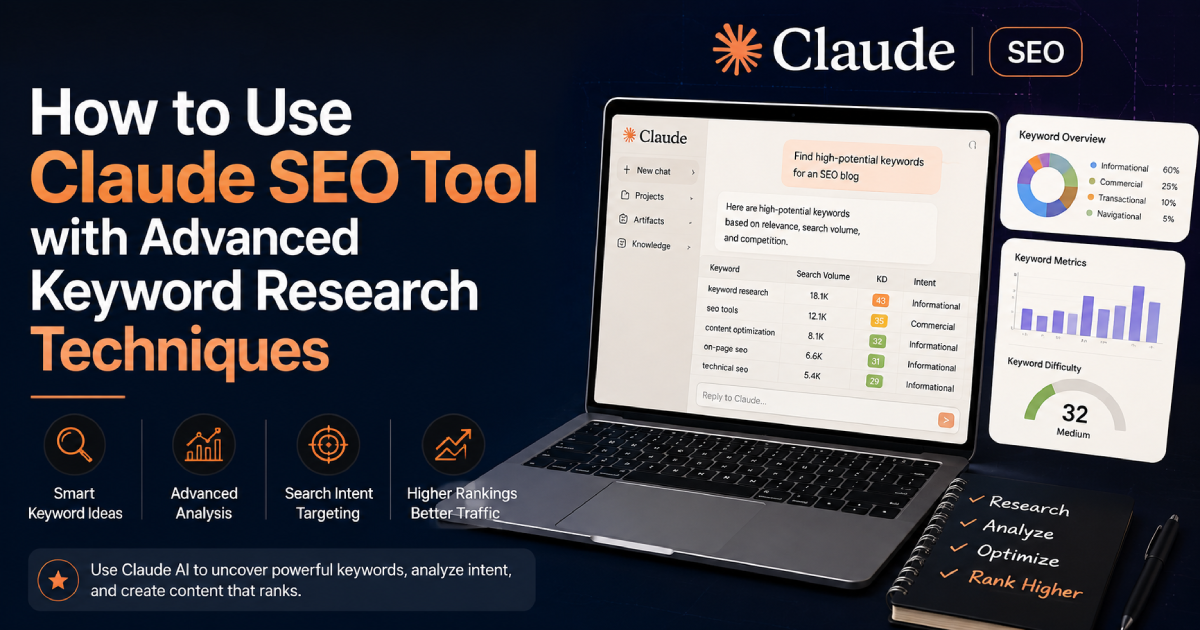
The Claude SEO tool reflects how modern SEO is evolving—where staying competitive requires more than basic keyword research or outdated tactics. Search engines now prioritize context, user intent, and overall content quality. Simply collecting keywords is no longer enough. There’s a growing need for tools that provide deeper insight into how people search and how content should respond to those needs.
Rather than acting as a simple keyword generator, an AI-powered SEO tool like this helps interpret search behavior in a more meaningful way. It highlights patterns, identifies the intent behind queries, and suggests how content can be structured to better match user expectations.
I’m Zohanuddin Shaikh, an SEO consultant based in Karachi, Pakistan, with 8 years of experience. In my work, I’ve found that AI tools are genuinely useful for reducing guesswork and organizing research — but only when guided by human judgment. This guide explores how AI-driven SEO tools work in practice, where they provide the most value, and how to use them responsibly for long-term growth rather than short-term tactics.
What Is the Claude SEO Tool?
The Claude SEO tool refers to using Claude—an AI assistant—to support SEO tasks like keyword research, content planning, search intent analysis, and content optimization by interpreting how people search and what content best answers their needs.
Unlike traditional keyword tools that mainly output data, an AI-driven approach focuses on interpretation. In simple terms, it helps you:
- Identify keyword opportunities and group them logically
- Understand the intent behind searches
- Improve how content is structured and written
It’s worth being clear about what this means in practice: Claude is a general-purpose AI assistant, not a dedicated SEO platform with dashboards and rank tracking. Its value for SEO comes from analysis, brainstorming, clustering, and content guidance — the interpretive work — rather than from live ranking data, which still requires dedicated tools like Google Search Console. For a broader look at this topic, see my guide on AI and SEO.
Why AI-Driven SEO Tools Matter in Modern SEO
SEO is no longer about repeating keywords. It’s about understanding what users are searching for, why they’re searching, and how well content satisfies that need. AI tools help connect these elements.
Instead of focusing only on search volume, an AI approach emphasizes the following:
Focus Area |
What It Means |
|
Semantic relevance |
Related concepts and terms, not just exact keywords |
| Content depth |
Thorough coverage that fully answers the query |
| Intent alignment |
Matching content to what users actually want |
This makes AI tools useful for building content that performs consistently over time. The shift matters because modern search engines evaluate not just what content says but also how well it satisfies the searcher—and interpreting that satisfaction is exactly where AI analysis helps most.
Key Features of an AI SEO Tool like Claude
Here’s what AI-driven SEO analysis actually helps with and why each matters.
Feature |
What It Does |
Why It Helps |
|
Keyword clustering |
Groups related keywords into meaningful clusters | Builds topical structure, avoids overlap |
|
Search intent analysis |
Classifies queries as informational, commercial, transactional | Ensures content matches expectations |
| Semantic suggestions | Identifies related terms and concepts |
Adds depth and context |
| Content gap analysis | Highlights gaps between your content and competitors |
Reveals opportunities |
| Optimization guidance | Suggests structure, headings, readability improvements |
Improves on-page quality |
AI-Based Keyword Clustering
Instead of treating keywords as a flat list, AI groups related terms into meaningful clusters based on topic and intent. This turns scattered keywords into an organized content structure. For a deeper process, see my keyword research guide.
Search Intent Analysis
AI classifies queries into informational, transactional, or commercial intent—helping you match each page to what users actually expect. For more, see my search intent optimization guide.
Semantic Keyword Suggestions
Rather than focusing on a single keyword, AI identifies related phrases and concepts that improve context and topical depth—helping content read naturally while covering a subject thoroughly.
How to Use Claude for SEO: A Practical Setup
Since Claude is a conversational AI rather than a dashboard tool, “setup” means structuring how you work with it. Here’s a practical approach.
Step 1: Define Your Niche and Goals
Start by clearly telling the AI your niche, target audience, and goals — whether you’re creating blog posts, landing pages, or comprehensive guides. Clear context produces far better output.
Step 2: Bring Your Own Data
AI analysis works best when combined with real data. Pull queries from Google Search Console, your analytics platform, or keyword tools, then ask the AI to analyze and cluster them. The AI interprets; your data grounds it in reality.
Step 3: Provide Competitor Context
Share competitor content or topics you want to analyze. The AI can then help identify gaps, missing subtopics, and opportunities to create more complete content.
Step 4: Define Content Goals Clearly
Specify the content type and purpose for each piece. The more specific your instructions, the more useful and targeted the AI’s guidance becomes.
Advanced Keyword Research with AI
Keyword research is where AI-driven analysis delivers some of its clearest value.
Semantic Keyword Discovery
Instead of focusing on one keyword, AI identifies related phrases that improve context and help content cover a topic comprehensively. This supports the semantic, entity-based way modern search engines evaluate relevance.
Long-Tail Keyword Opportunities
AI helps surface specific, lower-competition long-tail queries that are often easier to rank for and carry clearer intent. These are frequently the fastest wins for newer or smaller sites.
Intent-Based Clustering
AI groups keywords by user intent rather than just by phrase similarity—improving content alignment and helping you structure pages around genuine user goals. This is more useful than volume-based grouping because it maps directly to what content you should create.
Using AI for Content Strategy
A strong content strategy depends on clarity and structure. AI-driven analysis supports both.
With an AI tool, you can plan topic clusters, create structured outlines, and improve content relevance — helping ensure each page has a clear purpose. The connection between clustered keywords and content structure is where this shines: once keywords are grouped by intent, the content plan almost designs itself, with pillar pages and supporting articles falling into place. For the full framework, see my content strategy guide.
On-Page SEO Optimization with AI
AI can provide practical guidance for the on-page elements that affect both readability and search visibility.
Element |
How AI Helps |
|
Title tags |
Suggests clear, keyword-relevant titles |
|
Meta descriptions |
Drafts compelling summaries within length limits |
| Headings (H1–H4) |
Recommends logical heading structure |
| Keyword placement |
Advises natural, non-stuffed placement |
| Internal linking |
Suggests relevant connections between pages |
The key is treating these as suggestions to refine, not final answers to paste. AI drafts quickly; your judgment ensures the output actually fits your audience and brand voice.
Competitor Analysis Made Practical
Instead of copying competitors, AI helps you identify what’s missing. By analyzing competing content, it can highlight missing topics, content gaps, and improvement opportunities.
This allows you to create more complete and useful content than what currently ranks — which is exactly what search engines reward. The goal isn’t to replicate competitors but to genuinely exceed them by covering what they’ve left out. AI makes spotting those gaps faster and more systematic.
Tracking SEO Performance
SEO requires ongoing monitoring, and it’s important to be clear about where AI fits here. Claude itself doesn’t track live rankings—that data comes from dedicated tools.
The realistic workflow: use Google Search Console and analytics platforms to track keyword rankings, traffic trends, and engagement metrics; then use AI to interpret that data—spotting patterns, diagnosing declines, and suggesting improvements. AI handles interpretation; dedicated tools handle measurement. Together they support continuous improvement. For more on dedicated platforms, see my SEO SaaS tools guide.
Common Mistakes to Avoid
AI tools are powerful but easy to misuse. These are the most common mistakes.
Mistake |
Why It’s a Problem |
|
Over-reliance on AI |
AI is a guide, not a replacement for strategy |
|
Ignoring search intent |
Content must match real user expectations |
| Publishing without review |
AI output needs human accuracy and clarity checks |
| Creating too much content |
Quality and relevance beat raw volume |
| Accepting AI facts blindly |
AI can be confidently wrong; always verify claims |
The biggest trap is over-reliance. AI generates suggestions and drafts, but it doesn’t understand your specific audience, brand, or market context. Treating AI output as strategy—rather than input to strategy—leads to generic, unfocused content. And crucially, AI can state incorrect information confidently, so every factual claim needs verification before publishing.
AI SEO Tools vs Traditional SEO Tools
Understanding the difference clarifies how they work together.
Factor |
Traditional SEO Tools |
AI Tools Like Claude |
|
Primary strength |
Data (volume, difficulty, rankings) | Interpretation and analysis |
|
Best for |
Measurement and tracking | Clustering, strategy, content |
| Output | Metrics and numbers |
Insights and suggestions |
| Live ranking data | Yes |
No |
| Content guidance | Limited |
Strong |
Traditional tools focus on data; AI tools focus on interpretation. This difference is why they complement each other so well. Traditional tools tell you what’s happening (rankings, volume, difficulty), while AI helps you understand what to do about it (structure, intent, content). Using both together reduces guesswork and improves content alignment.
Improving Content Quality with AI
Good content should be clear, accurate, and helpful. AI supports all three by suggesting improvements to structure, clarity, and coverage—but final quality always depends on human input.
AI can help you tighten explanations, improve readability, and ensure thorough topic coverage. What it can’t do is replace genuine expertise, original insight, or real experience — the very things that make content stand out and demonstrate E-E-A-T. The most effective approach uses AI to handle the mechanical improvements while you provide the expertise and judgment that make content genuinely valuable.
FAQs
1. Is the Claude SEO tool suitable for beginners?
Yes. AI-driven SEO analysis provides structured, easy-to-understand insights that help beginners grasp concepts like search intent, keyword clustering, and content structure. However, beginners get the most value when they pair the tool with foundational SEO learning — understanding the basics helps you apply the AI’s suggestions effectively rather than following them blindly.
2. Can the Claude SEO tool replace other SEO tools?
No, it complements them rather than replacing them. Claude excels at interpretation, clustering, and content guidance, but it doesn’t provide live ranking data, search volume, or technical crawling—which dedicated tools like Google Search Console, Ahrefs, or Semrush handle. The best approach combines AI interpretation with traditional tools’ measurement capabilities.
3. How often should keyword research be done?
Keyword research should be an ongoing process rather than a one-time task. Regular updates keep content aligned with changing search behavior and trends. The right frequency depends on your niche — fast-moving industries need frequent research, while stable topics need only periodic reviews. Let performance data signal when it’s time to revisit.
4. Does the Claude SEO tool guarantee rankings?
No tool can guarantee rankings, and any that claims to should be treated with skepticism. Rankings depend on many factors — content quality, competition, site authority, technical health, and search intent alignment. AI tools improve your decision-making and efficiency, but results ultimately depend on consistent execution and genuine value, not the tool alone.
5. Can it help with content optimization?
Yes. AI provides actionable suggestions for improving content structure, headings, readability, keyword placement, and topic coverage. It’s particularly useful for identifying gaps and improving clarity. The key is treating these as suggestions to refine with your own judgment, ensuring the final content genuinely serves your audience rather than just following AI recommendations mechanically.
6. Is it useful for different niches?
Yes, AI-driven analysis adapts to various industries and content types because it interprets search intent and content relevance rather than relying on niche-specific databases. That said, for highly specialized or technical niches, human expertise becomes even more important — AI provides a strong starting point, but domain knowledge ensures accuracy and depth.
7. Does it support long-term SEO strategy?
Yes, when used consistently and combined with good practices. AI supports long-term strategy by helping maintain content clarity, structure, and intent alignment over time. However, sustainable success comes from applying insights consistently, updating content as search behavior evolves, and keeping user value at the center—not from the tool itself.
8. Can AI-generated SEO content rank on Google?
Yes, AI-assisted content can rank well, as Google doesn’t penalize content simply for being AI-assisted. What matters is quality, accuracy, and genuine usefulness. Content that provides real value ranks regardless of how it was created. The risk is publishing unedited, generic AI output — which tends to be thin and unhelpful. Human review and expertise are essential.
Final Thoughts
The Claude SEO tool reflects how SEO is evolving in a more thoughtful, user-focused direction. It moves beyond basic keyword targeting and encourages a deeper understanding of context, search intent, and content structure. This shift matters because modern search engines evaluate not just what content says but how well it satisfies user needs.
In practice, AI tools help reduce manual effort by organizing data, identifying patterns, and suggesting improvements. But their value depends entirely on how they’re used. From my experience, the most effective approach is balanced: AI provides insights, highlights opportunities, and improves efficiency, but it works best when guided by human judgment.
This means reviewing suggestions carefully, adapting them to your audience, and ensuring the final content remains accurate, clear, and genuinely helpful. It also means verifying any facts the AI provides, since AI can state incorrect information confidently. And it involves maintaining a consistent strategy rather than relying on quick, isolated changes.
SEO success doesn’t come from tools alone. It comes from applying insights consistently, improving content over time, and staying adaptable as search behavior evolves. When clarity, structure, and user value remain the focus, results tend to be more stable and sustainable in the long run. AI is a powerful assistant in that process — but the strategy, judgment, and expertise remain yours.
For questions about using AI tools effectively in your own SEO workflow, feel free to reach out through my Contact page.
For more SEO guides, browse Search Engine Realm.
Last Updated: July 2026