


Most site owners don’t really understand what crawling and indexing are. Pages either show up in search results or they don’t. People typically think that search engines will automatically find, comprehend, and rank information once it is uploaded. But anyone who has worked with crawl logs, index coverage reports, and big audits knows that How Search Engines Crawl and Index Websites is not often that simple or that neat.
In genuine SEO effort, difficulties with visibility don’t usually start with ranking. They start a long time before anyone is given a job. When you want them to, pages don’t get crawled. Some are crawled over and over but never indexed. Some get indexed for a short time, show up in Search Console, and then go away without a warning or penalty notice. People typically get these problems wrong since everything looks “fine” on the surface.
This is where most of the confusion starts. The robots.txt file isn’t broken. There is no clear no-index tag. No action by hand. But a lot of the site doesn’t stay viewable. In audits, this frequently comes down to structural signals like weak internal linking, unclear intent, redundant or overlapping material, or URL patterns that don’t work well and make it harder for crawlers to focus. Search engines are not ignoring the site; they are just concluding that it doesn’t need as much attention.
Understanding how crawlers and indexes work isn’t only a technical theory for big businesses. It directly decides if your work has a chance to compete. If a page isn’t found quickly or isn’t indexed with confidence, talks about its ranking don’t matter. Crawlability and indexability are the most important factors in search success. If you don’t pay attention to them, you’ll waste your time, no matter how good the content looks on the surface.
Crawling vs indexing: a distinction many sites misunderstand
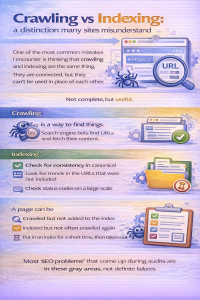
One of the most common mistakes I encounter is thinking that crawling and indexing are the same thing. They are connected, but they can’t be used in place of each other.
- Crawling is a way to find things. Search engine bots find URLs and fetch their content.
- Indexing is a way to judge. The search engine evaluates if that content is worth keeping and showing.
A page can be
- Crawled but not added to the index
- Indexed but not often crawled again
- Put in an index for a short time, then taken out
Most “SEO problems” that come up during audits are in these gray areas, not definite failures.
How search engines discover URLs in the first place
Search engines don’t only know that your sites are there. Discovery usually happens in a few different ways:
- Links inside
- Sitemaps in XML
- Links from outside
- Chains of redirects
- Data from historical crawls
Internal connection is by far the strongest indication. Technically, you can go to pages without internal links, but you can’t see them.
I have seen big sites with thousands of URLs that were “in the sitemap” but were mostly disregarded since internal linking didn’t work for them.
Sitemaps are useful, but they don’t fix a bad structure.
Search engine bots don’t crawl evenly
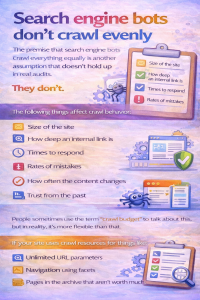
The premise that search engine bots crawl everything equally is another assumption that doesn’t hold up in real audits.
They don’t.
The following things affect crawl behavior:
- Size of the site
- How deep an internal link is
- Times to respond
- Rates of mistakes
- How often the content changes
- Trust from the past
People sometimes use the term “crawl budget” to talk about this, but in reality, it’s more flexible than that.
If your site uses crawl resources for things like:
- Unlimited URL parameters
- Navigation using facets
- Pages in the archive that aren’t worth much
Less often, or not at all, do crawlers go to important pages.
What crawl budget really looks like in practice
The crawl budget isn’t a set amount. It’s a distribution.
You will commonly notice the following in log analysis:
- Repeatedly crawling URLs that aren’t important
- Pages that are important don’t get crawled often
- Crawlers that get caught in pagination loops
This doesn’t mean that Google is broken. It’s Google following the signs your site offers it.
“Optimized” content frequently doesn’t do as well as clean architecture.
robots.txt: powerful, but often misused
Indexing is not controlled by robots.txt. It controls crawling.
How to block a URL in robots.txt:
- Stops creeping
- Doesn’t delete indexed URLs
- Can keep “URL-only” listings in the index
I have seen sites block big parts of their pages in several audits because they thought it would “clean up” indexing. Instead, they made phantom URLs that stayed around and couldn’t be crawled or looked at.
Use robots.txt just when you need to and on purpose.
XML sitemaps: helpful, but not authoritative
XML sitemaps are not orders; they are hints.
They operate well when:
- There are already links between URLs
- The status codes are clean.
- Canonicals are always the same.
Putting hundreds of low-value URLs in a sitemap doesn’t help with indexing. It typically makes finding things that matter take longer.
In real life, lean sitemaps work better than full ones.
Indexing is a quality decision, not a technical one
This is the hardest thing for site owners to deal with.
Most of the time, “Crawled – currently not indexed” incidents aren’t technological problems. They are evaluations of quality.
Search engines want to know:
- Does this page have anything new?
- Is its purpose clear?
- Is it the same as something that is already there?
- Does the site have a clear focus on its subject?
Pages that are technically perfect can still not be indexed if they don’t explain why they are there.
Duplicate content isn’t always obvious
Problems with duplicate material aren’t just on pages that are the same.
Things that happen a lot are the following:
- Very similar templates with a few keyword changes
- Faceted URLs that make different versions of content
- Combinations of pagination and filtering
- Soft duplication made by linking to other pages on the same site
Most of the time, search engines just show one version. Everything else turns into crawl space.
JavaScript, rendering, and delayed indexing
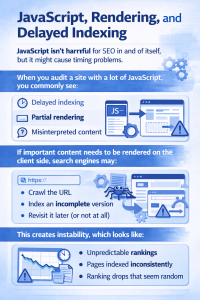
JavaScript isn’t harmful for SEO in and of itself, but it might cause timing problems.
When you audit a site with a lot of JavaScript, you commonly see:
- Indexing that takes a long time
- Partial rendering
- Misinterpretation of content
If important content needs to be rendered on the client side, search engines may:
- Crawl the link
- Index a version that isn’t complete
- Look at it again later (or not at all)
This makes things unstable, which looks like random drops in rank.
A realistic crawl & index failure scenario
For one audit of a blog with a lot of content:
- The pages could be crawled.
- The sitemaps were right.
- No manual actions
But only 30% of URLs stayed in the index.
There weren’t any technical problems. There was too much overlap in the content and a weak internal hierarchy. After the category structure was made tighter and the thin pages were combined, indexing became stable without any “SEO tricks.”
What commonly goes wrong (audit patterns)
The most prevalent flaws found in repeated audits are:
- Publishing quicker than search engines can check
- Making pages without clearly separating their purposes
- Using noindex too much instead of improving the structure
- Instead of sanitizing URLs, blocking crawl
- Using sitemaps to remedy weak links between pages on the same site
Most indexing problems are caused by the structure of the data, not the algorithm.
A practical diagnostic checklist
When a page isn’t indexed, you should ask:
- Is there a link to it from a page that is related to it?
- Does it have a special use?
- Would taking it away hurt the site?
- Is it better, faster, or clearer than other pages like it?
- Does it fit with the site’s main topic?
Search engines will also pause if the answers aren’t clear.
Crawling, indexing, and long-term visibility
Search engines give points to sites that:
- Are easy to creep
- Are careful with URLs
- Stay on topic
- Don’t copy anything that don’t need to be copied.
Over time, crawling gets more and more effective. So does crawl waste.
FAQs
1. Why is my page crawled but not indexed?
Usually because it doesn’t add enough unique value or overlaps with existing content.
2. Does crawl budget matter for small sites?
Less than large sites, but poor structure can still waste resources.
3. Should I block low-quality pages with robots.txt?
Usually no. Fix or consolidate instead.
4. Do sitemaps guarantee indexing?
No. They only assist discovery.
5. How long does indexing take?
It varies. Quality and clarity matter more than speed.
Conclusion
People prefer to pay more attention to ranking concerns since they are easy to see and respond to. When a position drops and traffic slows down, teams instantly hunt for algorithm tweaks or quick remedies. But in real life, most visibility failures come considerably sooner. If search engines can’t easily scan your site or aren’t sure which pages should stay indexed, rankings don’t mean anything. That’s why it’s important to know how search engines crawl and index websites long before performance talks even get to rankings.
Understanding how search engines crawl and index websites moves SEO beyond fixing problems as they come up to making decisions about how to structure a website. It impacts how you post new information, how carefully you make internal links, and how you decide if a page should even exist. You stop asking why something isn’t ranking and start asking if the site is easy for search engines to understand, prioritize, and come back to again and over again.
The best-performing sites over time aren’t the ones that are often changing their headlines or looking for short-term fixes. They are the ones who make the whole discovery process less difficult. Crawling is something you can count on. It’s easy to understand indexing decisions. Content has a clear goal and a logical order. These traits don’t lead to quick wins, but they build up over time.
SEO becomes more steady and less volatile when crawling is done well and indexing is done on purpose. Rankings stop feeling shaky when they are built on a solid base that search engines can understand and trust.