

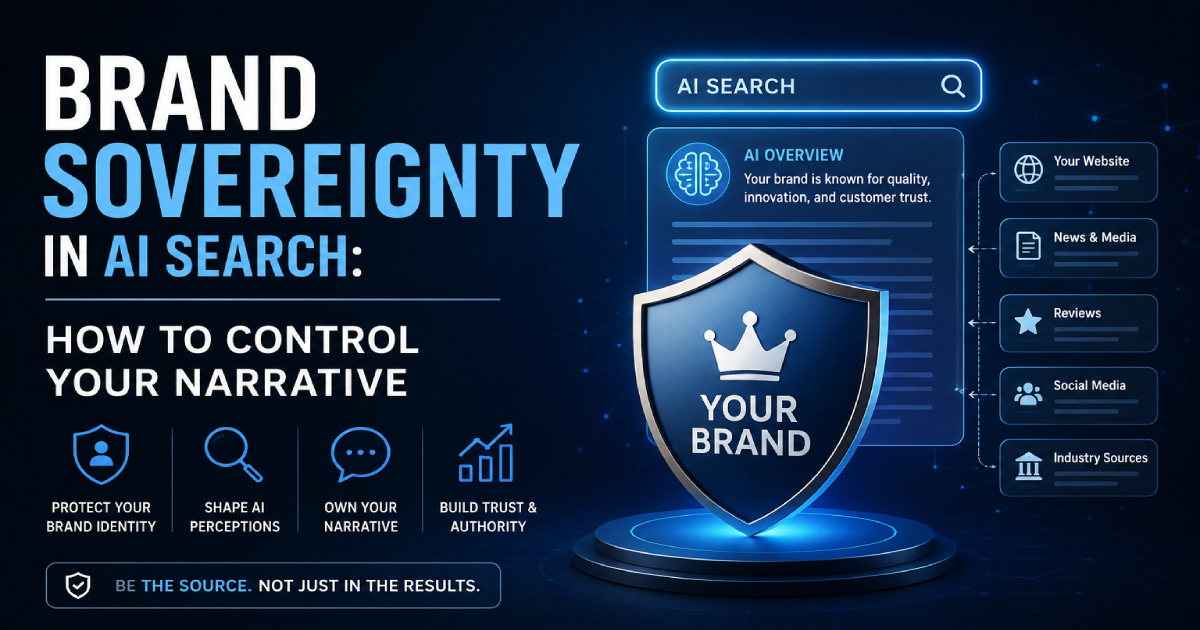
For years, brands controlled their own story online. You wrote your website copy and optimized your pages, and searchers clicked through to read your exact words. That direct line between your brand and your audience is now being reshaped. When someone asks an AI assistant about your company, product, or industry, the answer they receive isn’t written by you — it’s synthesized by a machine drawing from countless sources. This shift is what makes brand sovereignty in AI search one of the most important challenges brands face today.
I’m Zohanuddin Shaikh, an SEO consultant based in Karachi, Pakistan, with 8 years of experience. Over the years, I’ve watched the relationship between brands and search change fundamentally. In traditional search, your website was the destination. In AI search, your website is just one input among many that an AI system uses to describe you — often without the user ever visiting your site at all. This means the story told about your brand is increasingly out of your direct hands.
This guide explains what brand sovereignty in AI search actually means, why maintaining control has become harder, and how brands can influence — realistically, not magically — the way AI systems understand and represent them. The goal isn’t to manipulate AI but to ensure the information it draws from is accurate, consistent, and genuinely reflects who you are.
What Is Brand Sovereignty in AI Search?
Brand sovereignty in AI search is a brand’s ability to influence and maintain accuracy over how AI systems—like AI Overviews, ChatGPT, Perplexity, and Gemini—describe, represent, and recommend it when users ask questions.
In simple terms, it’s about answering one question: when an AI talks about your brand, does it get you right?
Unlike traditional SEO, where you optimize a page and control its exact content, brand sovereignty operates in an environment where:
- AI systems generate answers rather than linking to your pages
- Your brand information is pulled from many sources, not just your site
- Users often never see your website directly
- The “answer” about your brand is assembled by a machine
Sovereignty here doesn’t mean total control — no brand can dictate exactly what an AI says. It means actively shaping the information ecosystem the AI draws from, so the picture it forms is accurate and favorable rather than outdated, incomplete, or wrong.
How AI Search Actually Sees Your Brand
To influence how AI represents your brand, you first need to understand where AI gets its information. AI systems don’t “know” your brand the way a customer does—they assemble an understanding from multiple layers of data.
Source Layer |
What It Contributes |
|
Training data |
Broad knowledge absorbed during model training |
|
Live web retrieval |
Current information fetched at query time |
| Your own website |
Your official content and structured data |
| Third-party sources |
Wikipedia, reviews, news, forums, directories |
| Entity databases |
Structured facts from knowledge graphs |
Here’s the critical insight: your own website is only one of these layers, and often not the most influential one. When an AI describes your brand, it may weight a Wikipedia summary, a Reddit discussion, or an old news article as heavily as — or more heavily than — your official copy.
This is fundamentally different from traditional search, where your optimized page could rank first and speak for itself. In AI search, your brand is understood as an entity—a thing the AI recognizes and stores facts about—and those facts come from across the entire web. Building an accurate entity understanding is the foundation of brand sovereignty.
Why Brand Control Is Harder in AI Search
Brand control has become harder in AI search because an intermediary now sits between your brand and your audience, synthesizing information instead of delivering your exact words.
Several forces make this challenging:
Challenge |
What It Means for Brands |
|
Answer synthesis |
AI blends sources; your exact messaging gets paraphrased |
|
Source opacity |
You often can’t see which sources shaped an answer |
| Reduced click-through |
Users get answers without visiting your site |
| Outdated information |
AI may surface old facts you’ve since changed |
| Confident errors |
AI can state wrong facts about you convincingly |
The most difficult part is the loss of the direct channel. In traditional search, a user who wanted to know about your pricing, features, or values would land on your page and read your version. Now, they may get an AI’s summarized version—which could be based on a competitor’s comparison article, an outdated review, or a misremembered fact from training data.
This doesn’t mean brands are powerless. It means the work has shifted: instead of optimizing a single page, you’re now shaping an entire information ecosystem so that whichever sources the AI draws from, the picture stays accurate. For a related look at how AI introduces new SEO risks, see my guide on AI security risks in SEO.
Brand Sovereignty vs Traditional Brand SEO
Understanding the difference clarifies why a new approach is needed.
Factor |
Traditional Brand SEO |
Brand Sovereignty in AI Search |
|
Primary goal |
Rank your pages for brand terms | Shape how AI describes your brand |
|
Control point |
Your own website content | The entire information ecosystem |
|
Delivery |
A user clicks to your page |
AI synthesizes an answer |
| Key sources | Your optimized pages |
Your site + third-party + entity data |
| Success measure | Rankings and clicks |
Accuracy and favorability of AI answers |
| Main risk | Competitors outranking you |
AI misrepresenting you |
Traditional brand SEO still matters — a strong, authoritative website remains essential. But it’s no longer sufficient on its own. Brand sovereignty builds on traditional SEO by extending your focus beyond your own pages to every source an AI might reference. The brands that adapt treat their website as the anchor, then work outward to ensure consistency everywhere else.
The Technical Foundations of Brand Sovereignty
AI systems understand brands more reliably when the information about them is machine-readable and consistent. Several technical foundations make your brand easier for AI to understand correctly.
Structured Data and Entity Markup
Structured data (schema markup) tells machines explicit facts about your brand — your name, logo, founding details, products, and official profiles. Organization schema and well-formed entity markup help AI systems parse who you are without guessing. When your key facts are clearly marked up, AI is less likely to rely on ambiguous third-party interpretations. For the broader technical picture, see my technical SEO audit guide.
Consistency Across the Web
AI systems build confidence in a fact when they see it repeated consistently across sources. If your founding year, product names, or descriptions differ between your website, your social profiles, directories, and news mentions, AI may surface the wrong version. Maintaining consistent brand facts everywhere — a broader version of the classic NAP (Name, Address, Phone) principle — strengthens how reliably AI represents you.
Authoritative Entity Sources
Certain sources carry disproportionate weight in how AI understands entities — Wikipedia, Wikidata, and other structured knowledge bases among them. Ensuring these sources (where you legitimately qualify for inclusion) are accurate and up to date directly influences AI representation. You can’t force your way onto Wikipedia, but where you’re eligible, accuracy there matters more than almost anywhere else.
How to Build Brand Sovereignty in AI Search
Building brand sovereignty is about strengthening the accurate information ecosystem around your brand. Here’s a practical approach.
Publish Clear, Authoritative Brand Content
Create definitive, unambiguous content about who you are, what you offer, and what makes you distinct. AI systems favor clear, well-structured, factual content they can confidently extract. An “About” page, clear product descriptions, and direct answers to common questions give AI reliable material to draw from. Ambiguity invites the AI to fill gaps with less reliable sources.
Build Topical Authority Around Your Brand
When your brand consistently produces authoritative content in your subject area, AI systems associate your brand with genuine expertise. This makes you more likely to be cited accurately and recommended in relevant answers. Depth and consistency signal that you’re a real authority worth referencing. For a complete process, see my topical authority guide.
Strengthen Third-Party Signals
Since AI weighs third-party sources heavily, the mentions, reviews, and discussions about your brand across the web matter enormously. Encourage genuine reviews, earn legitimate press coverage, and participate authentically in relevant communities. You can’t control these sources, but you can influence them by being genuinely good and genuinely present. For more on community-driven signals, see my user-generated content guide.
Answer the Questions People Actually Ask
AI search is question-driven. When your content directly and clearly answers the real questions people ask about your brand and industry, you give AI extractable, accurate material. Structure content around genuine user intent rather than keywords alone. For a deeper process, see my search intent optimization guide.
How to Monitor Your Brand in AI Search
You can’t manage what you don’t measure. Monitoring how AI systems describe your brand is essential to maintaining sovereignty — and it’s more manual than traditional rank tracking.
A practical monitoring approach includes:
Method |
What It Reveals |
|
Direct AI queries |
Ask AI tools about your brand and read the answers |
|
Competitor comparison prompts |
See how AI positions you against rivals |
| Fact-checking answers |
Identify outdated or incorrect claims |
| Source investigation |
Trace which sources shaped the answer where possible |
| Repeat over time |
Track whether representation improves or drifts |
The most direct method is simply asking the AI systems themselves — ChatGPT, Perplexity, Gemini, and Google’s AI Overviews — the questions your customers would ask. “What does [your brand] do?” “Is [your brand] trustworthy?” “What are the best [your category] companies?” Read the answers carefully and note any inaccuracies, outdated facts, or missing information.
This reveals your starting point. If AI describes you inaccurately, that’s a signal to investigate which sources are feeding the error and strengthen the accurate ones. Because AI answers can vary and change over time, monitoring should be ongoing rather than a one-time check. This connects to the broader discipline of adapting as search evolves—see my adaptive SEO guide.
The Real Risks of Losing Brand Sovereignty
When brands ignore how AI represents them, several concrete risks emerge — and unlike a bad review, these can scale silently across every AI interaction.
Risk |
What It Involves |
|
Misinformation at scale |
Wrong facts repeated in every AI answer about you |
|
Competitor framing |
AI describing you through a rival’s narrative |
| Outdated representation |
Old pricing, products, or positioning surfacing |
| Lost recommendation |
AI omitting you from relevant recommendations |
| Reputation drift |
Negative sources shaping your AI narrative |
The most damaging risk is misinformation at scale. If an AI system learns an incorrect fact about your brand — a wrong founding story, a discontinued product presented as current, or a misattributed controversy — it may repeat that error confidently to every user who asks, without any indication that it’s wrong.
Another subtle risk is being framed through a competitor’s lens. If comparison content written by competitors is a major source AI draws from, your brand may be described in terms that favor them. Building your own clear, authoritative narrative is the best defense — not by attacking competitors, but by ensuring your accurate story is well-represented across the sources AI trusts.
Brand Sovereignty and E-E-A-T
Brand sovereignty aligns closely with Google’s E-E-A-T principles (Experience, Expertise, Authoritativeness, and Trustworthiness), because AI systems tend to favor sources and brands that demonstrate genuine credibility.
E-E-A-T Element |
How It Supports AI Representation |
|
Experience |
Real, demonstrated experience makes content citation-worthy |
|
Expertise |
Genuine subject authority increases accurate citations |
| Authoritativeness |
Recognized authority strengthens entity understanding |
| Trustworthiness |
Consistent, accurate signals build AI confidence |
Brands that genuinely demonstrate E-E-A-T give AI systems reliable, high-quality signals to draw from. This isn’t a coincidence — the same qualities that earn trust from human readers and search engines also make your brand more likely to be represented accurately by AI. There’s no shortcut here: sustainable brand sovereignty comes from being genuinely credible, then ensuring that credibility is visible and consistent across the web.
The Limits of Brand Sovereignty (An Honest Perspective)
It’s important to be realistic about what brand sovereignty can and cannot achieve. No brand can fully control what an AI says. AI systems are complex, their sources are often opaque, and their outputs can vary.
What you can do is meaningfully influence the inputs:
- Ensure your own content is clear, accurate, and authoritative
- Strengthen the accurate third-party sources AI draws from
- Maintain consistency across every representation of your brand
- Monitor and respond when inaccuracies appear
What you cannot do is dictate exact AI output, remove every unfavorable source, or guarantee inclusion in every relevant answer. Anyone promising complete control over AI representation is overselling. The realistic goal is to shift the odds strongly in favor of accurate, favorable representation by improving the information ecosystem — not to achieve perfect control, which doesn’t exist. Approaching brand sovereignty with this honest framing leads to better decisions than chasing an impossible standard.
FAQs
1. What is brand sovereignty in AI search?
Brand sovereignty in AI search is a brand’s ability to influence and maintain accuracy over how AI systems describe, represent, and recommend it. Because AI generates answers from many sources rather than linking to your website, sovereignty means shaping the broader information ecosystem — your content, third-party mentions, and entity data — so AI represents you accurately. It’s about influence over your narrative, not total control.
2. How do AI systems decide what to say about a brand?
AI systems assemble brand information from several layers: training data, live web retrieval, your website, third-party sources like Wikipedia and reviews, and structured entity databases. Your own website is only one input—often third-party sources and knowledge bases carry significant weight. The AI synthesizes these into an answer, which is why consistency and accuracy across all sources matters so much.
3. Can I control what AI says about my brand?
Not completely. No brand can dictate exact AI output, because AI systems are complex and their sources are often opaque. However, you can meaningfully influence AI representation by publishing clear, authoritative content; strengthening accurate third-party sources; maintaining consistency across the web; and monitoring for errors. The realistic goal is shifting the odds toward accurate representation, not achieving perfect control.
4. How is brand sovereignty different from traditional SEO?
Traditional SEO focuses on ranking your own pages so users click through to read your exact content. Brand sovereignty focuses on shaping how AI describes your brand across synthesized answers, where users may never visit your site. Traditional SEO controls your pages; brand sovereignty extends that focus to the entire information ecosystem AI draws from. Both matter, but sovereignty requires a broader approach.
5. How do I check how AI describes my brand?
Ask the AI systems directly. Query ChatGPT, Perplexity, Gemini, and Google’s AI Overviews with the questions your customers would ask—” What does [your brand] do?” or “What are the best [your category] options?” Read the answers carefully, note any inaccuracies or outdated facts, and repeat over time since AI answers change. This manual monitoring reveals your current representation and where to improve.
6. Does structured data help with AI search representation?
Yes. Structured data (schema markup) gives AI systems explicit, machine-readable facts about your brand—name, logo, products, and official profiles. When your key facts are clearly marked up, AI is less likely to rely on ambiguous third-party interpretations or guess incorrectly. Organization and entity markup strengthen how reliably AI understands and represents your brand.
7. What happens if AI spreads wrong information about my brand?
Incorrect information can be repeated confidently across every AI interaction, scaling misinformation silently. To address it, identify which sources are feeding the error, then strengthen accurate sources—update your own content, correct third-party listings where possible, and reinforce the right facts consistently. Because AI relearns from the ecosystem over time, improving the underlying sources gradually corrects the representation.
8. Is brand sovereignty only for large companies?
No. Brands of any size are represented by AI systems, so sovereignty matters for everyone. Smaller brands may actually find it more manageable because they have fewer sources to align and can move quickly to establish clear, consistent information. The fundamentals — clear content, consistent facts, genuine authority, and monitoring — apply regardless of size, though larger brands face more sources to manage.
Final Thoughts
Brand sovereignty in AI search represents a fundamental shift in how brands relate to their audiences. For years, your website spoke directly to searchers in your exact words. Now, an AI intermediary synthesizes answers about your brand from sources across the entire web — and users increasingly receive that synthesized version instead of visiting your pages.
This shift means the work of protecting your brand narrative has expanded. It’s no longer enough to optimize your own pages, though that remains essential. You now need to shape an entire information ecosystem—your content, structured data, third-party mentions, reviews, and entity sources—so that whichever inputs an AI draws from, the picture it forms stays accurate and favorable.
In my experience, the brands that will thrive in AI search are the ones that treat this proactively rather than reactively. They publish clear, authoritative content. They build genuine topical authority. Maintain consistency everywhere. They monitor how AI describes them and respond when something drifts. And crucially, they approach this with honest expectations—understanding that influence, not total control, is the realistic goal.
The most important principle is this: sustainable brand sovereignty comes from being genuinely credible and making that credibility visible and consistent across the web. There’s no shortcut and no manipulation that lasts. As AI increasingly mediates how people discover and understand brands, the ones that invest early in accurate, authoritative, consistent representation will hold a lasting advantage — while those who ignore it risk having their story told by everyone except themselves.
For questions about strengthening your brand’s presence in AI search, feel free to reach out through my contact page.
For more SEO guides, browse Search Engine Realm.
Last Updated: July 2026