


One of the most baffling SEO difficulties is the Google indexing issue. Although indexing is important in search engine optimization, the emphasis is mostly on rankings. Rankings are worthless if a site is not indexed; search engines regard it as if it does not exist.
Even if half of their essential URLs are marked as “Discovered – currently not indexed” or “Crawled – currently not indexed,” site owners often expect ranking increases when I do audits. Google says this is a signal, not a mistake. When making indexing decisions, Google takes crawl efficiency, page quality, duplication, and relevancy into account in relation to the whole site.
Indexing issues may provide evident outcomes. They reduce organic exposure, deplete crawl budgets, delay the display of new content in search results, and progressively erode subject authority. Also, if they are not repaired, they distort performance measurements, making it impossible to determine what is working.
This essay leverages real-world auditing experience rather than theoretical frameworks to illustrate why Google indexing mistakes arise, how to identify them in Search Console, and how to fix them.
Crawling vs. Indexing: Where Most Confusion Starts
Before trying to detect a Google indexing issue, you must first distinguish between the two concepts.
Crawling refers to the process by which Google discovers and retrieves URLs.
When Google determines a site is worth indexing, it indicates that it is valuable enough to store and show in search results.
Even after many crawls, a page may remain unindexed. This is where the bulk of indexing difficulties occur in reality.
Several audits have identified sites with significant crawl activity (Googlebot visits thousands of URLs) but little index coverage. That is not a mistake in logic. This option is about priorities and quality.
When you understand the difference, your approach to problem solving changes.
The Most Common Google Indexing Issues (Seen in Audits)
Discovered – Currently Not Indexed
Google is aware of the URL’s existence but has not yet indexed it, as shown by its status.
When it comes to it, this often happens when:
- The website’s URL value is low.
- Low strength of internal connections
- Crawling the site is not a high priority for Google.
This occurs often on websites that publish content before Google has a chance to evaluate its value. Increasing the amount of pages released will not increase indexing performance if the existing pages are ineffective.
Crawled – Currently Not Indexed
This is one of the most bothersome indexing difficulties.
For the time being, Google has decided not to index the site, despite crawling it. This status is often linked with audits when:
- Lack of depth or repetition.
- There is very little distinctiveness compared to other sites.
- Inadequate context connections within
- Signs of low site quality in general
In general, “request indexing” does not fix this. Improving the page’s fit within the site’s bigger structure resolves the issue.
URL Not Indexed Due to Duplicate Content
It’s not always straightforward to identify instances of duplicate content.
Duplication often occurs in real-world scenarios from:
- Link parameters
- Pages for Related Services
- Programmatic templates with minor modifications
- CMS produced archives.
Even when canonical tags are used appropriately, secondary URLs may not be indexed by Google owing to the lack of value they provide.
Noindex Tags and Accidental Blocking
Despite its simplicity, this genre is very popular.
Common causes of noindex concerns in audits include:
- Remaining staging parameters turned on.
- SEO plugins implement global rules.
- Non-conditional logic failure
Although the correction is straightforward, long-term deindexing of sites may pose problems.
Robots.txt Blocking Google
Problems with Robots.txt are less common anymore, but when they do occur, they are typically significant.
Example of a frequent cause:
- Overly aggressive crawl blocking
- Incorrectly configured wildcard criteria.
- Security extensions that modify robots.txt.
Though it slows the loss of pages from the index, preventing crawling prevents recovery from changes.
Google Search Console Coverage and Page Indexing Reports: How to Read Them Properly
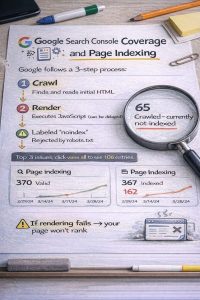
Misreading data from Search Console is something I see over and again.
The indexing report is more of a priority map than an error checklist. All “excluded” URLs are not always dangerous.
Audits typically include asking:
- How essential are forbidden URLs to traffic and business?
- Is the indexing of important pages consistent?
- Is there a pattern that emerges in several parts?
Looking at individual URLs without context often results in needless modifications.
Page Quality and Indexing: The Part People Avoid
Due to the cost of indexing, Google does not index all of the sites it crawls.
In truth, there are similarities across sites that are difficult to index:
- The question isn’t well addressed.
- They reiterate information that can be obtained elsewhere on the internet.
- Their internal connections are weak.
- They are mostly intended to solve content gaps rather than genuine issues.
Consolidating similar pages and improving internal linking have considerably improved indexing for several sites, even in the lack of new content.
Internal Linking and Orphan Pages: A Hidden Indexing Killer
Orphan pages are one of the most common indexing issues in real projects.
The following websites:
- Make it to the sitemap
- Are technically accessible?
- However, the absence of crucial internal links
According to Google, orphan pages lack context and relevance. Crawling these pages is sometimes delayed or nonexistent during audits, resulting in their deletion from the index.
When compared to content rewrites, repairing orphan pages often leads to faster indexing improvements.
Crawl Budget Issues on Small and Medium Sites
Many folks get the crawl budget incorrect. Large sites are not the only ones concerned about it.
When it comes down to it, smaller sites often have crawl financial constraints.
Because of filters or parameters, the number of URLs increases.
Archives produce thousands of unrelated URLs.
Connections inside the building Google towards irrelevant blogs
While key service pages took weeks to scan, small sites wasted crawl bandwidth on tag pages.
Increased crawl efficiency improves indexing speeds as well as stability.
JavaScript, Rendering, and Mobile-First Indexing Problems
Search engines may still index webpages with a lot of JavaScript, however issues arise when:
- Vital items take too long to load.
- There are no links in the first HTML.
- Rendering difficulties on mobile devices
When it comes to auditing, indexing issues with JavaScript often emerge as incomplete indexing. This implies that some pages appear, but others do not, and there are no visible errors.
The solution is to ensure that crucial data and links are accessible early in the display phase, rather than to “remove JavaScript.”
What I Commonly See Go Wrong in Indexing Fixes
This pattern keeps coming up.
1. When “Request Indexing” Is Overused
In other words, it treats the symptoms rather than the root cause.
2. Resolve particular URLs rather than patterns.
Clustering causes the majority of indexing issues.
4. Disregarding rivalry within
Pages get blocked when their purposes overlap.
5. To boost indexing, post more content.
When quality signals are low, indexing more pages is frequently slower.
A Practical Indexing Diagnostic Framework
My normal technique for identifying the cause of a Google indexing issue is as follows:
- Can bots index this page?
- Does it include internal connections to similar pages?
- Is there anything exceptional about it that complements the website?
- Are there any URLs similar to it?
- In general, is the website of great quality?
Skipping phases causes wasted effort.
How Long Does It Take to Recover From Indexing Issues?
The timing of healing may vary.
Based on my personal experiences:
- Weeks or days for basic technology solutions
- Weeks of increased internal connection
- Consolidation of content: several weeks or months
- Improved site-wide quality over months
Google reevaluates patterns over time, so indexing recovery is gradual, not instantaneous.
AI, Semantic Relevance, and Modern Indexing Signals
Nowadays, semantic understanding plays a larger role in indexing decisions.
This has real life implications:
- Relevance to the page’s topic should be evident.
- Entities must maintain consistency across the webpage.
- The material must be arranged within a wider subject.
When websites favor topical authority above specific keywords, indexing seems to grow.
FAQs
1. For what reason is Google ignoring my website?
Problems with quality, duplication, or internal linkage, not technological barriers, are the most common causes of indexing difficulty.
2. “Crawled – currently not indexed” – what does that mean?
This indicates that Google has not yet indexed the page after evaluating it.
3. When does Google typically index newly added pages?
Depending on factors including site quality, crawl efficiency, and relevancy, the time might vary from hours to weeks.
4. Is it helpful to ask for indexing?
While it may aid in discovery, it cannot replace judgments made about quality or prioritizing.
5. Is there a way for Google to not index thin content?
Yes. Pages sometimes don’t get indexed because of thin or repeated content.
Conclusion
Google indexing issue is seldom caused by a single technical issue. In real-world SEO, they indicate how Google evaluates a website’s usefulness, internal structure, and priority communication. Important pages that are not indexed often suggest that search engines are unable to determine which URLs are most important or how they fit into the site’s topic.
In my experience, boosting clarity at several levels effectively resolves indexing concerns. Clear search intent: Each page should answer a specific question or achieve a specific objective. Rather of dispersing messages over hundreds of similar URLs, it emphasizes relevance and context via clear internal linking. Finally, pages must provide value that is not covered elsewhere on the web.
Pages organized into topic groups and supported by strong internal links improve audit indexing consistency. Removing low-value pages, removing overlaps, and optimizing site structure may be more effective than indexing or modifying settings.
Google indexing issue cannot be resolved by tools or repeated submissions. You earn it over time by making it easy for search engines to understand your site, which pages are important, and why they should be indexed.